


Effects of Macuprev® Supplementation in Age-Related Macular Degeneration: A Double-Blind Randomized Morpho-Functional Study Along 6 Months of Follow-Up
- PMID: 31243641
- PMCID: PMC6822854
- DOI: 10.1007/s12325-019-01016-2
Effects of Macuprev® Supplementation in Age-Related Macular Degeneration: A Double-Blind Randomized Morpho-Functional Study Along 6 Months of Follow-Up
Erratum in
-
Correction to: Effects of Macuprev® Supplementation in Age-Related Macular Degeneration: A Double-Blind Randomized Morpho-Functional Study Along 6 Months of Follow-Up.Adv Ther. 2019 Nov;36(11):3288. doi: 10.1007/s12325-019-01094-2. Adv Ther. 2019. PMID: 31538305 Free PMC article.
Abstract
Background: To evaluate the effects of Macuprev® supplementation on macular function and structure in intermediate age-related macular degeneration (AMD) along 6 months of follow-up.
Methods: In this double-blind, monocentric, randomized, and prospective study, 30 patients with intermediate AMD were enrolled and randomly divided into two age-similar groups: 15 patients (AMD-M group; mean age 68.50 ± 8.79 years) received 6-month oral daily supplementation with Macuprev® (Farmaplus Italia s.r.l., Italy, two tablets/day on an empty stomach, before meals; contained in total lutein 20 mg, zeaxanthin 4 mg, N-acetylcysteine 140 mg, bromelain 2500GDU 80 mg, vitamin D3 800 IU, vitamin B12 18 mg, alpha-lipoic acid 140 mg, rutin 157 mg, vitamin C 160 mg, zinc oxide 16 mg, Vaccinium myrtillus 36% anthocyanosides 90 mg, Ganoderma lucidum 600 mg) and 15 patients (AMD-P group; mean age 70.14 ± 9.87) received two tablets of placebo daily on an empty stomach, before meals. A total of 28 eyes, 14 from each AMD group, completed the study. Multifocal electroretinogram (mfERG) and spectral domain-optical coherence tomography (SD-OCT) were assessed at baseline and after 6 months.
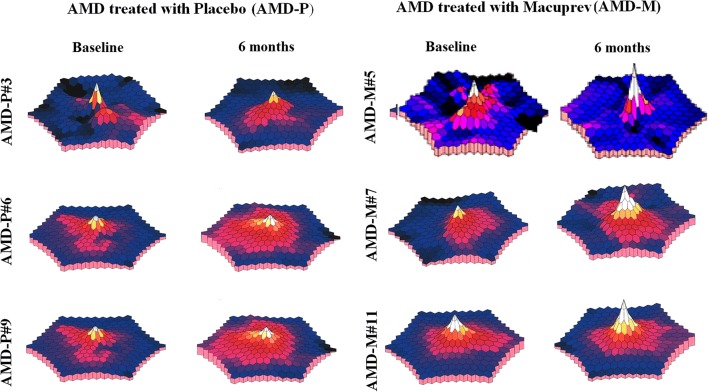
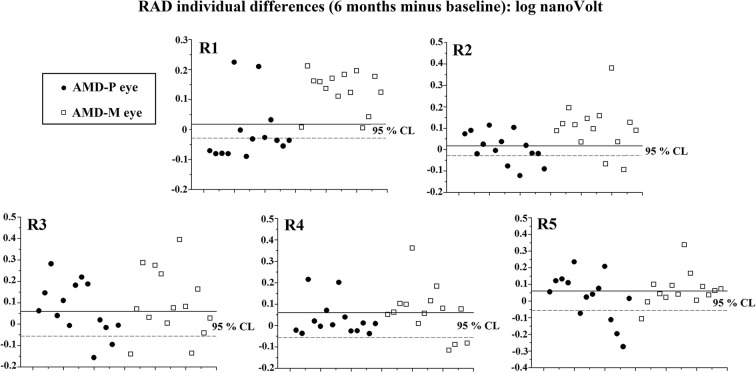
Results: At 6-month follow-up, AMD-M eyes showed a significant increase of mfERG response amplitude density (RAD) recorded from the central macular areas (ring 1, 0-2.5°; ring 2, 2.5-5°), whereas non-significant changes of retinal and choroidal SD-OCT parameters were found when values were compared to baseline. Non-significant correlations between functional and structural changes were found. In AMD-P eyes, non-significant differences for each mfERG and SD-OCT parameters were observed at 6 months.
Conclusions: In intermediate AMD, Macuprev® supplementation increases the function of the macular pre-ganglionic elements, with no associated retinal and choroidal ultra-structural changes.
Trial registration: ClinicalTrials.gov identifier, NCT03919019.
Funding: Research for this study was financially supported by the Italian Ministry of Health and Fondazione Roma. Article processing charges were funded by Farmaplus Italia s.r.l., Italy.
Keywords: Carotenoid and antioxidant supplementation; Intermediate age-related macular degeneration; OCT; Ophthalmology; mfERG.
Figures
References
Publication types
MeSH terms
Substances
Associated data
LinkOut - more resources
Full Text Sources
Medical
