


From Hypertrophy to Heart Failure: What Is New in Genetic Cardiomyopathies
- PMID: 31243690
- PMCID: PMC6823137
- DOI: 10.1007/s11897-019-00435-0
From Hypertrophy to Heart Failure: What Is New in Genetic Cardiomyopathies
Abstract
Purpose: The purpose of this review is to provide an update on the recent advances in the research and clinical care of patients with the major phenotypes of inherited cardiomyopathies-hypertrophic, dilated, and arrhythmogenic. Developments in genetics, risk stratification, therapies, and disease modeling will be discussed.
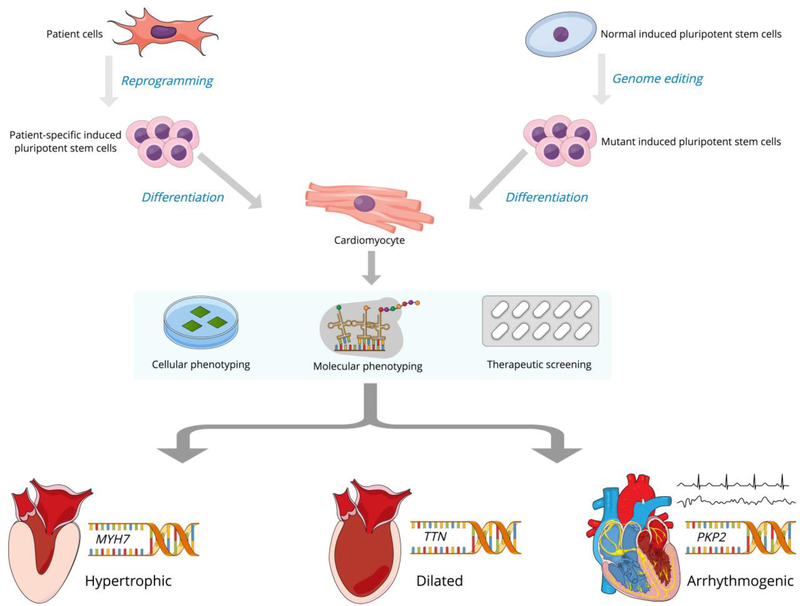
Recent: Diagnostic, prognostic, and therapeutic tools which incorporate genetic and genomic data are being steadily incorporated into the routine clinical care of patients with genetic cardiomyopathies. Human pluripotent stem cells are a breakthrough model system for the study of genetic variation associated with inherited cardiovascular disease. Next-generation sequencing technology and molecular-based diagnostics and therapeutics have emerged as valuable tools to improve the recognition and care of patients with hypertrophic, dilated, and arrhythmogenic cardiomyopathies. Improved adjudication of variant pathogenicity and management of genotype-positive/phenotype-negative individuals are imminent challenges in this realm of precision medicine.
Keywords: Arrhythmogenic right ventricular dysplasia; Dilated cardiomyopathy; Genetic testing; Genomics; Hypertrophic cardiomyopathy; Pluripotent stem cells.
Figures
References
-
- Fontaine G, Guiraudon G, Frank R, Vedel J, Grosgogeat Y, Cabrol C et al. Stimulation studies and epicardial mapping in ventricular tachycardia: study of mechanisms and selection for surgery In: Re-entrant arrhythmias: mechanisms and treatment. Baltimore: University Park Press;1977.
-
- Marcus FI, Fontaine GH, Guiraudon G, Frank R, Laurenceau JL, Malergue C et al. Right ventricular dysplasia: a report of 24 adult cases. Circulation 1982:65(2):384–98. - PubMed
-
- Maron BJ, Towbin JA, Thiene G, Antzelevitch C, Corrado D, Arnett D et al. Contemporary definitions and classification of the cardiomyopathies: an American Heart Association Scientific Statement from the Council on Clinical Cardiology, Heart Failure and Transplantation Committee; Quality of Care and Outcomes Research and Functional Genomics and Translational Biology Interdisciplinary Working Groups; and Council on Epidemiology and Prevention. Circulation 2006:113(14):1807–16. Doi: 10.1161/circulationaha.106.174287. - DOI - PubMed
-
- Elliott P, Andersson B, Arbustini E, Bilinska Z, Cecchi F, Charron P et al. Classification of the cardiomyopathies: a position statement from the European Society Of Cardiology Working Group on Myocardial and Pericardial Diseases. European Heart Journal 2008:29(2):270–6. Doi: 10.1093/eurheartj/ehm342. - DOI - PubMed
Publication types
MeSH terms
Grants and funding
LinkOut - more resources
Full Text Sources
Medical
