Review
. 2020 Mar;177(6):1241-1257.
doi: 10.1111/bph.14778. Epub 2019 Jul 25.

Mediterranean diet and health status: Active ingredients and pharmacological mechanisms

Affiliations
Review

Mediterranean diet and health status: Active ingredients and pharmacological mechanisms

Lukas Schwingshackl et al. Br J Pharmacol. 2020 Mar.

Abstract

The Mediterranean diet (MedDiet) is one of the most widely described and evaluated dietary patterns in scientific literature. It is characterized by high intakes of vegetables, legumes, fruits, nuts, grains, fish, seafood, extra virgin olive oil, and a moderate intake of red wine. A large body of observational and experimental evidence suggests that higher adherence to the MedDiet is associated with lower risk of mortality, cardiovascular disease, metabolic disease, and cancer. Current mechanisms underlying the beneficial effects of the MedDiet include reduction of blood lipids, inflammatory and oxidative stress markers, improvement of insulin sensitivity, enhancement of endothelial function, and antithrombotic function. Most likely, these effects are attributable to bioactive ingredients such as polyphenols, monounsaturated and polyunsaturated fatty acids, or fibre. This review will focus on both established and less established mechanisms of action of biochemical compounds contained in a MedDiet. LINKED ARTICLES: This article is part of a themed section on The Pharmacology of Nutraceuticals. To view the other articles in this section visit http://onlinelibrary.wiley.com/doi/10.1111/bph.v177.6/issuetoc.


Conflict of interest statement

The authors declare no conflicts of interest.

Figures
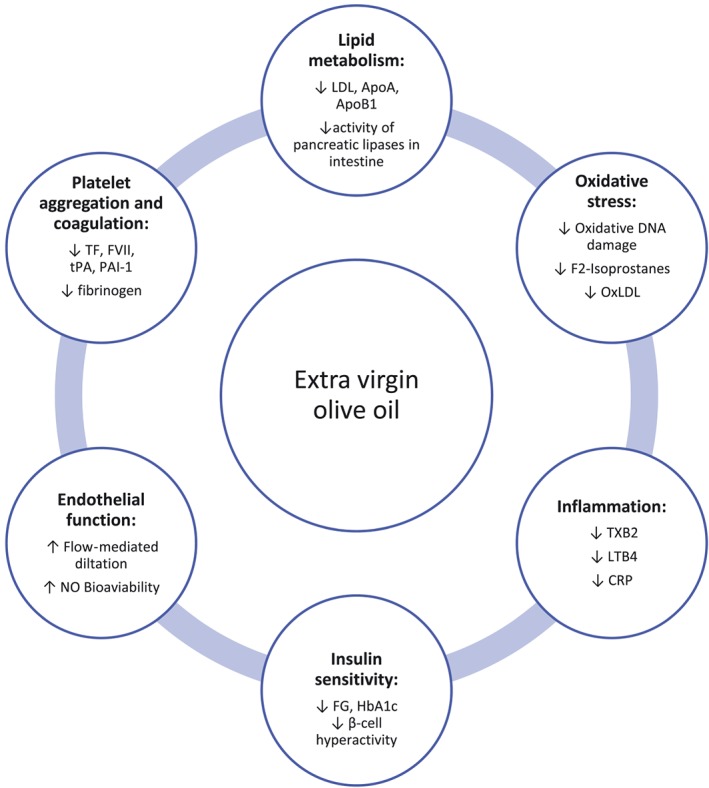
Figure 1
Figure 1
Overview of mechanistic properties of extra virgin oil (EVOO). EVOO may provide a beneficial effect for non‐communicable disease risk by modifying lipid metabolism, decreasing oxidative stress and inflammation, increasing insulin sensitivity, and improving endothelial function and coagulation. ApoA, apolipoprotein A; ApoB1, apolipoprotein B1; CRP, C‐reactive protein; FG, fasting glucose; FVII, coagulation factor VII; OxLDL, oxidized LDL; PAI‐1, plasminogen activator inhibitor‐1; TF, tissue factor; tPA, tissue plasminogen activator
Figure 2
Figure 2
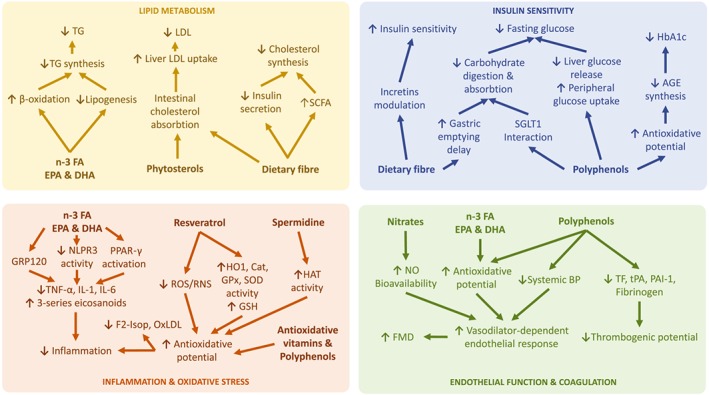
Schematic overview of potential mechanisms involved in the effects of bioactive compounds of ingredients of the Mediterranean diet other than olive oil. Dietary fibre may contribute to lower LDL and cholesterol synthesis, as well as to improve insulin sensitivity and reduce fasting glucose. Polyphenols may increase antioxidative potential, improve endothelial function, and have anti‐inflammatory properties. Moreover, polyphenols may lower fasting glucose and inhibit the synthesis of advanced glycation end products. Additional effects are attributed to the synergistic action of other agents such as ω‐3 fatty acids, phytosterols, resveratrol, spermidine, antioxidative vitamins, and nitrates. AGE, advanced glycation end products; Cat, catalase; DHA, docosahexaenoic acid; EPA, eicosanoid acid; F2‐Isop, F2‐isoprostanes; FMD, flow‐mediated dilation; FVII, coagulation factor VII; GRP120, GPCR 120; GPx, GSH peroxidase; HAT, histone acetyltransferase; HbA1c, glycated haemoglobin A1c; HO1, haem oxygenase 1; n‐3 FA, ω‐3 fatty acids; NLPR3, NACHT, LRR, and PYD domains‐containing protein 3; PAI‐1, plasminogen activator inhibitor‐1; RNS, reactive nitrogen species; SCFA, short‐chain fatty acid; SGLT1, sodium/glucose cotransporter 1; TF, tissue factor; TG, triacylglycerols; tPA, tissue plasminogen activator

References

    1. Abumweis, S. S. , Barake, R. , & Jones, P. J. (2008). Plant sterols/stanols as cholesterol lowering agents: A meta‐analysis of randomized controlled trials. Food & Nutrition Research, 52 10.3402/fnr.v52i0.1811 - DOI - PMC - PubMed
    1. Alexander, S. P. H. , Cidlowski, J. A. , Kelly, E. , Marrion, N. V. , Peters, J. A. , Faccenda, E. , … CGTP Collaborators . (2017). The Concise Guide to PHARMACOLOGY 2017/18: Nuclear hormone receptors. British Journal of Pharmacology, 174, S208–S224. 10.1111/bph.13880 - DOI - PMC - PubMed
    1. Alexander, S. P. H. , Fabbro, D. , Kelly, E. , Marrion, N. V. , Peters, J. A. , Faccenda, E. , … CGTP Collaborators . (2017). The Concise Guide to PHARMACOLOGY 2017/18: Enzymes. British Journal of Pharmacology, 174(Suppl 1), S272–S359. - PMC - PubMed
    1. Alexander, S. P. H. , Kelly, E. , Marrion, N. V. , Peters, J. A. , Faccenda, E. , Harding, S. D. , … CGTP Collaborators . (2017). The Concise Guide to PHARMACOLOGY 2017/18: Transporters. British Journal of Pharmacology, 174, S360–S446. 10.1111/bph.13883 - DOI - PMC - PubMed
    1. Anderson, J. W. (2008). Dietary fiber and associated phytochemicals in prevention and reversal of diabetes In Pasupuleti V. K., & Anderson J. W. (Eds.), Nutraceuticals, glycemic health and type 2 diabetes (p. xvii). Oxford: Wiley‐Blackwell; 10.1002/9780813804149.ch7 - DOI