


Secondary Forces in Protein Folding
- PMID: 31243961
- PMCID: PMC6995338
- DOI: 10.1021/acschembio.9b00339
Secondary Forces in Protein Folding
Abstract
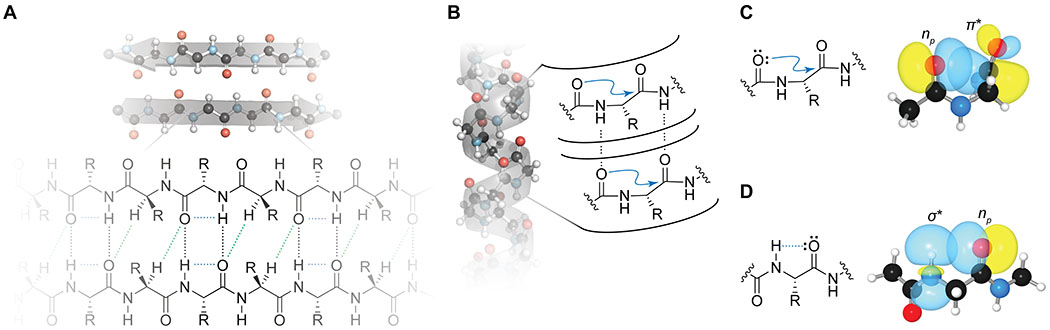
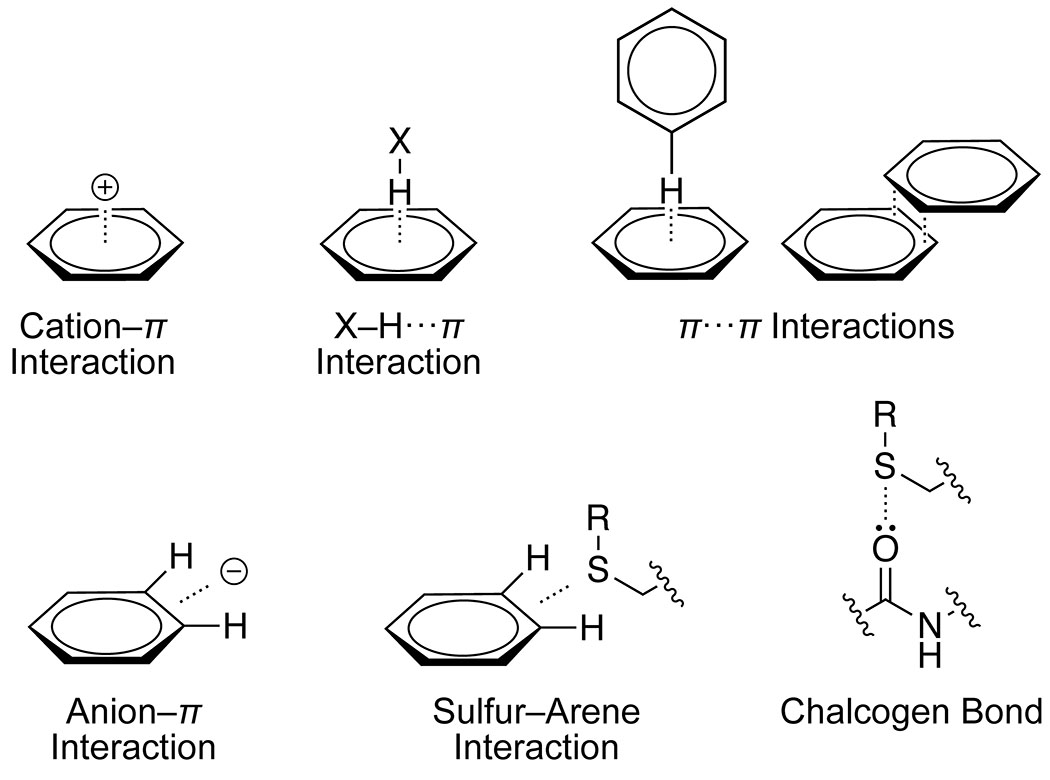
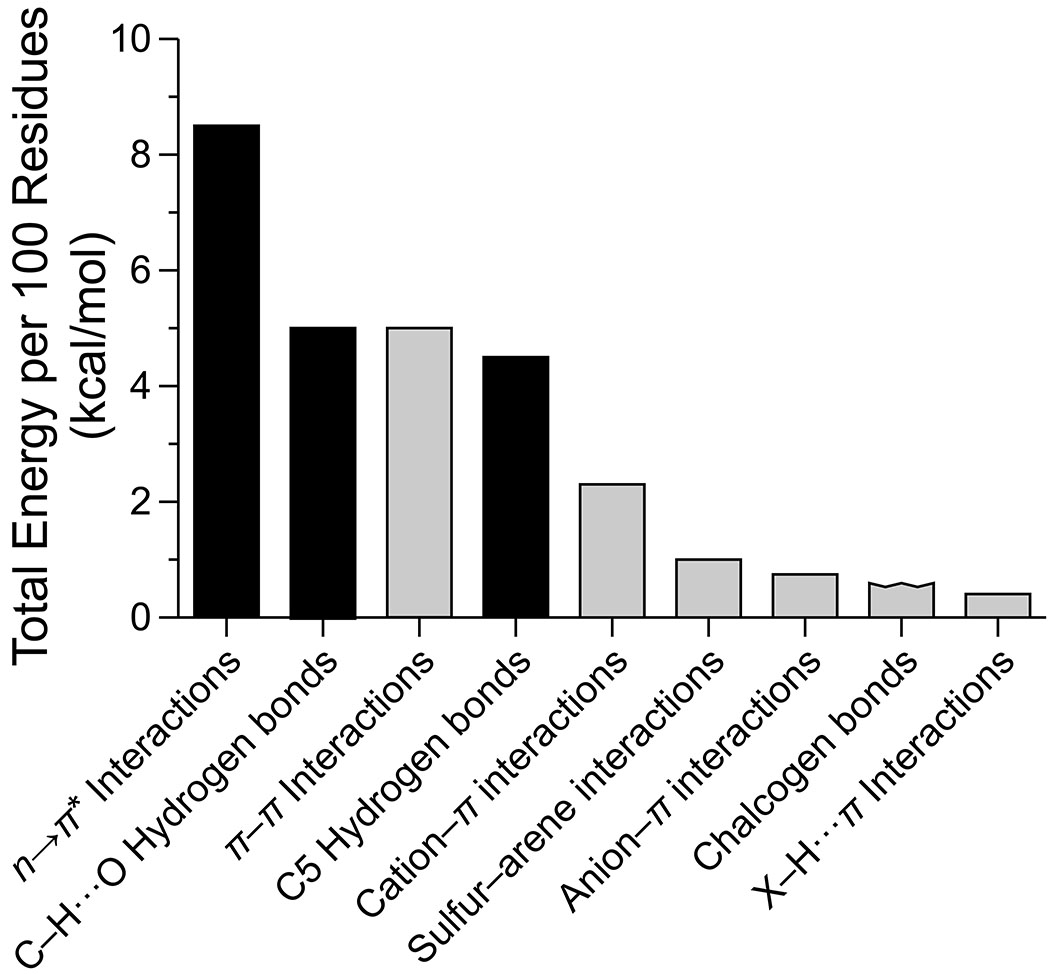
A complete inventory of the forces governing protein folding is critical for productive protein modeling, including structure prediction and de novo design, as well as understanding protein misfolding diseases of clinical significance. The dominant contributors to protein folding include the hydrophobic effect and conventional hydrogen bonding, along with Coulombic and van der Waals interactions. Over the past few decades, important additional contributors have been identified, including C-H···O hydrogen bonding, n→π* interactions, C5 hydrogen bonding, chalcogen bonding, and interactions involving aromatic rings (cation-π, X-H···π, π-π, anion-π, and sulfur-arene). These secondary contributions fall into two general classes: (1) weak but abundant interactions of the protein main chain and (2) strong but less frequent interactions involving protein side chains. Though interactions with high individual energies play important roles in specifying nonlocal molecular contacts and ligand binding, we estimate that weak but abundant interactions are likely to make greater overall contributions to protein folding, particularly at the level of secondary structure. Further research is likely to illuminate additional roles of these noncanonical interactions and could also reveal contributions yet unknown.
Conflict of interest statement
The authors declare no competing financial interests.
Figures
References
-
- Dill KA; MacCallum JL The protein-folding problem, 50 years on. Science 2012, 338, 1042–1046. - PubMed
-
- Anfinsen CB Principles that govern the folding of protein chains. Science 1973, 181, 223–230. - PubMed
-
- Venter JC; Adams MD; Myers EW; Li PW; Mural RJ; Sutton GG; Smith HO; Yandell M; Evans CA; Holt RA; Gocayne JD; Amanatides P; Ballew RM; Huson DH; Wortman JR; Zhang Q; Kodira CD; Zheng XH; Chen L; Skupski M; Subramanian G; Thomas PD; Zhang J; Gabor Miklos GL; Nelson C; Broder S; Clark AG; Nadeau J; McKusick VA; Zinder N; Levine AJ; Roberts RJ; Simon M; Slayman C; Hunkapiller M; Bolanos R; Delcher A; Dew I; Fasulo D; Flanigan M; Florea L; Halpern A; Hannenhalli S; Kravitz S; Levy S; Mobarry C; Reinert K; Remington K; Abu-Threideh J; Beasley E; Biddick K; Bonazzi V; Brandon R; Cargill M; Chandramouliswaran I; Charlab R; Chaturvedi K; Deng Z; Francesco VD; Dunn P; Eilbeck K; Evangelista C; Gabrielian AE; Gan W; Ge W; Gong F; Gu Z; Guan P; Heiman TJ; Higgins ME; Ji R-R; Ke Z; Ketchum KA; Lai Z; Lei Y; Li Z; Li J; Liang Y; Lin X; Lu F; Merkulov GV; Milshina N; Moore HM; Naik AK; Narayan VA; Neelam B; Nusskern D; Rusch DB; Salzberg S; Shao W; Shue B; Sun J; Wang ZY; Wang A; Wang X; Wang J; Wei M-H; Wides R; Xiao C; Yan C; Yao A; Ye J; Zhan M; Zhang W; Zhang H; Zhao Q; Zheng L; Zhong F; Zhong W; Zhu SC; Zhao S; Gilbert D; Baumhueter S; Spier G; Carter C; Cravchik A; Woodage T; Ali F; An H; Awe A; Baldwin D; Baden H; Barnstead M; Barrow I; Beeson K; Busam D; Carver A; Center A; Cheng ML; Curry L; Danaher S; Davenport L; Desilets R; Dietz S; Dodson K; Doup L; Ferriera S; Garg N; Gluecksmann A; Hart B; Haynes J; Haynes C; Heiner C; Hladun S; Hostin D; Houck J; Howland T; Ibegwam C; Johnson J; Kalush F; Kline L; Koduru S; Love A; Mann F; May D; McCawley S; McIntosh T; McMullen I; Moy M; Moy L; Murphy B; Nelson K; Pfannkoch C; Pratts E; Puri V; Qureshi H; Reardon M; Rodriguez R; Rogers Y-H; Romblad D; Ruhfel B; Scott R; Sitter C; Smallwood M; Stewart E; Strong R; Suh E; Thomas R; Tint NN; Tse S; Vech C; Wang G; Wetter J; Williams S; Williams M; Windsor S; Winn-Deen E; Wolfe K; Zaveri J; Zaveri K; Abril JF; Guigó R; Campbell MJ; Sjolander KV; Karlak B; Kejariwal A; Mi H; Lazareva B; Hatton T; Narechania A; Diemer K; Muruganujan A; Guo N; Sato S; Bafna V; Istrail S; Lippert R; Schwartz R; Walenz B; Yooseph S; Allen D; Basu A; Baxendale J; Blick L; Caminha M; Carnes-Stine J; Caulk P; Chiang Y-H; Coyne M; Dahlke C; Mays AD; Dombroski M; Donnelly M; Ely D; Esparham S; Fosler C; Gire H; Glanowski S; Glasser K; Glodek A; Gorokhov M; Graham K; Gropman B; Harris M; Heil J; Henderson S; Hoover J; Jennings D; Jordan C; Jordan J; Kasha J; Kagan L; Kraft C; Levitsky A; Lewis M; Liu X; Lopez J; Ma D; Majoros W; McDaniel J; Murphy S; Newman M; Nguyen T; Nguyen N; Nodell M; Pan S; Peck J; Peterson M; Rowe W; Sanders R; Scott J; Simpson M; Smith T; Sprague A; Stockwell T; Turner R; Venter E; Wang M; Wen M; Wu D; Wu M; Xia A; Zandieh A; Zhu X The sequence of the human genome. Science 2001, 291, 1304–1351. - PubMed
-
- Chiti F; Dobson CM Protein misfolding, functional amyloid, and human disease. Annu. Rev. Biochem 2006, 75, 333–366. - PubMed
Publication types
MeSH terms
Substances
Grants and funding
LinkOut - more resources
Full Text Sources
Research Materials
Miscellaneous
