


Physical Harm and Death in the Context of Coercive Measures in Psychiatric Patients: A Systematic Review
- PMID: 31244695
- PMCID: PMC6580992
- DOI: 10.3389/fpsyt.2019.00400
Physical Harm and Death in the Context of Coercive Measures in Psychiatric Patients: A Systematic Review
Abstract
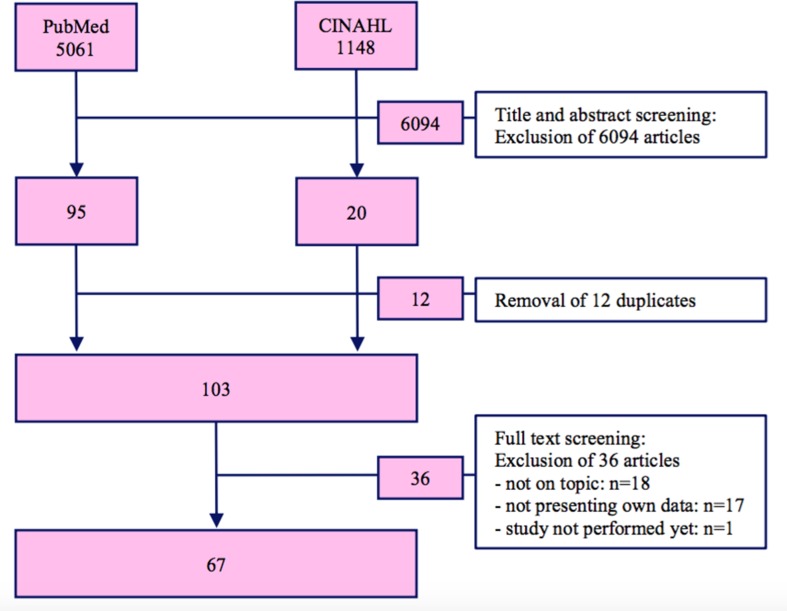
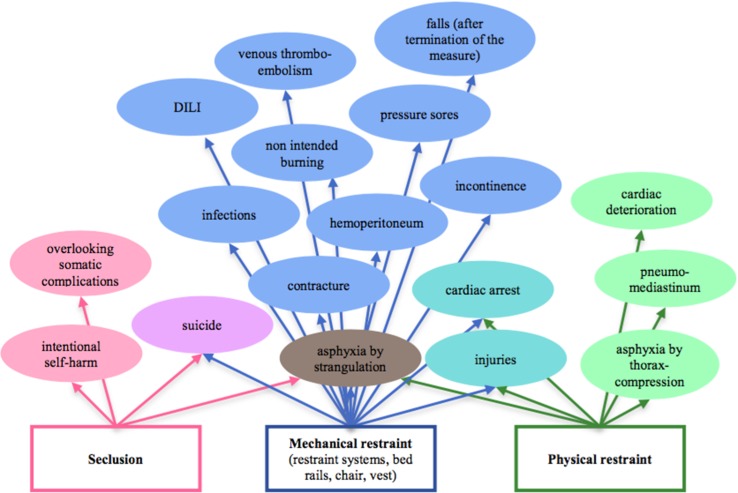
Background: For centuries coercive measures in psychiatry have been means of averting acute danger. It has been known for almost as long that these measures can lead to harm or even death to those affected. Over the past two decades the topic has increasingly been the subject of scientific discussion and research. While the legal and ethical preconditions for coercive measures in psychiatry as well as epidemiological studies on their incidence and patients' subjective experiences have increasingly come into focus, research on possible adverse events has lagged behind. To our knowledge there is no systematic review on the harmful or even fatal physical adverse effects of coercive interventions in psychiatry. Methods: We searched the databases PubMed and CINAHL for primary literature with a search string based on the PICO framework including key words describing different psychiatric diagnoses, coercive measures, and harms. Results: In total, 67 eligible studies (mainly case reports and case series) of very heterogeneous quality were included. Two RCTs were found reporting position-dependent cardiac deterioration, but were, however, carried out with healthy people and were characterized by a small number of cases. Death was the most frequently reported harm: cardiac arrest by chest compression in 14 studies, cardiac arrest by strangulation in 9, and pulmonary embolism in 8 studies. Further harms were, among others, venous thromboembolism and injuries. Injuries during physical restraint were reported in 0.8-4% of cases. For other kinds of coercive interventions, there are no sufficient data. Venous thromboembolism occurred in a considerable percentage of cases during mechanical restraint, also under prophylaxis. The most commonly reported coercive measure was restraint, distinguishing in mechanical restraint (43 studies), physical restraint (22 studies), bedrails (eight studies), vest restraint (7 studies), and chair restraint (6 studies). Forced medication was explicitly mentioned only in two, but seems to have occurred in nine studies. Six studies included seclusion. Conclusion: Coercive measures can lead to physical harm or even death. However, there is a significant lack of data on the incidence of such adverse events related to coercive interventions. Though reported anecdotally, physical adverse events during seclusion appear to be highly underresearched.
Keywords: coercion; harm; restraint; seclusion; side-effect.
Figures
References
-
- Celsus AC. Chapter 18. In: De Medicina Book 3. Loeb Classical Library edition Loeb Classic Library, Harvard: (1935). p. 291 Available at http://penelope.uchicago.edu/Thayer/L/Roman/Texts/Celsus/3*.html (Accessed December 1, 2018).
-
- Steinert T. An International Perspective on the Use of Coercive Measures In: Völlm B, Nedopil N, editors. The Use of Coercive Measures in Forensic Psychiatric Care. Springer International Publishing, Springer Cham; (2016). p. 87–100. 10.1007/978-3-319-26748-7_6 - DOI
-
- Heinroth JCA. Lehrbuch der Stoerungen des Seelenlebens oder der Seelenstoerungen und ihrer Behandlung: vom rationalen Standpunkte aus entworfen. Leipzig: Vogel; (1818). p. 304.
-
- Hayner CAF. Aufforderung an Regierungen, Obrigkeiten und Vorsteher der Irrenhäuser zur Abstellung einiger schwerer Gebrechen in der Behandlung der Irren. Leipzig Göschen, Leipzig: (1817). p. 10.
Publication types
LinkOut - more resources
Full Text Sources
Miscellaneous
