Review
. 2019 Jun 17:12:1756284819852047.
doi: 10.1177/1756284819852047. eCollection 2019.

Pathophysiology and management of diabetic gastroenteropathy

Affiliations
Review

Pathophysiology and management of diabetic gastroenteropathy

Theresa Meldgaard et al. Therap Adv Gastroenterol. .

Abstract

Polyneuropathy is a common complication to diabetes. Neuropathies within the enteric nervous system are associated with gastroenteropathy and marked symptoms that severely reduce quality of life. Symptoms are pleomorphic but include nausea, vomiting, dysphagia, dyspepsia, pain, bloating, diarrhoea, constipation and faecal incontinence. The aims of this review are fourfold. First, to provide a summary of the pathophysiology underlying diabetic gastroenteropathy. Secondly to give an overview of the diagnostic methods. Thirdly, to provide clinicians with a focussed overview of current and future methods for pharmacological and nonpharmacological treatment modalities. Pharmacological management is categorised according to symptoms arising from the upper or lower gut as well as sensory dysfunctions. Dietary management is central to improvement of symptoms and is discussed in detail, and neuromodulatory treatment modalities and other emerging management strategies for diabetic gastroenteropathy are discussed. Finally, we propose a diagnostic/investigation algorithm that can be used to support multidisciplinary management.

Keywords: complications; diabetes mellitus; diabetic neuropathies; enteric nervous system; enteropathy; gastrointestinal motility; gastrointestinal transit; pharmacology.


Conflict of interest statement

Conflict of interest statement: The authors declare that there is no conflict of interest.

Figures
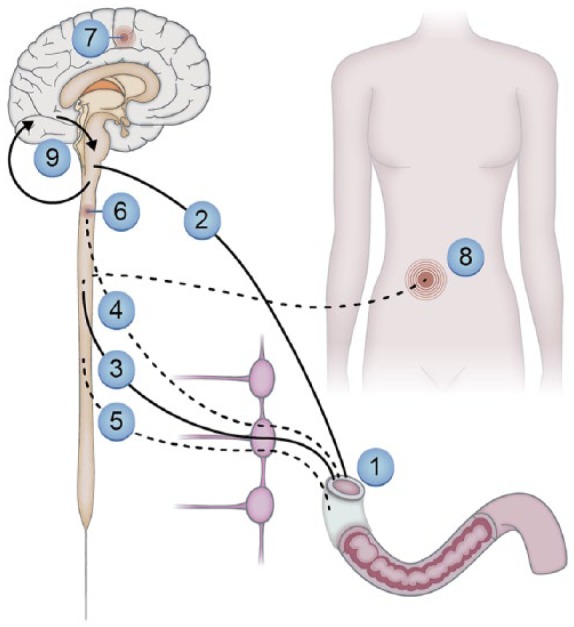
Figure 1.
Figure 1.
Neural pathways and mechanisms that may lead to pain and other sensory symptoms from the gastrointestinal system in people with diabetic neuropathy. Neuropathic changes in the enteric nervous system where e.g., motility dysfunction can lead to sensory symptoms: (1) autonomic neuropathy influencing the parasympathetic (2) and (3) sympathetic pathways. Due to cross-talk between the nerve pathways and involvement of inhibitory pathways, this may indirectly modulate sensations from the gut; negative impact on visceral (4) (and somatic (5) if the peritoneum is involved) afferents lead to spontaneous and evoked pain. Structural and functional changes in the spinal cord (6) and brain (7) may lead to spontaneous and evoked pain, amplify afferent barrage and give abnormal referred pain to somatic structures (8). Spino-bulbo-spinal loops (9) that normally control pain intensity often malfunction in people with diabetes.
Figure 2.
Figure 2.
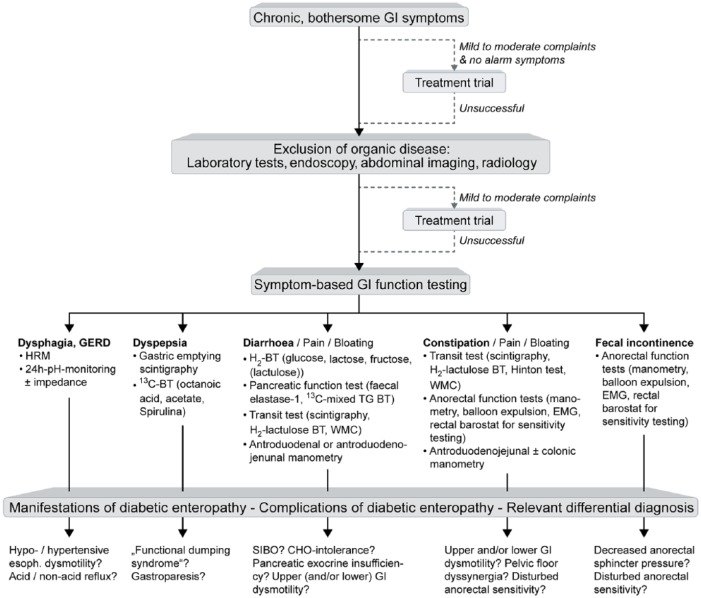
Diagnostic algorithm in persons with suspected diabetic gastroenteropathy. People with bothersome gastrointestinal symptoms should first undergo laboratory and imaging tests for exclusion of organic disease. If these are not helpful and symptoms are severe, or do not respond to simple therapeutic measures, GI function tests should be performed based on individual symptom pattern. These may reveal manifestations of diabetic gastroenteropathy (e.g. typical small bowel dysmotility in a person with diarrhoea), complications of diabetic gastroenteropathy (e.g. small bowel bacterial overgrowth) or differential diagnoses (e.g. lactose intolerance). BT: breath test; CHO: carbohydrate; EMG: Electromyography; GERD: gastro-oesophageal reflux disease; GI: gastrointestinal; HRM: high resolution manometry; SIBO: small bowel bacterial overgrowth; TG: triglyceride; WMC: wireless motility capsule.
Figure 3.
Figure 3.
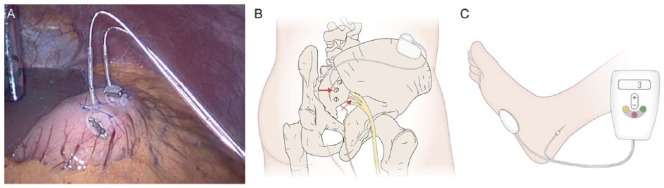
Neuromodulatory modalities in gastroenteropathy. (a) A laparoscopic view of gastric electrical stimulation electrodes sutured to the wall of the gastric antrum. Photograph courtesy of Sri Kardirkamanthan, Broomfield Hospital, Essex, UK. (b) A schematic representation of sacral nerve stimulation demonstrating the electrodes and signal generator. (c) Percutaneous tibial nerve stimulation. In this photograph, the tibial nerve is being stimulated using a 34-gauge needle inserted in/around the tibial nerve with a cutaneous electrode on the sole of the foot.

References

    1. Terkelsen AJ, Karlsson P, Lauria G, et al. The diagnostic challenge of small fibre neuropathy: clinical presentations, evaluations, and causes. Lancet Neurol 2017; 16: 934–944. - PubMed
    1. Pop-Busui R, Boulton AJM, Feldman EL, et al. Diabetic neuropathy: a position statement by the American diabetes association. Diabetes Care 2017; 40: 136–154. - PMC - PubMed
    1. Abbott CA, Malik RA, van Ross ERE, et al. Prevalence and characteristics of painful diabetic neuropathy in a large community-based diabetic population in the U.K. Diabetes Care 2011; 34: 2220–2224. - PMC - PubMed
    1. Breiner A, Lovblom LE, Perkins BA, et al. Does the prevailing hypothesis that small-fiber dysfunction precedes large-fiber dysfunction apply to type 1 diabetic patients? Diabetes Care 2014; 37: 1418–1424. - PubMed
    1. Spångéus A, El-Salhy M, Suhr O, et al. Prevalence of gastrointestinal symptoms in young and middle-aged diabetic patients. Scand J Gastroenterol 1999; 34: 1196–202. - PubMed

LinkOut - more resources