


Validation and Cross-cultural Adaptation of the Sinonasal Outcome Test (SNOT)-22 for the Arabian Patient Population
- PMID: 31245231
- PMCID: PMC6559682
- DOI: 10.7759/cureus.4447
Validation and Cross-cultural Adaptation of the Sinonasal Outcome Test (SNOT)-22 for the Arabian Patient Population
Abstract
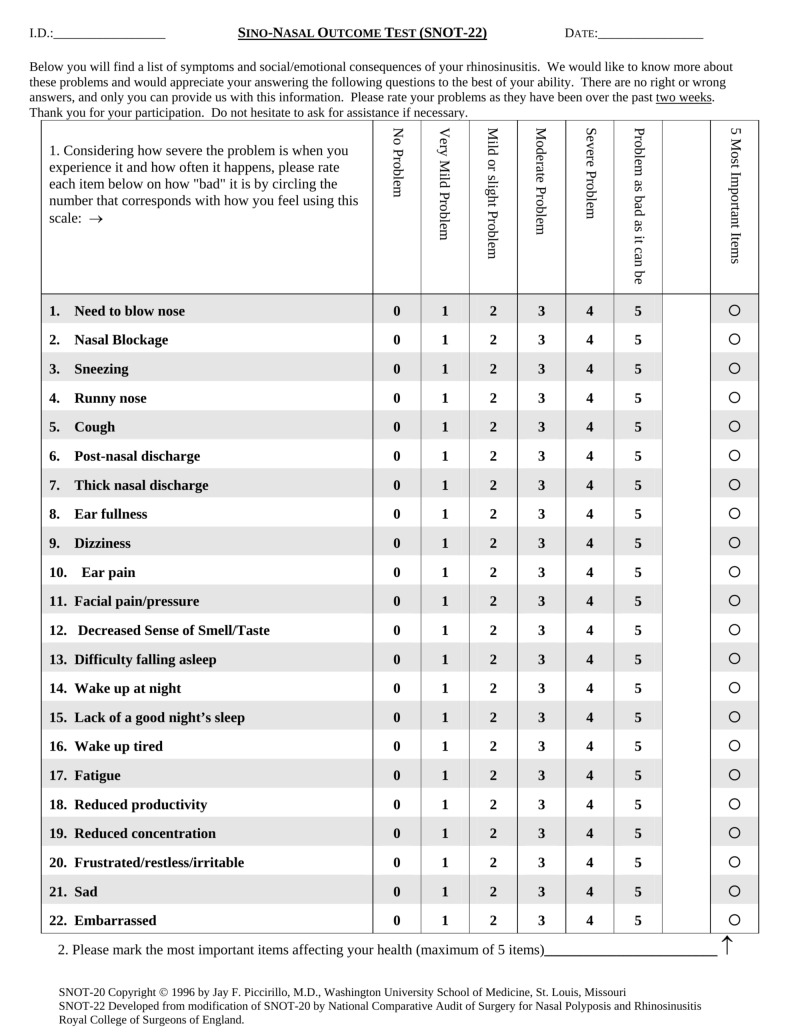
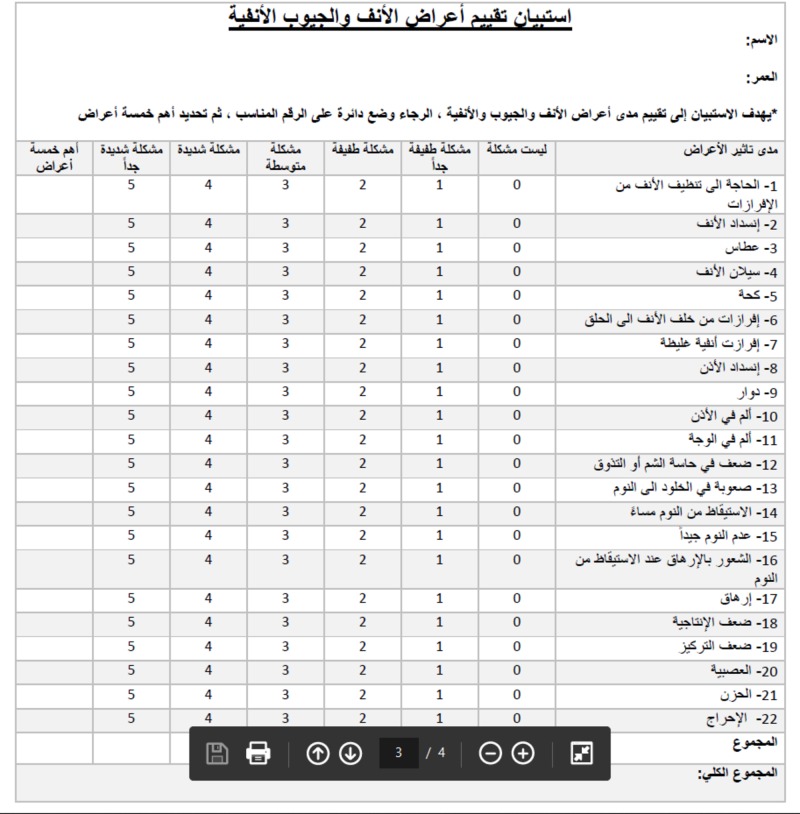
Background and objective Quality of life measurement is an essential element of healthcare evaluation. The Sino-Nasal Outcome Test 22 (SNOT-22) has been validated in different languages, and in this study we validated the SNOT-22 in Arabic language. The objective of this study is to provide a validated, cross-culturally adapted version of the SNOT-22 for the Arabic speaking population. Materials, methods, and main outcome measures This was a prospective cohort study set in a tertiary hospital in Riyadh, Saudi Arabia. The SNOT-22 was translated into Arabic by two native Arabic speakers. A total of 30 patients with chronic rhinosinusitis (CRS) with/without nasal polyps were included in test-retest study. Following that, a prospective study was conducted where the translated SNOT-22 was distributed to a different set of 30 CRS patients before and three months after endoscopic sinus surgery. Another 50 healthy individuals were included as a control group. The main outcome measure was the translation and validation of the SNOT-22 in Arabic. Results Internal consistency was assessed by performing a test-retest study. Cronbach's alpha was 0.803 at both the initial examination and at the retest, showing good internal consistency. There was a statistically significant difference between the results of the control group and the preoperative results of the CRS group (p<.001). The preoperative mean (SD) SNOT-22 score for the CRS group was 64.8 (20.3) and it dropped to 29.2 (11.8) postoperatively showing statistically significant change (p<.001), indicating the responsiveness of the SNOT-22. Conclusion The Arabic version of the SNOT-22 has internal consistency, reliability, and reproducibility that is needed for it to be a valid instrument to be used in research and clinical practice.
Keywords: arabic; chronic rhinosinusitis; crs; quality of life; sinonasal outcome test; sinus surgery; sinusitis; snot; snot-22; validation.
Conflict of interest statement
The authors have declared that no competing interests exist.
Figures
References
-
- EPOS 2012: European position paper on rhinosinusitis and nasal polyps 2012. A summary for otorhinolaryngologists. Fokkens WJ, Lund VJ, Mullol J, et al. Rhinology. 2012;50:1–12. - PubMed
-
- Translation cross-cultural adaptation, and validation of the sino-nasal outcome test (SNOT)-22 for Lithuanian patients. Vaitkus S, Padervinskis E, Balsevicius T, et al. Eur Arch Otorhinolaryngol. 2013;270:1843–1848. - PubMed
-
- Quality of life in patients with chronic rhinosinusitis. Rudmik L, Smith TL. Curr Allergy Asthma Rep. 2011;11:247–252. - PubMed
-
- Psychometric and clinimetric validity of the 20-Item SinoNasal Outcome Test (SNOT-20) Piccirillo JF, Merritt MG, Jr Richards ML. Otolaryngol Head Neck Surg. 2002;126:41–47. - PubMed
-
- The Sino-Nasal Outcome Test (SNOT): can we make it more clinically meaningful? Browne JP, Hopkins C, Slack R, Cano SJ. Otolaryngol Head Neck Surg. 2007;136:736–741. - PubMed
LinkOut - more resources
Full Text Sources