


Coumarins from the peel of citrus grown in Colombia: composition, elicitation and antifungal activity
- PMID: 31245648
- PMCID: PMC6582165
- DOI: 10.1016/j.heliyon.2019.e01937
Coumarins from the peel of citrus grown in Colombia: composition, elicitation and antifungal activity
Abstract
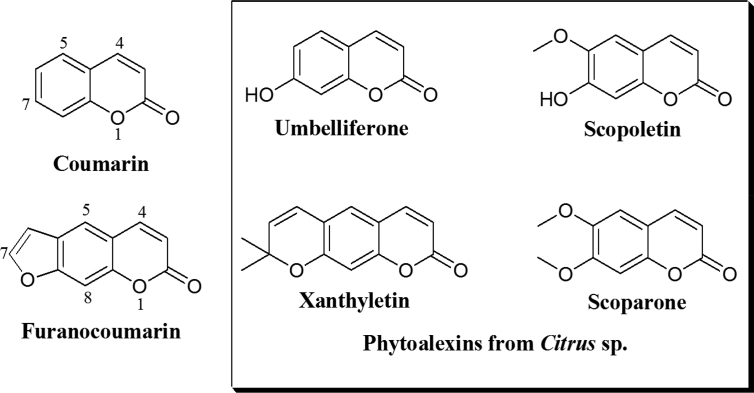
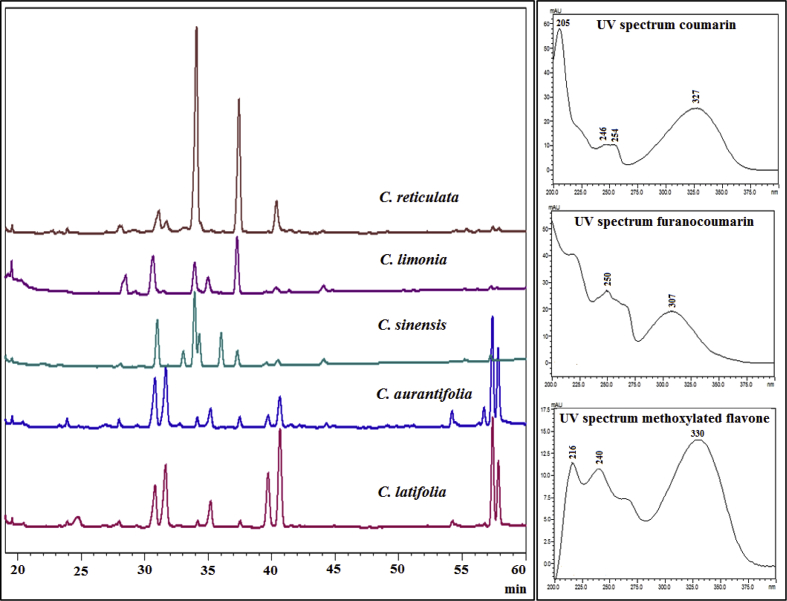
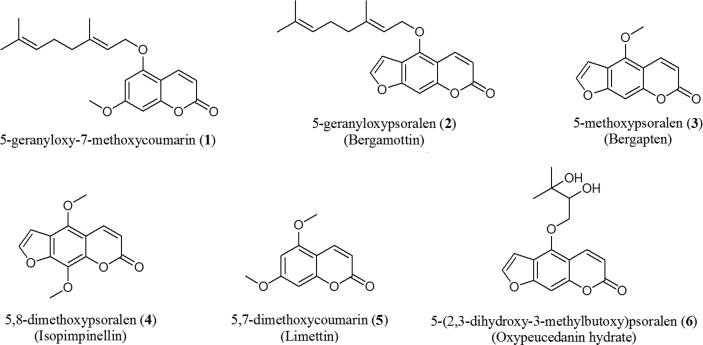
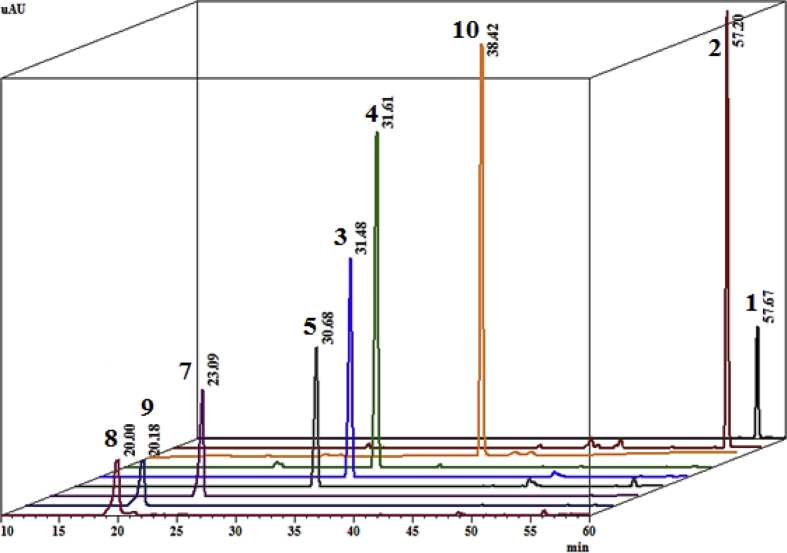
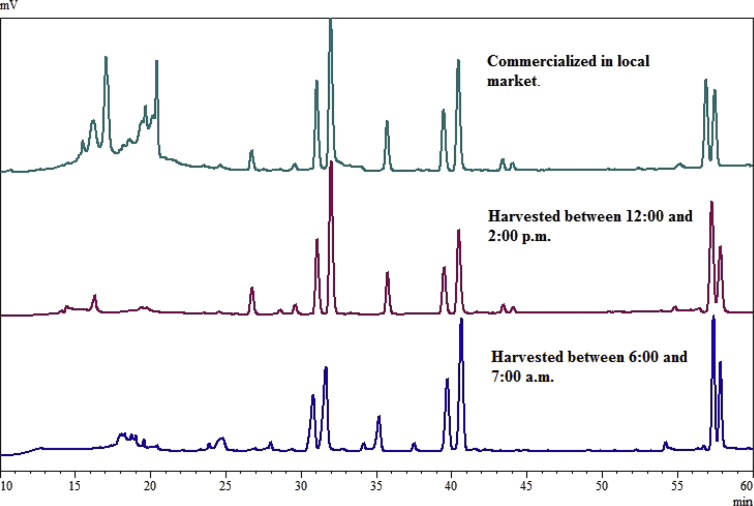
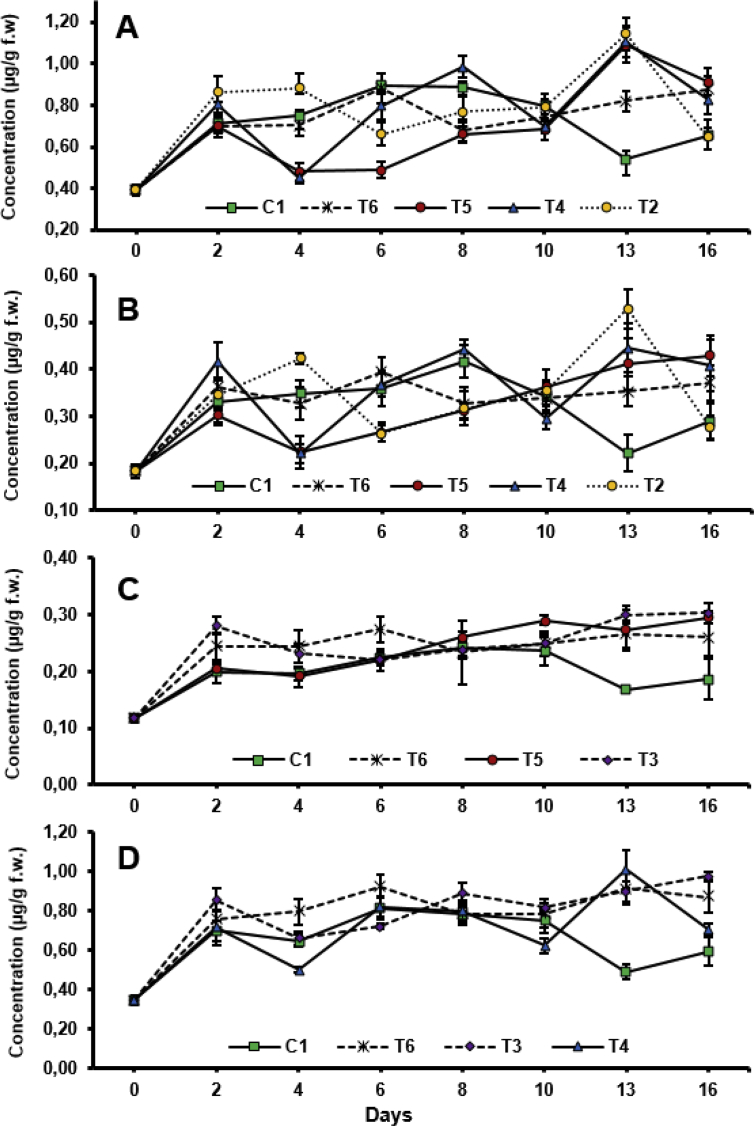
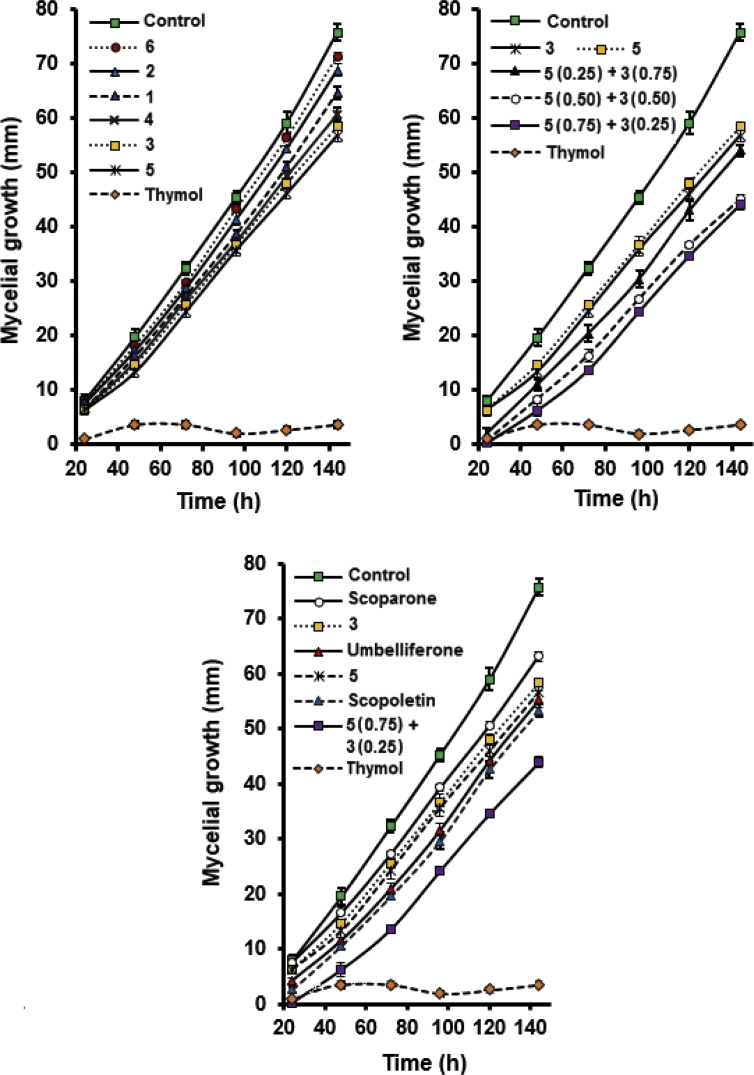
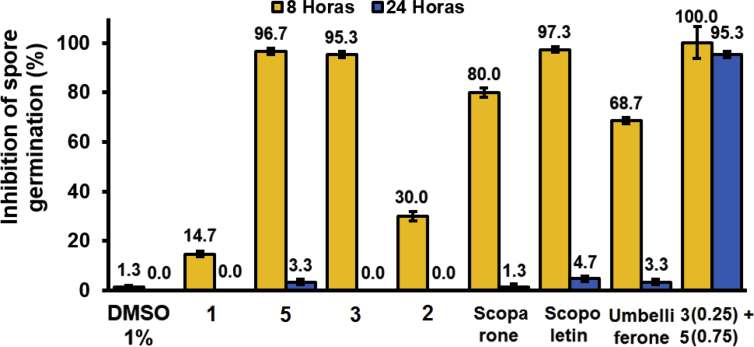
The present work analyses the chromatographic profile of the peels from fruits of different citrus cultivated in Colombia: sweet orange (Citrus sinensis [L.] Osbeck var. Valencia), mandarins (Citrus reticulata L. var. Arrayana and Oneco), Key lime (Citrus aurantifolia [Christ.] Swingle var. Pajarito), Mandarine lime (Citrus x limonia, a hybrid between Citrus reticulata and Citrus x limon) and Tahitian lime (C. latifolia Tanaka, syn. Persian lime). Coumarins, furanocoumarins and polymethoxylated flavones are the major compounds. Then, six coumarins were isolated and identified from fruits of Tahitian and Key lime corresponding to 5-geranyloxy-7-methoxycoumarin; 5,7-dimethoxycoumarin (syn. limettin); 5,8-dimethoxypsoralen (syn. isopimpinellin); 5-methoxypsoralen (syn. bergaptene); 5-geranoxypsoralen (syn. bergamottin) and 5-(2,3-dihydroxy-3-methylbutoxy) psoralen (syn. oxypeucedanin hydrate). Coumarins and furanocoumarins were quantified by liquid chromatography (HPLC-DAD). Results show that the prenylated compounds were present in high concentrations in Tahitian and Key lime but in very low amounts in mandarins and sweet orange. Subsequently, the antifungal activity (inhibition of mycelial growth and germination of spores) of the coumarins against the fungus causing the anthracnose, Colletotrichum sp. (isolated from aerial parts of Tahitian lime) was determined. The compounds limettin and bergaptene, as well as mixtures of them, showed significant inhibitory effect (radial growth and spore germination) when compared to the control. Finally, the effect of some recognized elicitors to induce the coumarin production in fruits of C. latifolia was evaluated. The results showed that the chemical profiles are dependent on the applied elicitor and the post-induction time. As a result of the induction, a high concentration of some coumarins and furanocoumarins was maintained in the course of time for the Tahitian lime. In conclusion, isolated coumarins could be involved in the defense mechanisms of C. latifolia, C. aurantifolia and C. limonia and their accumulation may be modulated by the application of elicitors.
Keywords: Antifungal activity; Citrus fruits; Coumarin; Elicitors; Food science; Furanocoumarins; Limettin; Plant elicitor molecule; Rutaceae; Spore germination inhibition; Tahitian lime.
Figures
References
-
- Afek U., Sztejnberg A. Scoparone (6,7- dimethoxycoumarin), a citrus phytoalexin involved in resistance to pathogens. In: Dniel M., Purkayastha R.P., editors. Handbook of Phytoalexin Metabolismand Action. Marcel Dekker Inc.; New York, Basel, Hong Kong: 1994. pp. 262–286.
-
- Afek U., Sztejnberg A. Accumulation of scoparone, a phytoalexin associated with resistance of citrus to Phytophthora citrophthora. Phytopathology. 1988;78:1678–1682.
-
- Afek U., Orenstein J., Carmeli S., Rodov V., Joseph M.B. Umbelliferone: a phytoalexin associated with resistance of immature Marsh grapefruit to Penicillium digitatum. Phytochemistry. 1999;50:1129–1132.
-
- Ahuja I., Kissen R., Bones A.M. Phytoalexins in defense against pathogens. Trends Plant Sci. 2012;17:73–90. - PubMed
-
- Araújo R.S.A., Guerra F.Q.S., Lima E.O., de Simone C.A., Tavares J.F., Scotti L., Scotti M.T., de Aquino T.M., de Moura R.O., Mendonça F.J.B., Barbosa-Filho J.M. Synthesis, structure-activity relationships (SAR) and in silico studies of coumarin derivatives with antifungal activity. Int. J. Mol. Sci. 2013;14:1293–1309. - PMC - PubMed
LinkOut - more resources
Full Text Sources
Research Materials
Miscellaneous
