


Metabolomics of sorghum roots during nitrogen stress reveals compromised metabolic capacity for salicylic acid biosynthesis
- PMID: 31245765
- PMCID: PMC6508800
- DOI: 10.1002/pld3.122
Metabolomics of sorghum roots during nitrogen stress reveals compromised metabolic capacity for salicylic acid biosynthesis
Abstract
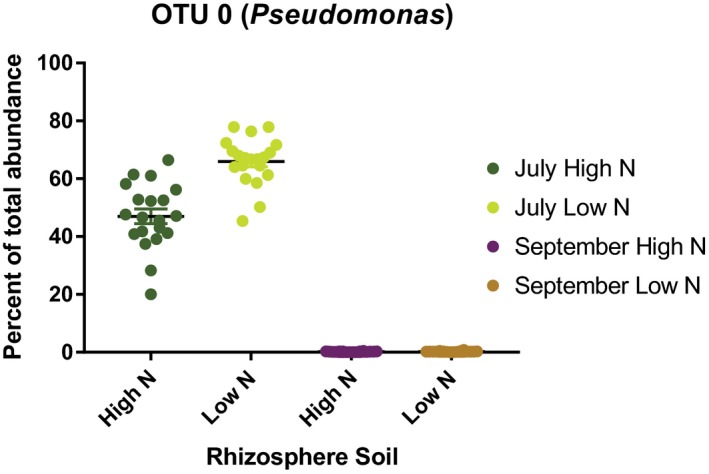
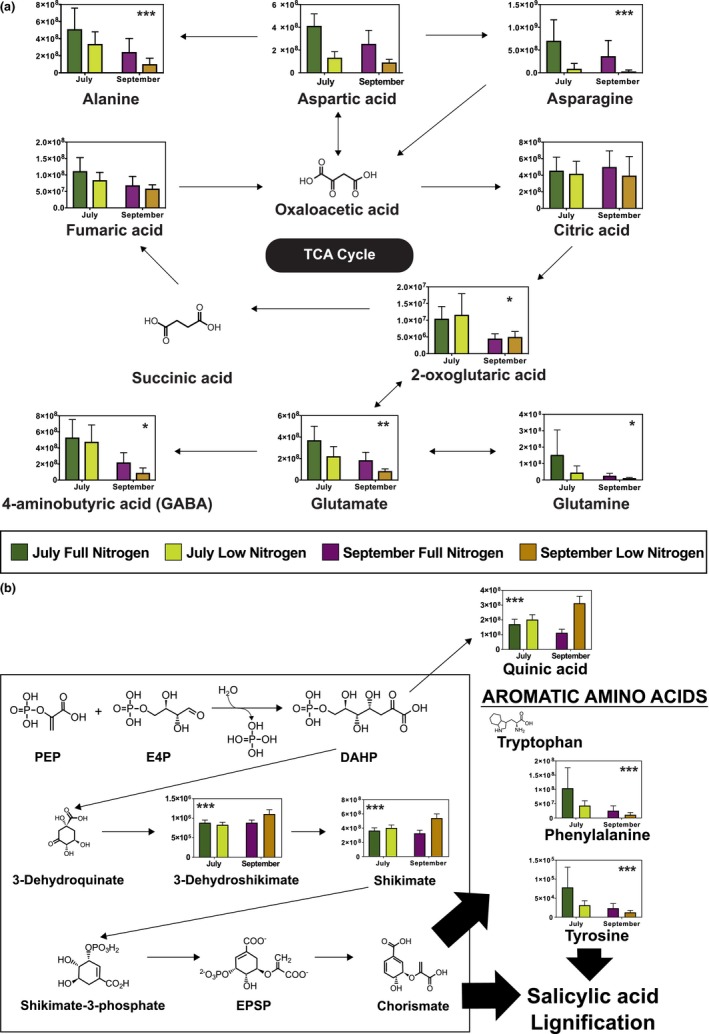
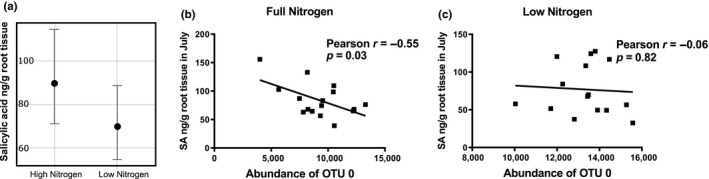
Sorghum (Sorghum bicolor [L.] Moench) is the fifth most productive cereal crop worldwide with some hybrids having high biomass yield traits making it promising for sustainable, economical biofuel production. To maximize biofuel feedstock yields, a more complete understanding of metabolic responses to low nitrogen (N) will be useful for incorporation in crop improvement efforts. In this study, 10 diverse sorghum entries (including inbreds and hybrids) were field-grown under low and full N conditions and roots were sampled at two time points for metabolomics and 16S amplicon sequencing. Roots of plants grown under low N showed altered metabolic profiles at both sampling dates including metabolites important in N storage and synthesis of aromatic amino acids. Complementary investigation of the rhizosphere microbiome revealed dominance by a single operational taxonomic unit (OTU) in an early sampling that was taxonomically assigned to the genus Pseudomonas. Abundance of this Pseudomonas OTU was significantly greater under low N in July and was decreased dramatically in September. Correlation of Pseudomonas abundance with root metabolites revealed a strong negative association with the defense hormone salicylic acid (SA) under full N but not under low N, suggesting reduced defense response. Roots from plants with N stress also contained reduced phenylalanine, a precursor for SA, providing further evidence for compromised metabolic capacity for defense response under low N conditions. Our findings suggest that interactions between biotic and abiotic stresses may affect metabolic capacity for plant defense and need to be concurrently prioritized as breeding programs become established for biofuels production on marginal soils.
Keywords: metabolism; metabolomics; microbiome; nitrogen; rhizosphere; roots; salicylic acid; sorghum; stress.
Conflict of interest statement
The authors have no conflict of interest to declare for this research.
Figures
References
-
- AbuQamar, S. , Chen, X. , Dhawan, R. , Bluhm, B. , Salmeron, J. , Lam, S. , … Mengiste, T. (2006). Expression profiling and mutant analysis reveals complex regulatory networks involved in Arabidopsis response to Botrytis infection. The Plant Journal, 48, 28–44. 10.1111/j.1365-313X.2006.02849.x - DOI - PubMed
-
- Anderson, M. J. (2001). A new method for non‐parametric multivariate analysis of variance. Austral Ecology, 26, 32–46.
-
- Bates, D. , Mächler, M. , Bolker, B. , & Walker, S. (2014). Fitting linear mixed‐effects models using lme4. arXiv preprint arXiv:1406.5823.
-
- Beals, E. W. (1984). Bray‐Curtis ordination: An effective strategy for analysis of multivariate ecological data. Advances in Ecological Research, 14, 1–55.
LinkOut - more resources
Full Text Sources
