


Association Between the Use of Social Media and Photograph Editing Applications, Self-esteem, and Cosmetic Surgery Acceptance
- PMID: 31246236
- PMCID: PMC6604085
- DOI: 10.1001/jamafacial.2019.0328
Association Between the Use of Social Media and Photograph Editing Applications, Self-esteem, and Cosmetic Surgery Acceptance
Abstract
Importance: Social media platforms and photograph (photo) editing applications are increasingly popular sources of inspiration for individuals interested in cosmetic surgery. However, the specific associations between social media and photo editing application use and perceptions of cosmetic surgery remain unknown.
Objective: To assess whether self-esteem and the use of social media and photo editing applications are associated with cosmetic surgery attitudes.
Design, setting, and participants: A population-based survey study was conducted from July 1 to September 19, 2018. The web-based survey was administered through online platforms to 252 participants.
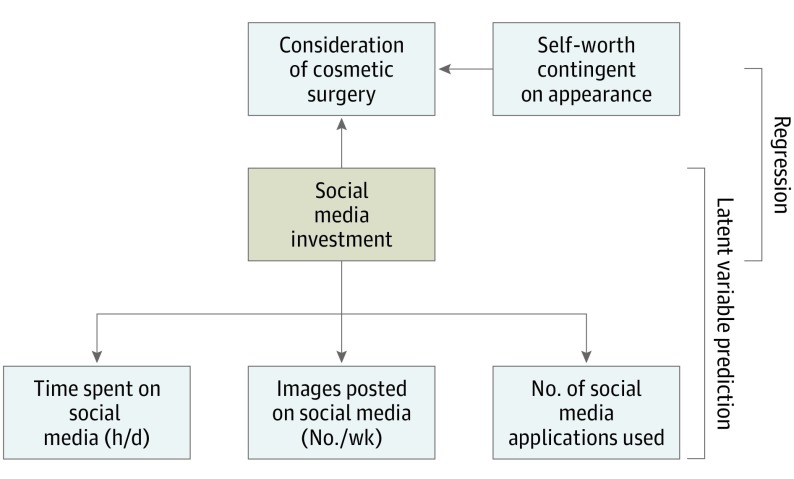
Main outcomes and measures: Each participant's self-esteem was measured using the Rosenberg Self-esteem Scale (scores range from 0-30; higher scores indicate higher self-esteem) and the Contingencies of Self-worth Scale (scores range from 1-7; higher scores indicate higher self-worth). Cosmetic surgery attitude was measured using the Acceptance of Cosmetic Surgery Scale (scores range from 1-7; higher scores indicate higher acceptance of cosmetic surgery). Unpaired, 2-tailed t tests were used to assess the significance of self-esteem and cosmetic surgery attitude score differences among users of various social media and photo editing applications. Structural equation modeling was used to assess the association between social media investment and cosmetic surgery attitudes.
Results: Of the 252 participants, 184 (73.0%) were women, 134 (53.2%) reported themselves to be white, and the mean age was 24.7 (range, 18-55) years. Scores on the Rosenberg Self-esteem Scale from users and nonusers across applications were compared, with lower self-esteem scores noted in participants who reported using YouTube (difference in scores, -1.56; 95% CI, -3.01 to -0.10), WhatsApp (difference in scores, -1.47; 95% CI, -2.78 to -0.17), VSCO (difference in scores, -3.20; 95% CI, -4.98 to -1.42), and Photoshop (difference in scores, -2.92; 95% CI, -5.65 to -0.19). Comparison of self-esteem scores for participants who reported using other social media and photo editing applications yielded no significant differences. Social media investment had a positive association with consideration of cosmetic surgery (R, 0.35; 95% CI, 0.04-0.66). A higher overall score on the Acceptance of Cosmetic Surgery Scale was noted in users of Tinder (difference in means, 0.79; 95% CI, 0.34-1.23), Snapchat (difference in means, 0.39; 95% CI, 0.07 to 0.71), and/or Snapchat photo filters (difference in means, 0.44; 95% CI, 0.16-0.72). Increased consideration of cosmetic surgery but not overall acceptance of surgery was noted in users of VSCO (difference in means, 0.84; 95% CI, 0.32-1.35) and Instagram photo filters (difference in means, 0.38; 95% CI, 0.01-0.76) compared with nonusers.
Conclusions and relevance: This study's findings suggest that the use of certain social media and photo editing applications may be associated with increased acceptance of cosmetic surgery. These findings can help guide future patient-physician discussions regarding cosmetic surgery perceptions, which vary by social media or photo editing application use.
Level of evidence: NA.
Conflict of interest statement
Figures
Comment in
-
Is There a Selfie Epidemic?JAMA Facial Plast Surg. 2019 Sep 1;21(5):367-368. doi: 10.1001/jamafacial.2019.0419. JAMA Facial Plast Surg. 2019. PMID: 31246225 No abstract available.
References
-
- Wang R, Yang F, Haigh MM. Let me take a selfie: exploring the psychological effects of posting and viewing selfies and groupies on social media. Telematics and Informatics. 2017;34(4):274-283. doi: 10.1016/j.tele.2016.07.004 - DOI
-
- American Psychiatric Association Diagnostic and Statistical Manual of Mental Disorders. 5th ed Washington, DC: American Psychiatric Association; 2013. doi: 10.1176/appi.books.9780890425596. - DOI
MeSH terms
LinkOut - more resources
Full Text Sources