. 2019 Nov;160(11):2473-2486.
doi: 10.1097/j.pain.0000000000001648.

Assessment of nociception and related quality-of-life measures in a porcine model of neurofibromatosis type 1

Affiliations

Assessment of nociception and related quality-of-life measures in a porcine model of neurofibromatosis type 1

Rajesh Khanna et al. Pain. 2019 Nov.

Abstract

Neurofibromatosis type 1 (NF1) is an autosomal dominant genetic disorder resulting from germline mutations in the NF1 gene, which encodes neurofibromin. Patients experience a variety of symptoms, but pain in the context of NF1 remains largely underrecognized. Here, we characterize nociceptive signaling and pain behaviors in a miniswine harboring a disruptive NF1 mutation (exon 42 deletion). We present the first characterization of pain-related behaviors in a pig model of NF1, identifying unchanged agitation scores, lower tactile thresholds (allodynia), and decreased response latencies to thermal laser stimulation (hyperalgesia) in NF1 (females only) pigs. Male NF1 pigs with tumors showed reduced sleep quality and increased resting, 2 health-related quality-of-life symptoms found to be comorbid in people with NF1 pain. We explore these phenotypes in relationship to suppression of the increased activity of the N-type voltage-gated calcium (CaV2.2) channel by pharmacological antagonism of phosphorylation of a regulatory protein-the collapsin response mediator protein 2 (CRMP2), a known interactor of neurofibromin, and by targeting the interface between the α subunit of CaV2.2 and the accessory β-subunits with small molecules. Our data support the use of NF1 pigs as a large animal model for studying NF1-associated pain and for understanding the pathophysiology of NF1. Our findings demonstrate the translational potential of 2 small molecules in reversing ion channel remodeling seen in NF1. Interfering with CaV2.2, a clinically validated target for pain management, might also be a promising therapeutic strategy for NF1-related pain management.


Conflict of interest statement

Conflict of interest

Dr. Chris Rogers is an employee of Exemplar Genetics. There is no conflict of interest for any of the other authors.

Figures
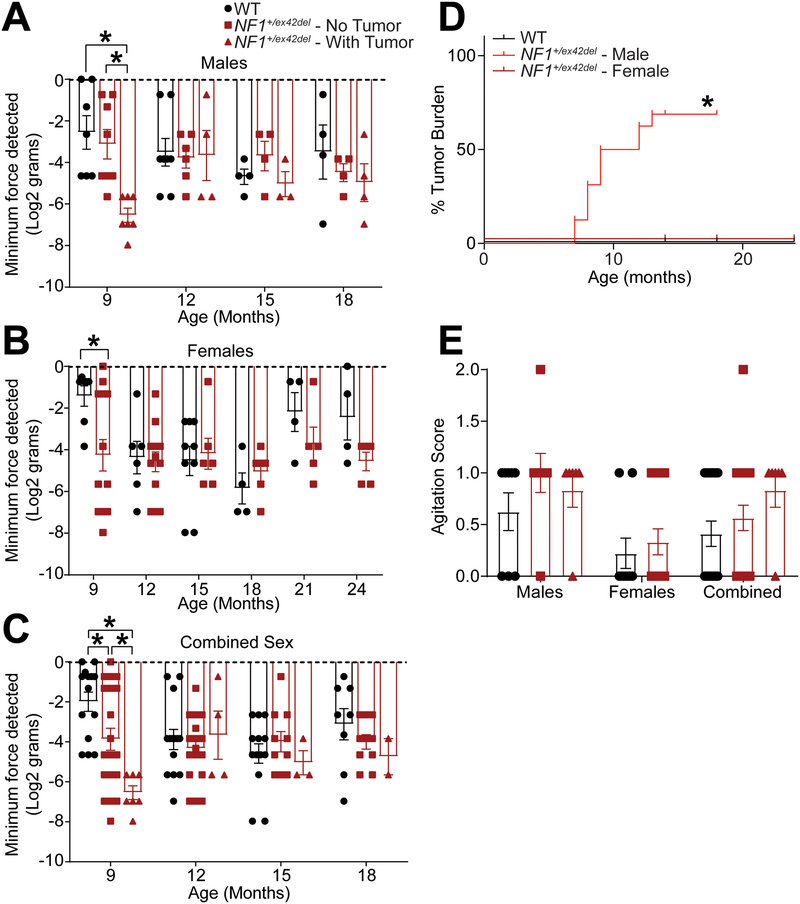
Figure 1.
Figure 1.. NF1+/ex42del pigs exhibit transient mechanical allodynia, dependent on tumor burden and sex.
Bar graph with scatter plot of inner ear tactile threshold values for male (A) or female (B) pigs (data is combined in (C)) from the indicated genotype. Tactile thresholds were decreased in both tumor-burdened male and female NF1+/ex42del pig (*p<0.05; Two-way ANOVA with Tukey post-hoc.). (D) Demonstration of tumor burden, showing the only male NF1+/ex42del pig exhibit tumor formation. (Mantel-Cox test, ****p<0.0001. N=16 WT, 16 NF1 males, 16 NF1 females). (E) Observed agitation scores as measured in Supplemental Table 2 were not significantly different between the genotypes (p>0.05, Mann Whitney), indicating anxiety or hyperactivity did not confound von Frey results in A-C.
Figure 2.
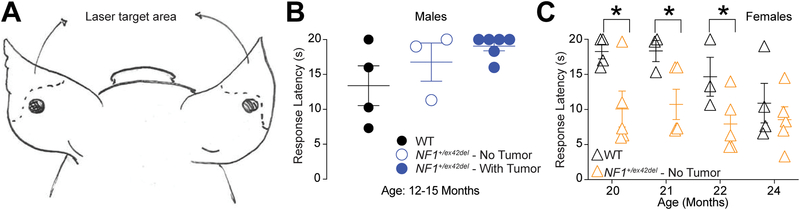
Figure 2.. NF1+/ex42del pigs show sexually dimorphic behaviors in response to thermal laser stimulation.
(A) Schematic of site of thermal laser stimulation in pigs. (B) Male NF1+/ex42del pigs do not have enhanced response latency to thermal laser stimulation in comparison to wildtype pigs regardless of tumor presence at 12–15 months of age. (C) Female NF1+/ex42del pigs exhibit significantly reduced response latencies to thermal laser stimulation in comparison to wildtype pigs at several time points. Wildtype females become more sensitive to the laser stimuli over multiple testings, indicating perhaps testing fatigue and sensitization. (*p<0.05, ordinary two-way ANOVA, Fisher’s LSD test for each time point).
Figure 3.
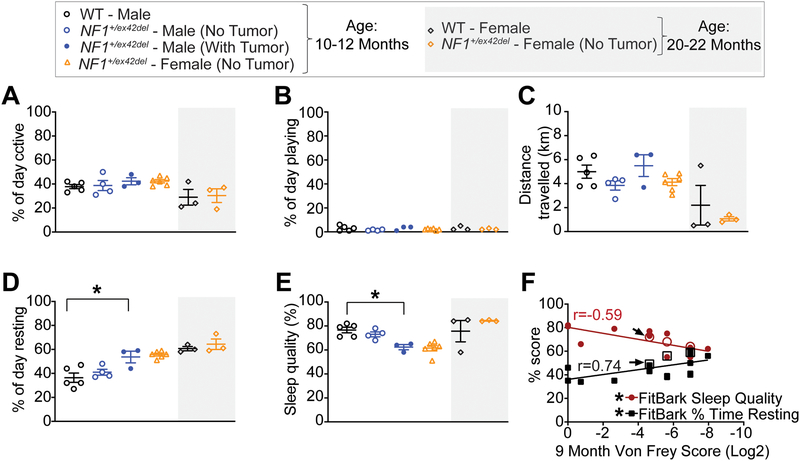
Figure 3.. NF1+/ex42del pigs exhibit poor sleep and increased time resting.
Scatter plots for (A) percent of day active, (B) percent of day playing, (C) total distance travelled, (D) percent of day resting, and (E) sleep quality for the indicated genotype and gender at 10–12 months or 20–22 months of age. Measures of both percent of day resting and sleep quality were affected in female and tumor-burdened male NF1+/ex42del pigs. Asterisks indicate significance between compared groups (*p<0.05; One-way ANOVA with Tukey post-hoc). (F). Correlation analysis between 9 month von Frey data and 10–12 month FitBark quality of life data indicates significant correlation (Pearson correlation coefficient values are indicated) between the two assays. Higher sensitivity to von Frey stimuli is associated with increased rest time and decreased quality of sleep (*p<0.05). Animals with tumor burden (open circles and squares) cluster towards higher scores on all three assays. One animal appeared to be transitioning to tumor formation during testing (arrows). As this animal scored lower than the animals with established tumors, it’s possible that tumor burden directly affects assay scores.
Figure 4.
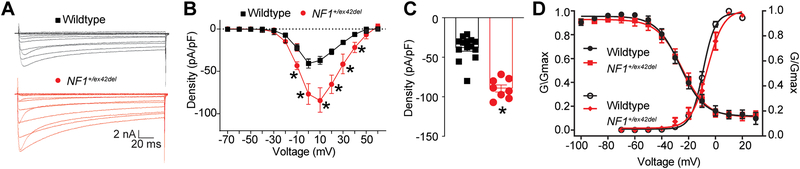
Figure 4.. Calcium currents are increased in NF1+/ex42del pig DRGs.
(A) representative calcium traces from wildtype or NF1+/ex42del pig DRGs. (B) Summary current-voltage curve of peak current density normalized to the cell capacitance (pA/pF) for each voltage step. (C) Bar graph with scatter plot of peak current density at 10 mV for the indicated conditions. (D) Activation and inactivation curves of normalized calcium currents (G/Gmax) for the indicated genotype. *p<0.05, One-way ANOVA with Tukey post-hoc test, n= 8–14 cells per condition from three wildtype and two NF1+/ex42del boars. Unless otherwise stated, all data are presented as means ± SEM.
Figure 5.
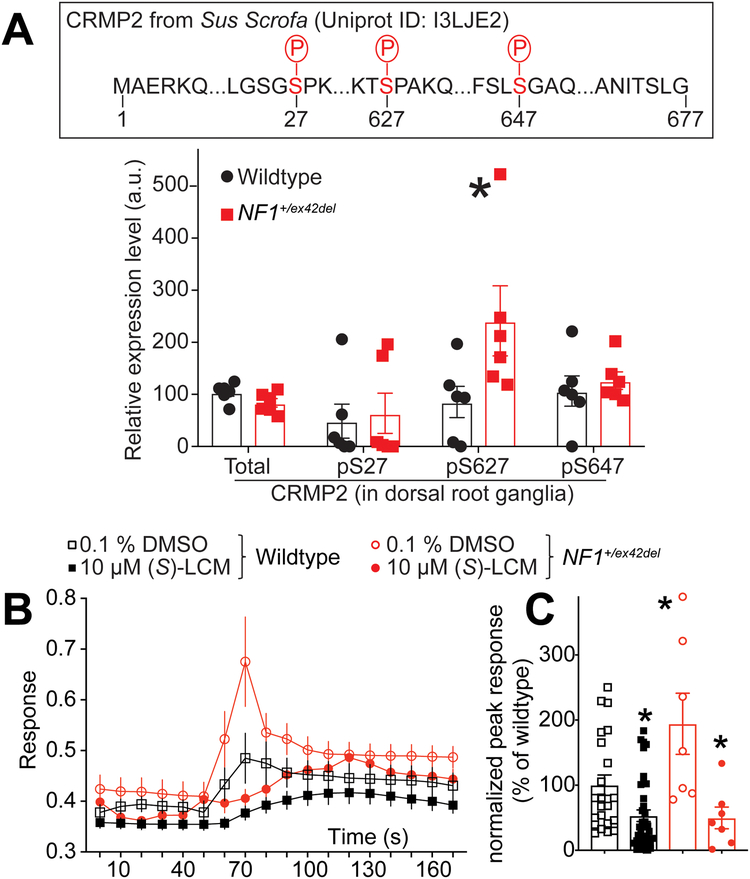
Figure 5.. Phosphoproteomic analysis of CRMP2 phosphorylation in NF1+/ex42del pig DRGs highlights the potential use of the CRMP2 inhibitor (S)-Lacosamide to decrease depolarization evoked calcium influx.
(A) Wildtype or NF1+/ex42del pig (female) DRGs whole lysate was analyzed by mass spectrometry for CRMP2 expression and phosphorylation level. The peptide ions m/z was analyzed based on CRMP2 protein sequence from pigs (sus scrofa) in Uniprot (I3LJE2). Partial CRMP2 protein sequence is shown and the identified phosphorylation sites highlighted in red. Mass spectrometry returned a quantitative value of peptide abundance compared to the sample load, presented in the bar graph. CRMP2 total expression was unchanged in NF1+/ex42del compared to wildtype pig DRGs. Expression level of the phosphorylation sites pS27, pS627 and pS647 was altered in NF1+/ex42del pig DRGs. *p<0.05, Mann-Whitney test (n=6 animals per genotype). (B) Time course of depolarization evoked calcium influx measured by fura-2 based calcium imaging, in NF1+/ex42del or wildtype pig DRG neurons treated with 10 μM of (S)-LCM as indicated. After a 1-min baseline acquisition, calcium influx was evoked by a 15 seconds depolarization using 90 mM KCl. (C) Bar graph with scatter plot of peak response (the difference of peak calcium influx normalized to its own baseline for each individual cell) in Pig DRGs treated as indicated. Peak responses were normalized to the wildtype levels for better comparison. Vehicle (0.1% DMSO) or 10 μM (S)-LCM were applied for 30 min prior to depolarization. Peak calcium response was increased in NF1+/ex42del pig DRGs compared to wildtype. (S)-LCM treatment inhibited calcium influx in both genotypes. *p<0.05 (Mann Whitney) compared to wildtype (0.1 % DMSO).
Figure 6:
Figure 6:. The N-type specific inhibitor IPPQ can decrease calcium currents in wildtype and NF1+/ex42del pig DRGs.
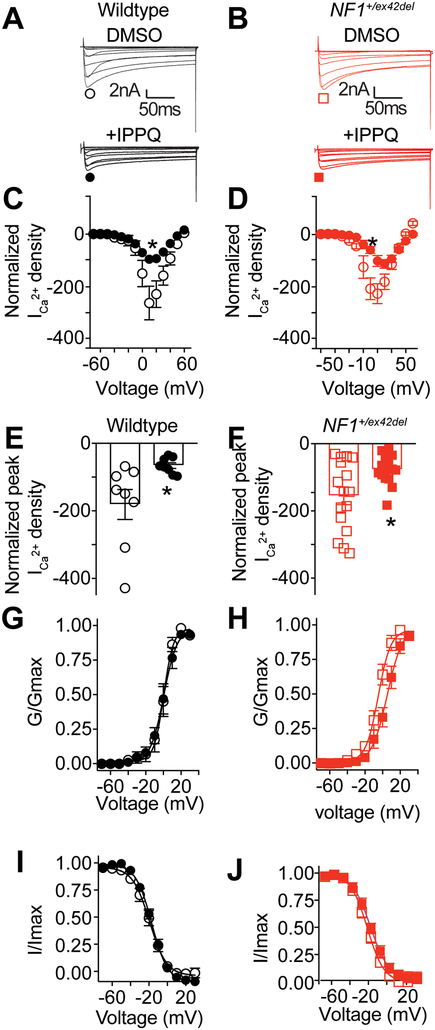
Representative traces of calcium currents obtained from (A) wildtype or (B) NF1+/ex42del pig DRGs treated with 20 μM of IPPQ or 0.1 % DMSO (vehicle control) overnight. Curve of current density normalized on the capacitance of each cells and to the level of the DMSO treated control for (C) wildtype or (D) NF1+/ex42del pig DRGs. Bar graph with scatter plot of the peak current density obtained at +10 mV in DRG neurons treated with 20 μM IPPQ overnight compared to vehicle control (0.1 % DMSO) for (E) wildtype or (F) NF1+/ex42del pig DRGs. IPPQ inhibited calcium currents in both genotypes. Activation (G/Gmax) and inactivation (I/Imax) properties of the calcium currents were not impacted after overnight treatment with IPPQ in both (G-I) wildtype and (H-J) NF1+/ex42del pig DRGs. Graphs show mean ± s.e.m. *p<0.05, Student’s t-test.

References

    1. Anastasaki C, Rensing N, Johnson KJ, Wong M, Gutmann DH. Neurofibromatosis type 1 (Nf1)-mutant mice exhibit increased sleep fragmentation. J Sleep Res 2019:e12816. - PMC - PubMed
    1. Axen I Pain-related Sleep Disturbance: A Prospective Study With Repeated Measures. The Clinical journal of pain 2016;32(3):254–259. - PubMed
    1. Balastik M, Zhou XZ, Alberich-Jorda M, Weissova R, Ziak J, Pazyra-Murphy MF, Cosker KE, Machonova O, Kozmikova I, Chen CH, Pastorino L, Asara JM, Cole A, Sutherland C, Segal RA, Lu KP. Prolyl Isomerase Pin1 Regulates Axon Guidance by Stabilizing CRMP2A Selectively in Distal Axons. Cell Rep 2015;13(4):812–828. - PMC - PubMed
    1. Ballester R, Marchuk D, Boguski M, Saulino A, Letcher R, Wigler M, Collins F. The NF1 locus encodes a protein functionally related to mammalian GAP and yeast IRA proteins. Cell 1990;63(4):851–859. - PubMed
    1. Bellampalli SS, Khanna R. Towards a neurobiological understanding of pain in neurofibromatosis type 1: mechanisms and implications for treatment. Pain 2019;160(5):1007–1018. - PMC - PubMed

Publication types