. 2019 Jun 28;68(25):568-572.
doi: 10.15585/mmwr.mm6825a3.

Cryptosporidiosis Outbreaks - United States, 2009-2017

Cryptosporidiosis Outbreaks - United States, 2009-2017

Radhika Gharpure et al. MMWR Morb Mortal Wkly Rep. .

Abstract

Cryptosporidium is a parasite that causes cryptosporidiosis, a profuse, watery diarrhea that can last up to 3 weeks in immunocompetent patients and can lead to life-threatening malnutrition and wasting in immunocompromised patients.* Fecal-oral transmission can occur by ingestion of contaminated recreational water, drinking water, or food, or through contact with infected persons or animals. For the period 2009-2017, public health officials from 40 states and Puerto Rico voluntarily reported 444 cryptosporidiosis outbreaks resulting in 7,465 cases. Exposure to treated recreational water (e.g., in pools and water playgrounds) was associated with 156 (35.1%) outbreaks resulting in 4,232 (56.7%) cases. Other predominant outbreak exposures included contact with cattle (65 outbreaks; 14.6%) and contact with infected persons in child care settings (57; 12.8%). The annual number of reported cryptosporidiosis outbreaks overall increased an average of approximately 13% per year over time. Reversing this trend will require dissemination of prevention messages to discourage swimming or attending child care while ill with diarrhea and encourage hand washing after contact with animals. Prevention and control measures can be optimized by improving understanding of Cryptosporidium transmission through regular analysis of systematically collected epidemiologic and molecular characterization data.


Conflict of interest statement

All authors have completed and submitted the ICMJE form for disclosure of potential conflicts of interest. No potential conflicts of interest were disclosed.

Figures
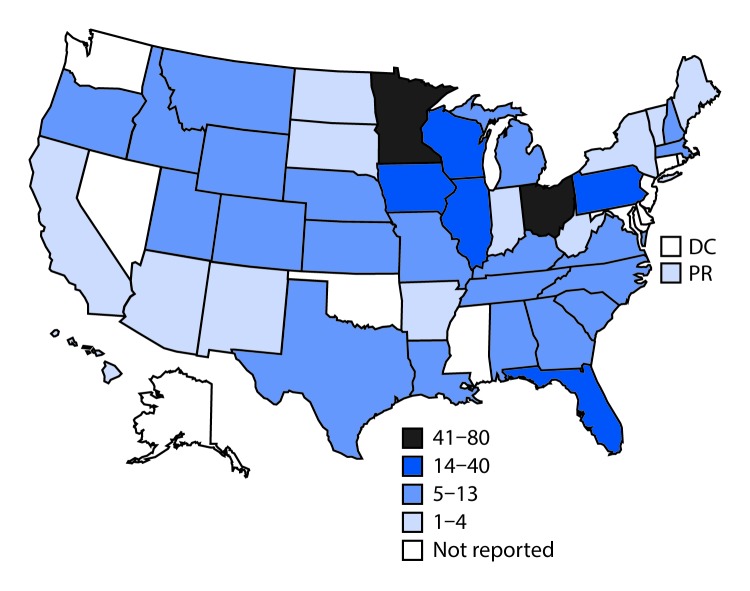
FIGURE 1
FIGURE 1
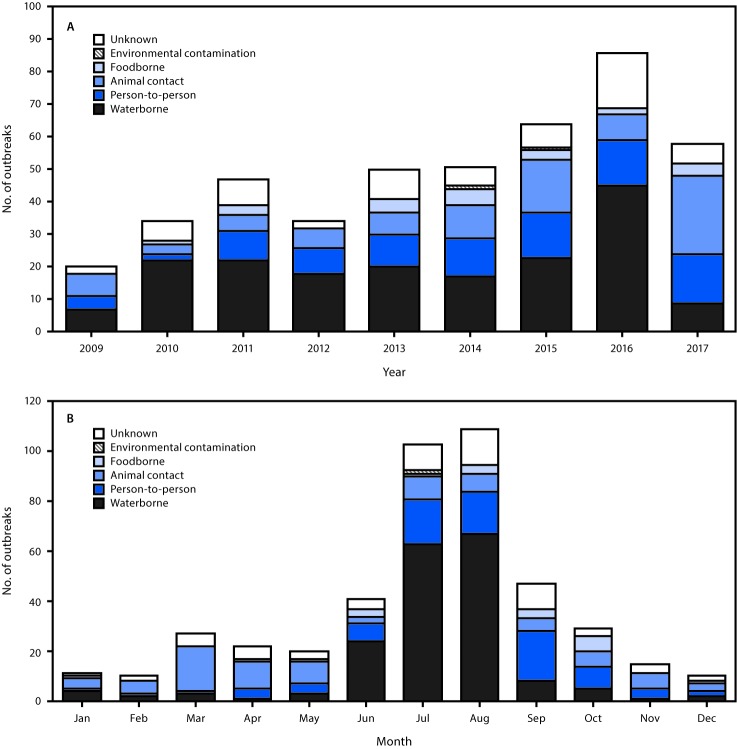
Reported cryptosporidiosis outbreaks (N = 444), by exposure jurisdiction — United States, 2009–2017 Abbreviations: DC = District of Columbia; PR = Puerto Rico. * Exposure jurisdictions are states, DC, and PR. These numbers are largely dependent on public health capacity and reporting requirements, which vary across jurisdictions and do not necessarily indicate the actual occurrence of cryptosporidiosis outbreaks in a given jurisdiction.
FIGURE 2
FIGURE 2
Reported cryptosporidiosis outbreaks (N = 444), by mode of transmission and year of earliest illness onset date (A) and month of earliest illness onset date (B) — United States, 2009–2017 * Transmission modes were categorized as follows: Unknown if insufficient evidence to implicate one specific primary mode of transmission; Environmental contamination if transmitted through exposure to a contaminated environment not attributable to foodborne, waterborne, person-to-person, or animal contact transmission; Foodborne if transmitted by consumption of contaminated food or non-water beverages; Animal contact if transmitted through contact with animals or their living environments; Person-to-person if transmission occurred from direct contact with an infected person, their bodily fluids, or by contact with the local environment where the exposed person was simultaneously present; and Waterborne if transmission occurred via ingestion, inhalation, contact, or another exposure to water (e.g., treated or untreated recreational water, drinking water [including bottled water], or an environmental or indeterminate water source). https://www.cdc.gov/nors/forms.html.

References

    1. Hlavsa MC, Cikesh BL, Roberts VA, et al. Outbreaks associated with treated recreational water—United States, 2000–2014. MMWR Morb Mortal Wkly Rep 2018;67:547–51. 10.15585/mmwr.mm6719a3 - DOI - PMC - PubMed
    1. Hale CR, Scallan E, Cronquist AB, et al. Estimates of enteric illness attributable to contact with animals and their environments in the United States. Clin Infect Dis 2012;54(Suppl 5):S472–9. 10.1093/cid/cis051 - DOI - PubMed
    1. Goodgame RW, Genta RM, White AC, Chappell CL. Intensity of infection in AIDS-associated cryptosporidiosis. J Infect Dis 1993;167:704–9. 10.1093/infdis/167.3.704 - DOI - PubMed
    1. Murphy JL, Arrowood MJ, Lu X, Hlavsa MC, Beach MJ, Hill VR. Effect of cyanuric acid on the inactivation of Cryptosporidium parvum under hyperchlorination conditions. Environ Sci Technol 2015;49:7348–55. 10.1021/acs.est.5b00962 - DOI - PMC - PubMed
    1. Painter JE, Hlavsa MC, Collier SA, Xiao L, Yoder JS. Cryptosporidiosis surveillance—United States, 2011–2012. MMWR Suppl 2015;64(No. Suppl 3). - PubMed