. 2019 Jun 27;13(6):e0007421.
doi: 10.1371/journal.pntd.0007421. eCollection 2019 Jun.

One hypervirulent clone, sequence type 283, accounts for a large proportion of invasive Streptococcus agalactiae isolated from humans and diseased tilapia in Southeast Asia

Affiliations

One hypervirulent clone, sequence type 283, accounts for a large proportion of invasive Streptococcus agalactiae isolated from humans and diseased tilapia in Southeast Asia

Timothy Barkham et al. PLoS Negl Trop Dis. .

Abstract

Background: In 2015, Singapore had the first and only reported foodborne outbreak of invasive disease caused by the group B Streptococcus (GBS; Streptococcus agalactiae). Disease, predominantly septic arthritis and meningitis, was associated with sequence type (ST)283, acquired from eating raw farmed freshwater fish. Although GBS sepsis is well-described in neonates and older adults with co-morbidities, this outbreak affected non-pregnant and younger adults with fewer co-morbidities, suggesting greater virulence. Before 2015 ST283 had only been reported from twenty humans in Hong Kong and two in France, and from one fish in Thailand. We hypothesised that ST283 was causing region-wide infection in Southeast Asia.

Methodology/principal findings: We performed a literature review, whole genome sequencing on 145 GBS isolates collected from six Southeast Asian countries, and phylogenetic analysis on 7,468 GBS sequences including 227 variants of ST283 from humans and animals. Although almost absent outside Asia, ST283 was found in all invasive Asian collections analysed, from 1995 to 2017. It accounted for 29/38 (76%) human isolates in Lao PDR, 102/139 (73%) in Thailand, 4/13 (31%) in Vietnam, and 167/739 (23%) in Singapore. ST283 and its variants were found in 62/62 (100%) tilapia from 14 outbreak sites in Malaysia and Vietnam, in seven fish species in Singapore markets, and a diseased frog in China.

Conclusions: GBS ST283 is widespread in Southeast Asia, where it accounts for a large proportion of bacteraemic GBS, and causes disease and economic loss in aquaculture. If human ST283 is fishborne, as in the Singapore outbreak, then GBS sepsis in Thailand and Lao PDR is predominantly a foodborne disease. However, whether transmission is from aquaculture to humans, or vice versa, or involves an unidentified reservoir remains unknown. Creation of cross-border collaborations in human and animal health are needed to complete the epidemiological picture.


Conflict of interest statement

I have read the journal's policy and the authors of this manuscript have the following competing interests: SLC and TB are named applicants on a patent for the ST83-specific PCR test used in this study.

Figures
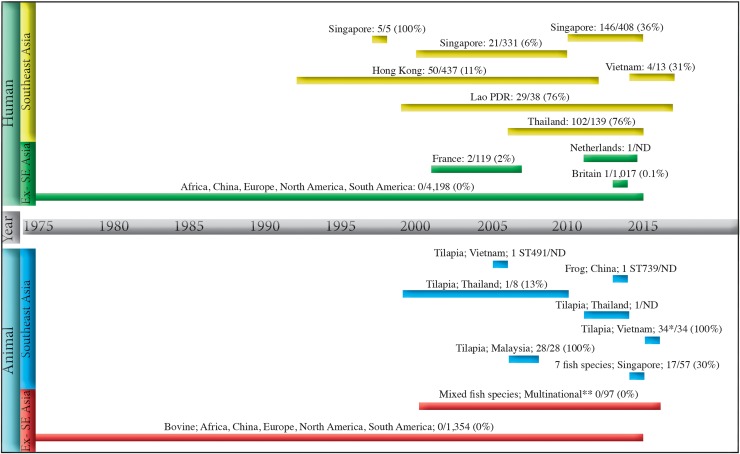
Fig 1
Fig 1. Prevalence of clonal complex 283 in human and animal collections of group B Streptococcus showing their host, geographic origin, and period of collection.
This figure represents our new data, as well as the literature on Streptococcus agalactiae (GBS) that includes multi locus sequencing typing data up to December 2017. The vertical bars on the left indicate human or animal origin and the geographical region, Southeast Asia (SEA) or outside SEA (Ex- SE Asia), where collections of GBS originated. The horizontal bars delineate the time period of each collection of GBS, with reference to the central time bar; associated text shows the host, the country of origin, and number of ST283/all GBS in each collection, except where other STs are shown. The figure shows the lack of reports, from humans and animals, in SEA compared with outside SEA, both in terms of time periods and absolute numbers of GBS studied. It also shows that GBS CC283 is rare outside SEA, with only four human and no animal CC283 reported, despite the large number of GBS studied. In contrast, CC283 is prevalent in all human and animal GBS collections from SEA. *One of these 34 from a tilapia in Vietnam is ST1311, a double locus variant of ST283. ** Australia, Ghana, South America, North America, Israel and Kuwait. Abbreviation: ND = not determined.
Fig 2
Fig 2. Phylogenetic analysis of group B Streptococcus (GBS) with emphasis on clonal complex (CC) 283 genomes.
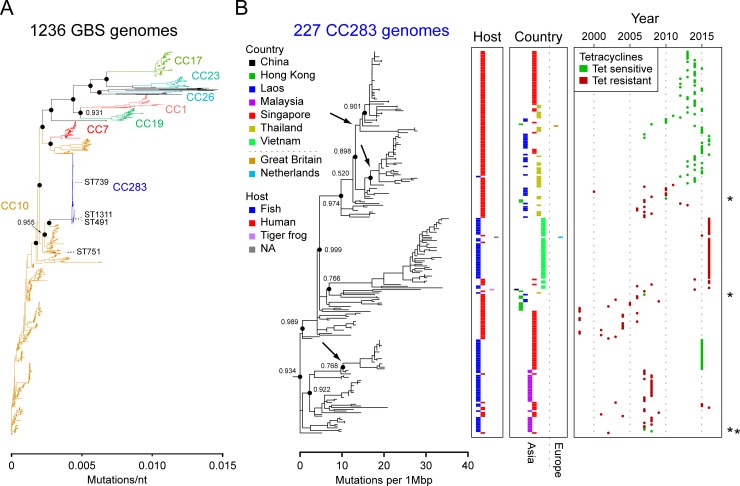
(A) Approximately maximum-likelihood phylogenetic tree of 1,236 GBS strains. The ST283 isolate SG-M1 was used as a reference sequence. The scale bar is shown on the x-axis, in mutations/nucleotide. The bootstrap values for selected branches (supporting the difference between different CCs) are indicated by black circles; all are 1.000 except where indicated. Major clonal complexes are indicated with coloured branches and a matching coloured label. The clade containing all CC283 isolates is highlighted in blue. All ST283 variants discussed in the text (ST491, ST739, ST751, and ST1311) are highlighted with black branches and an adjacent label in black text. (B) Approximately maximum-likelihood phylogenetic tree of 227 GBS CC283 genomes. Reconstructed genome sequences (based on the SG-M1 reference sequence) of the isolates indicated as CC283 in (A) were used, after excluding redundant isolates, defined as identical sequences from the same site, based on SNP calls. Bootstrap support is indicated for selected branches by black circles. Arrows show predicted events resulting in loss of tetracycline resistance. (C) For each CC283 isolate, the metadata are indicated at the same horizontal position (i.e. directly to the right of the phylogenetic tree tip) as in panel B. Host and country are represented by coloured rectangles, as indicated in the legend. Different values for Host and Country are further offset horizontally for clarity. Asterisks to the right of the Year box indicate isolates for which individual loss of tetracycline resistance appears to have occurred.

References

    1. Kalimuddin S, Chen SL, Lim CTK, Koh TH, Tan TY, Kam M, et al. 2015 Epidemic of Severe Streptococcus agalactiae Sequence Type 283 Infections in Singapore Associated With the Consumption of Raw Freshwater Fish: A Detailed Analysis of Clinical, Epidemiological, and Bacterial Sequencing Data. Clin Infect Dis. 2017;64(suppl_2):S145–S52. Epub 2017/05/06. 10.1093/cid/cix021 . - DOI - PubMed
    1. Tan S, Lin Y, Foo K, Koh HF, Tow C, Zhang Y, et al. Group B Streptococcus Serotype III Sequence Type 283 Bacteremia Associated with Consumption of Raw Fish, Singapore. Emerg Infect Dis. 2016;22(11):1970–3. Epub 2016/10/22. 10.3201/eid2211.160210 - DOI - PMC - PubMed
    1. Rajendram P, Mar Kyaw W, Leo YS, Ho H, Chen WK, Lin R, et al. Group B Streptococcus Sequence Type 283 Disease Linked to Consumption of Raw Fish, Singapore. Emerg Infect Dis. 2016;22(11):1974–7. Epub 2016/10/22. 10.3201/eid2211.160252 - DOI - PMC - PubMed
    1. Foxman B, Gillespie BW, Manning SD, Marrs CF. Risk factors for group B streptococcal colonization: potential for different transmission systems by capsular type. Ann Epidemiol. 2007;17(11):854–62. Epub 2007/08/11. 10.1016/j.annepidem.2007.05.014 - DOI - PMC - PubMed
    1. Carl MA, Ndao IM, Springman AC, Manning SD, Johnson JR, Johnston BD, et al. Sepsis from the gut: the enteric habitat of bacteria that cause late-onset neonatal bloodstream infections. Clin Infect Dis. 2014;58(9):1211–8. Epub 2014/03/22. 10.1093/cid/ciu084 - DOI - PMC - PubMed

Publication types

MeSH terms