. 2019 Jun 26;11(7):1439.
doi: 10.3390/nu11071439.

Diurnal Variation of Markers for Cholesterol Synthesis, Cholesterol Absorption, and Bile Acid Synthesis: A Systematic Review and the Bispebjerg Study of Diurnal Variations

Affiliations

Diurnal Variation of Markers for Cholesterol Synthesis, Cholesterol Absorption, and Bile Acid Synthesis: A Systematic Review and the Bispebjerg Study of Diurnal Variations

Maite M Schroor et al. Nutrients. .

Abstract

Human studies have shown diurnal rhythms of cholesterol and bile acid synthesis, but a better understanding of the role of the circadian system in cholesterol homeostasis is needed for the development of targeted interventions to improve metabolic health. Therefore, we performed a systematic literature search on the diurnal rhythms of cholesterol synthesis and absorption markers and of bile acid synthesis markers. We also examined the diurnal rhythms of the cholesterol synthesis markers lathosterol and desmosterol, and of the cholesterol absorption markers cholestanol, campesterol, and sitosterol in serum samples from the Bispebjerg study. These samples were collected every three hours over a 24-hour period in healthy males (n = 24) who consumed low-fat meals. The systematic search identified sixteen papers that had examined the diurnal rhythms of the cholesterol synthesis markers lathosterol (n = 3), mevalonate (n = 9), squalene (n = 2), or the bile acid synthesis marker 7α-hydroxy-4-cholesten-3-one (C4) (n = 4). Results showed that lathosterol, mevalonate, and squalene had a diurnal rhythm with nocturnal peaks, while C4 had a diurnal rhythm with daytime peaks. Furthermore, cosinor analyses of the serum samples showed a significant diurnal rhythm for lathosterol (cosinor p < 0.001), but not for desmosterol, campesterol, sitosterol, and cholestanol (cosinor p > 0.05). In conclusion, cholesterol synthesis and bile acid synthesis have a diurnal rhythm, though no evidence for a diurnal rhythm of cholesterol absorption was found under highly standardised conditions. More work is needed to further explore the influence of external factors on the diurnal rhythms regulating cholesterol homeostasis.

Keywords: bile acid synthesis; cholesterol absorption; cholesterol synthesis; circadian system; diurnal rhythms.


Conflict of interest statement

The authors declare no conflict of interest. The Danish Biotechnology Center for Cellular Communication was not involved in designing the study nor in data collection, analysis, and interpretation.

Figures
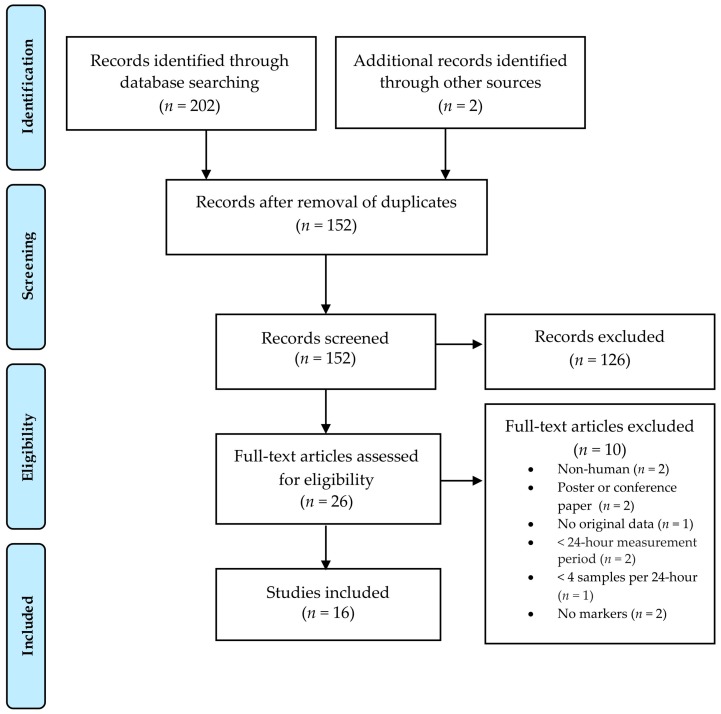
Figure 1
Figure 1
PRISMA flowchart of the study selection process.
Figure 2
Figure 2
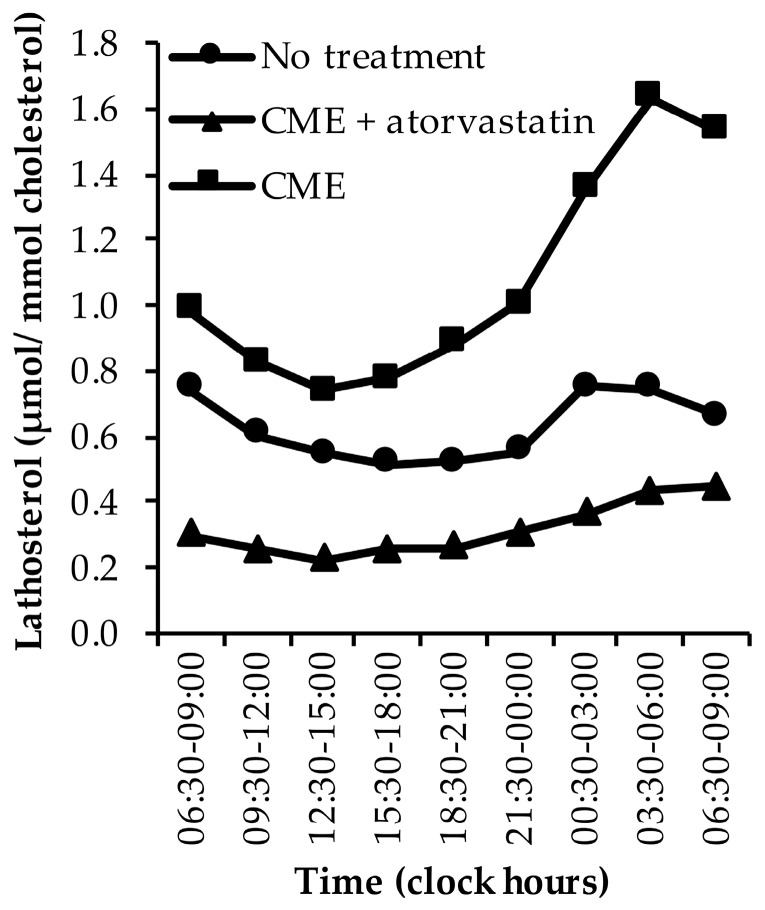
The diurnal rhythm of lathosterol levels in untreated subjects, in subjects treated with cholestyramine (CME) alone, and in subjects treated with CME plus atorvastatin [40,41,43]. Data are presented as medians.
Figure 3
Figure 3
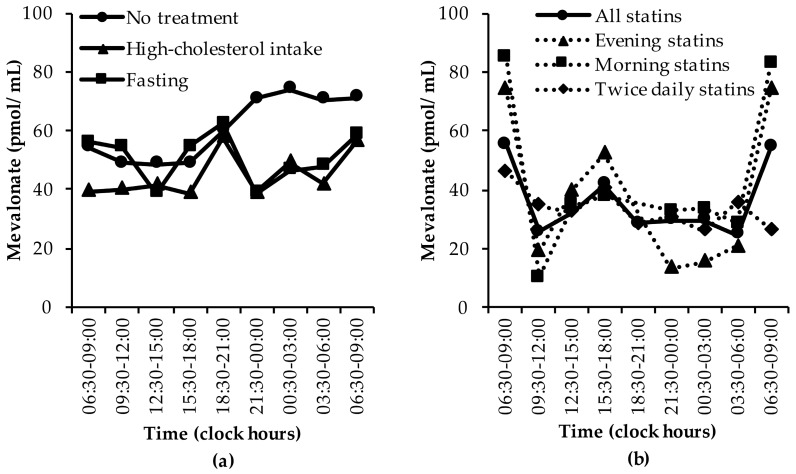
The diurnal rhythm of MVA concentrations: (a) in untreated subjects, in subjects who consumed high-cholesterol meals, and in subjects who fasted [28,30,31,33,34,35,37,38,39], and (b) in subjects who were treated with statins [37,38,39]. Data are presented as medians.
Figure 4
Figure 4
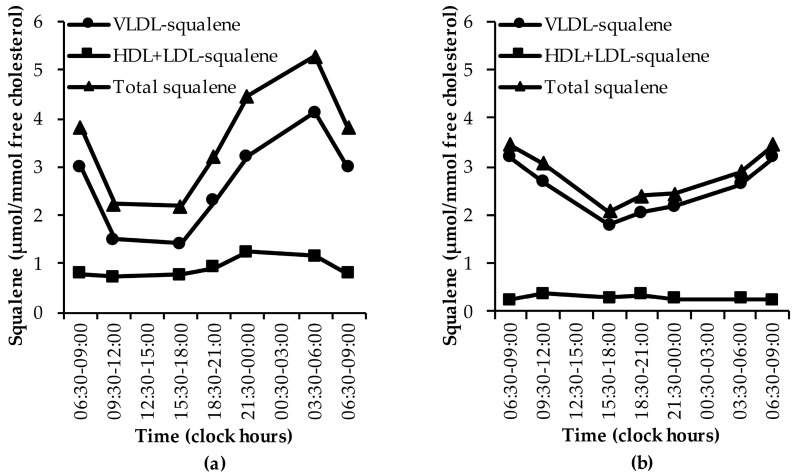
The diurnal rhythm of squalene levels: (a) in healthy subjects [29], and (b) in subjects with jejunoileal bypass and ileal exclusion [32]. Data are presented as medians.
Figure 5
Figure 5
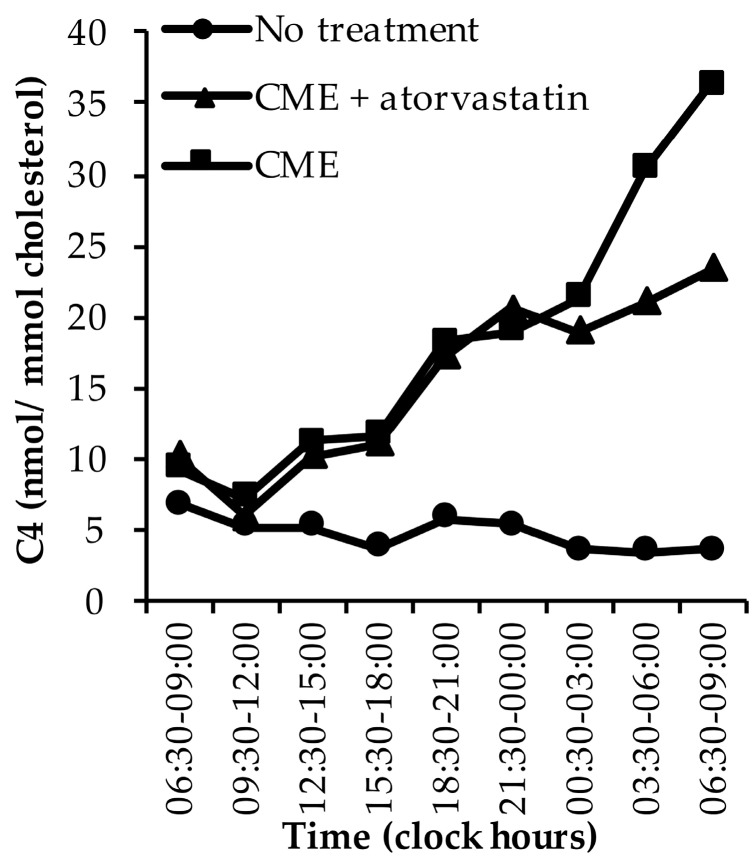
The diurnal rhythm of C4 levels in untreated subjects, in subjects treated with cholestyramine (CME) alone, and in subjects treated with CME plus atorvastatin [40,43]. Data are presented as medians.
Figure 6
Figure 6
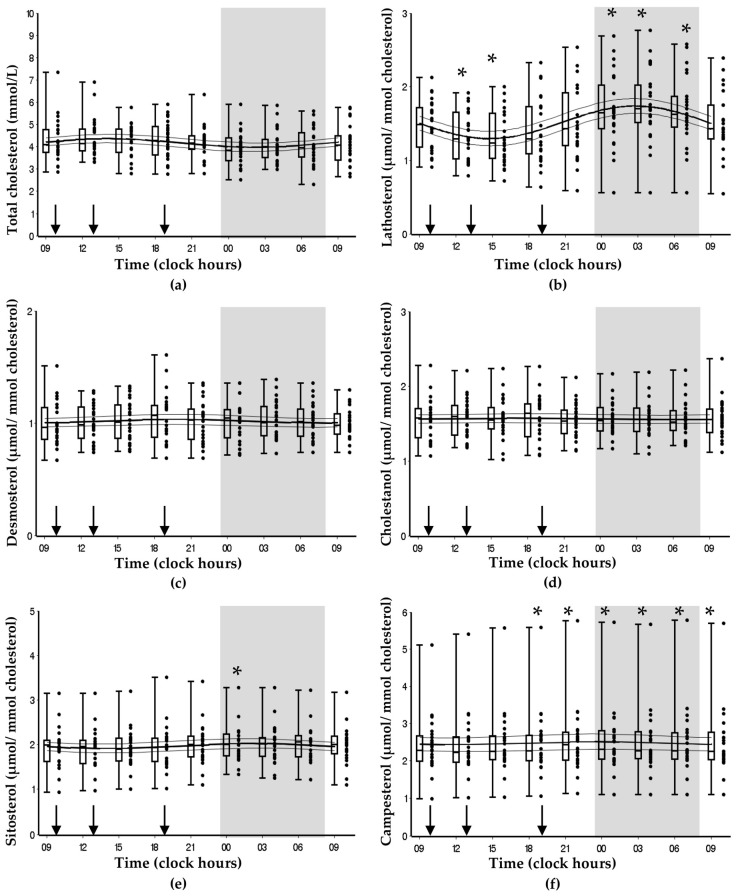
The diurnal rhythms of: (a) total cholesterol (cosinor p = 0.070), (b) lathosterol (cosinor p < 0.001), (c) desmosterol (cosinor p = 0.640), (d) cholestanol (cosinor p = 0.950), (e) sitosterol (cosinor p = 0.460), and (f) campesterol (cosinor p = 0.890) in healthy males (n = 24). Data are presented as cosinor curves with confidence bounds. The dots next to the boxplots indicate individual data points. The grey area indicates the sleeping period and the arrows indicate meal timing. * Indicates significant difference (p < 0.05) compared with 09:00 h on day 1 using Bonferroni post hoc tests following significant time-effects using a linear mixed model.

References

    1. Reppert S.M., Weaver D.R. Molecular analysis of mammalian circadian rhythms. Annu. Rev. Physiol. 2001;63:647–676. doi: 10.1146/annurev.physiol.63.1.647. - DOI - PubMed
    1. Poggiogalle E., Jamshed H., Peterson C.M. Circadian regulation of glucose, lipid, and energy metabolism in humans. Metabolism. 2018;84:11–27. doi: 10.1016/j.metabol.2017.11.017. - DOI - PMC - PubMed
    1. Szosland D. Shift work and metabolic syndrome, diabetes mellitus and ischaemic heart disease. Int. J. Occup. Med. Environ. Health. 2010;23:287–291. doi: 10.2478/v10001-010-0032-5. - DOI - PubMed
    1. Vyas M.V., Garg A.X., Iansavichus A.V., Costella J., Donner A., Laugsand L.E., Janszky I., Mrkobrada M., Parraga G., Hackam D.G. Shift work and vascular events: Systematic review and meta-analysis. BMJ. 2012;345:e4800. doi: 10.1136/bmj.e4800. - DOI - PMC - PubMed
    1. Morris C.J., Purvis T.E., Hu K., Scheer F.A. Circadian misalignment increases cardiovascular disease risk factors in humans. Proc. Natl. Acad. Sci. USA. 2016;113:E1402–E1411. doi: 10.1073/pnas.1516953113. - DOI - PMC - PubMed

Publication types