


Growth, Feeding Tolerance and Metabolism in Extreme Preterm Infants under an Exclusive Human Milk Diet
- PMID: 31248006
- PMCID: PMC6683272
- DOI: 10.3390/nu11071443
Growth, Feeding Tolerance and Metabolism in Extreme Preterm Infants under an Exclusive Human Milk Diet
Abstract
Background: For preterm infants, human milk (HM) has to be fortified to cover their enhanced nutritional requirements and establish adequate growth. Most HM fortifiers are based on bovine protein sources (BMF). An HM fortifier based on human protein sources (HMF) has become available in the last few years. The aim of this study is to investigate the impact of an HMF versus BMF on growth in extremely low birth weight (ELBW, <1000 g) infants.
Methods: This was a retrospective, controlled, multicenter cohort study in infants with a birthweight below 1000 g. The HMF group received an exclusive HM diet up to 32+0 weeks of gestation and was changed to BMF afterwards. The BMF group received HM+BMF from fortifier introduction up to 37+0 weeks.
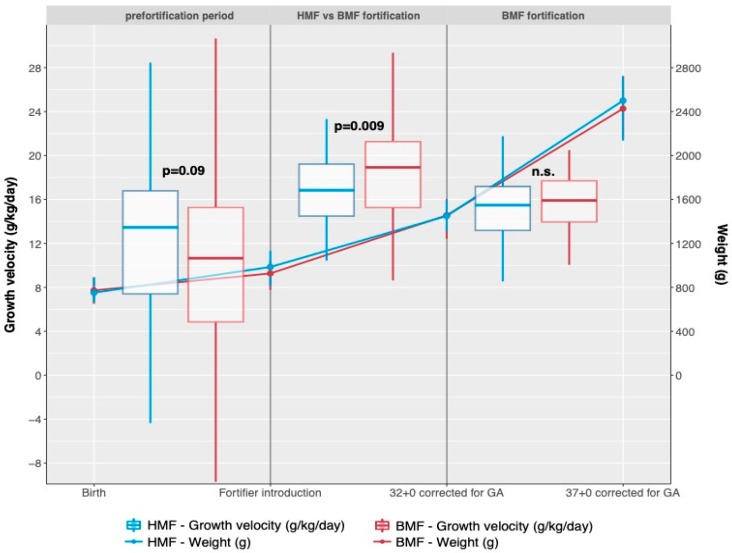
Results: 192 extremely low birth weight (ELBW)-infants were included (HMF n = 96, BMF n = 96) in the study. After the introduction of fortification, growth velocity up to 32+0 weeks was significantly lower in the HMF group (16.5 g/kg/day) in comparison to the BMF group (18.9 g/kg/day, p = 0.009) whereas all other growth parameters did not differ from birth up to 37+0 weeks. Necrotizing enterocolitis (NEC) incidence was 10% in the HMF and 8% in the BMF group.
Conclusion: Results from this study do not support the superiority of HFM over BMF in ELBW infants.
Keywords: ELBW-infants; exclusive human milk diet; feeding tolerance; fortification of human milk; growth velocity.
Conflict of interest statement
The authors declare no conflict of interest.
Figures

References
-
- Agostoni C., Buonocore G., Carnielli V.P., De Curtis M., Darmaun D., Decsi T., Domellöf M., Embleton N.D., Fusch C., Genzel-Boroviczeny O., et al. Enteral nutrient supply for preterm infants: Commentary from the European Society of Paediatric Gastroenterology, Hepatology and Nutrition Committee on Nutrition. J. Pediatr. Gastroenterol. Nutr. 2010;50:85–91. doi: 10.1097/MPG.0b013e3181adaee0. - DOI - PubMed
-
- Horbar J.D., Ehrenkranz R.A., Badger G.J., Edwards E.M., Morrow K.A., Soll R.F., Buzas J.S., Bertino E., Gagliardi L., Bellù R., et al. Weight Growth Velocity and Postnatal Growth Failure in Infants 501 to 1500 Grams: 2000–2013. Pediatrics. 2015;136:e84–e92. doi: 10.1542/peds.2015-0129. - DOI - PubMed
-
- Nutrition AAoPCo Nutritional needs of Low-Birth-Weight Infants. Pediatrics. 1977;60:519–530. - PubMed
-
- Nutrition AAoPCo Nutritional Needs of Low-Birth-Weight Infants. Pediatrics. 1985;75:976–986. - PubMed
Publication types
MeSH terms
LinkOut - more resources
Full Text Sources
Medical
