Review
. 2019 Jun 26;20(13):3131.
doi: 10.3390/ijms20133131.

Death-Associated Protein Kinase 1 Phosphorylation in Neuronal Cell Death and Neurodegenerative Disease

Affiliations
Review

Death-Associated Protein Kinase 1 Phosphorylation in Neuronal Cell Death and Neurodegenerative Disease

Nami Kim et al. Int J Mol Sci. .

Abstract

Regulated neuronal cell death plays an essential role in biological processes in normal physiology, including the development of the nervous system. However, the deregulation of neuronal apoptosis by various factors leads to neurodegenerative diseases such as ischemic stroke and Alzheimer's disease (AD). Death-associated protein kinase 1 (DAPK1) is a calcium/calmodulin (Ca2+/CaM)-dependent serine/threonine (Ser/Thr) protein kinase that activates death signaling and regulates apoptotic neuronal cell death. Although DAPK1 is tightly regulated under physiological conditions, DAPK1 deregulation in the brain contributes to the development of neurological disorders. In this review, we describe the molecular mechanisms of DAPK1 regulation in neurons under various stresses. We also discuss the role of DAPK1 signaling in the phosphorylation-dependent and phosphorylation-independent regulation of its downstream targets in neuronal cell death. Moreover, we focus on the major impact of DAPK1 deregulation on the progression of neurodegenerative diseases and the development of drugs targeting DAPK1 for the treatment of diseases. Therefore, this review summarizes the DAPK1 phosphorylation signaling pathways in various neurodegenerative diseases.

Keywords: Alzheimer’s disease (AD); death-associated protein kinase 1 (DAPK1); ischemic stroke; neuronal cell death; phosphorylation.


Conflict of interest statement

Xiao Zhen Zhou is an inventor of conformation-specific antibody technology, which was licensed by Beth Israel Deaconess Medical Center (BIDMC) to Pinteon Therapeutics. Dr Zhou owns equity in, and consult for, Pinteon. Her interests were reviewed and managed by BIDMC in accordance with its conflict of interest policy.

Figures
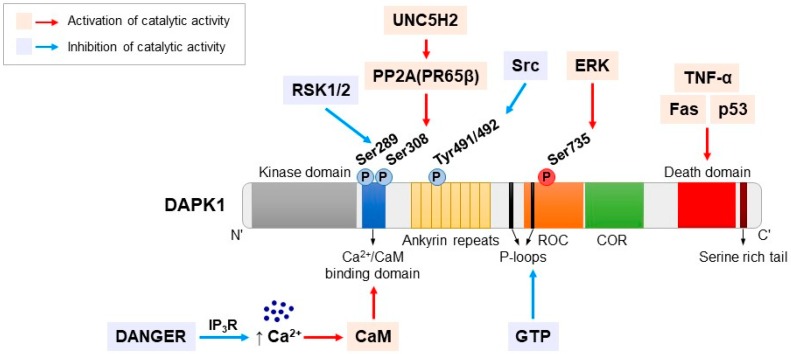
Figure 1
Figure 1
Schematic diagram of the structure of DAPK1. There are diverse molecules involved in the regulation of DAPK1 activity in neuronal cell death. The molecular mechanisms and function of DAPK1 can be regulated by multiple signals in variety of phosphorylation sites. DAPK1 activity is negatively regulated by its phosphorylation at Ser308 as well as Ser289 in the CaM autoregulatory domain and Tyr491 and Tyr492 in the ankyrin repeat domain (blue arrows). Moreover, the phosphorylation of Ser735 in the ROC-COR domain induces the catalytic activity of DAPK1 (red arrow). Furthermore, several interacting partners modify DAPK1 catalytic activity, protein-protein interactions, and pro-apoptotic activity. Phosphorylation sites in blue are negatively regulating and the one in red is activating DAPK1 activity.
Figure 2
Figure 2
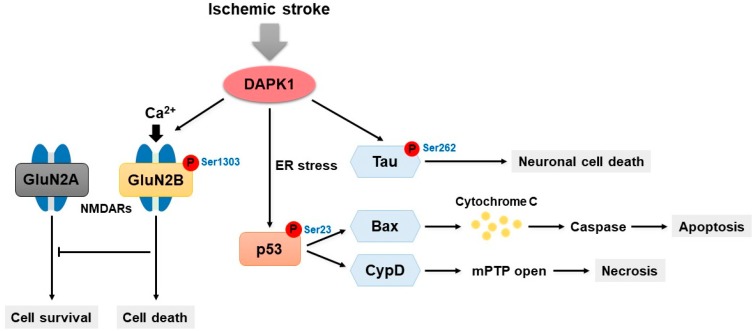
Signal transduction of DAPK1 in ischemic stroke. DAPK1 induces neuronal cell death by multiple signaling mechanisms upon ischemic stroke. Activated DAPK1 directly interacts with NMDA receptor GluN2B and phosphorylates it at Ser1303, thereby increasing neuronal cell death by enhancing Ca2+ influx. Upon ER stress, death domain of DAPK1 binds to the p53 DNA binding motif, followed by phosphorylation of p53 at Ser23. The interaction between DAPK1 and p53 activates both apoptotic and necrotic signaling pathways by death-related genes such as Bax and CypD through transcriptional- and mitochondrial-dependent mechanisms. Moreover, DAPK1 directly phosphorylates tau at Ser262 resulting in accumulation in the dendritic spines, which promotes neuronal cell death. mPTP, mitochondrial permeability transition pore.
Figure 3
Figure 3
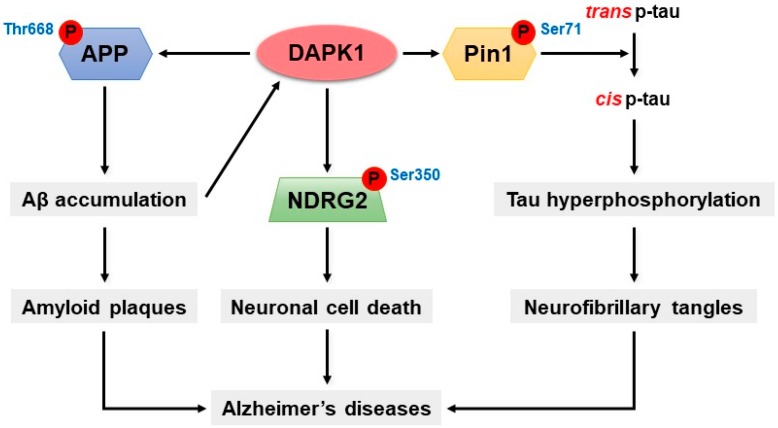
The molecular mechanism of DAPK1 in AD. The activation of DAPK1 triggers the phosphorylation of APP at Thr668, shifting APP processing toward the amyloidogenic pathway and Aβ production. Moreover, DAPK1 considerably inactivates Pin1 activity through its phosphorylation at Ser71. The inactivation of Pin1 increases cis p-tau and induces the hyperphosphorylation of tau. Furthermore, DAPK1 regulates NDRG2 phosphorylation at Ser350, which may lead to AD through significant cell death.

References

    1. Chi H., Chang H.Y., Sang T.K. Neuronal cell death mechanisms in major neurodegenerative diseases. Int. J. Mol. Sci. 2018;19:3082. doi: 10.3390/ijms19103082. - DOI - PMC - PubMed
    1. Fricker M., Tolkovsky A.M., Borutaite V., Coleman M., Brown G.C. Neuronal cell death. Physiol. Rev. 2018;98:813–880. doi: 10.1152/physrev.00011.2017. - DOI - PMC - PubMed
    1. Deribe Y.L., Pawson T., Dikic I. Post-translational modifications in signal integration. Nat. Struct. Mol. Biol. 2010;17:666–672. doi: 10.1038/nsmb.1842. - DOI - PubMed
    1. Wang Y.C., Peterson S.E., Loring J.F. Protein post-translational modifications and regulation of pluripotency in human stem cells. Cell Res. 2014;24:143–160. doi: 10.1038/cr.2013.151. - DOI - PMC - PubMed
    1. Niemi N.M., MacKeigan J.P. Mitochondrial phosphorylation in apoptosis: Flipping the death switch. Antioxid Redox Signal. 2013;19:572–582. doi: 10.1089/ars.2012.4982. - DOI - PMC - PubMed

MeSH terms