


Cardiovascular Health, Adiposity, and Food Insecurity in an Underserved Population
- PMID: 31248113
- PMCID: PMC6628173
- DOI: 10.3390/nu11061376
Cardiovascular Health, Adiposity, and Food Insecurity in an Underserved Population
Abstract
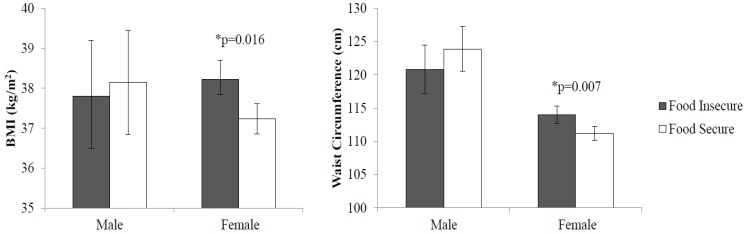
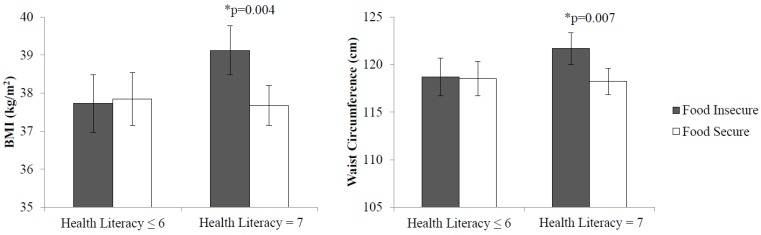
This study investigated associations between cardiovascular health (CVH), adiposity, and food insecurity by race, sex, and health literacy in a sample of 800 underserved patients with obesity (body mass index [BMI] ≥ 30 kg/m2). CVH was assessed using American Heart Association Life's Simple 7 (LS7) and adiposity was estimated using BMI and waist circumference (WC). Mixed models including interaction terms between food insecurity and sex, race, and health literacy were analyzed for LS7, BMI, and WC. Stratified models were analyzed as indicated by significant interactions. Mean BMI and WC were 37.3 kg/m2 (4.6 SD) and 113.5 cm (12.4 SD), respectively. Among patients, 31% were food insecure and 31% had low health literacy. There were significant positive associations between food insecurity and BMI (p = 0.03) and WC (p = 0.03) in the overall sample. In sex-stratified models, women who were food insecure had higher BMI (p = 0.02) and WC (p = 0.007) than their food secure counterparts. Further, food insecure patients with better health literacy had greater BMI (p = 0.004) and WC (p = 0.007) than their food secure counterparts. Results suggest that adiposity is a greater burden in food insecure patients, which may be an important consideration for obesity treatment in underserved populations.
Keywords: adiposity; cardiovascular health; food insecurity; health literacy; underserved population.
Conflict of interest statement
The authors declare no conflicts of interest.
Figures
References
-
- Murphy S.L., Xu J., Kochanek K.D., Arias E. Mortality in the United States, 2017. National Center for Health Statistics; Hyattsville, MD, USA: 2018.
Publication types
MeSH terms
Grants and funding
LinkOut - more resources
Full Text Sources
Medical
