


Plasticizer Interaction With the Heart: Chemicals Used in Plastic Medical Devices Can Interfere With Cardiac Electrophysiology
- PMID: 31248280
- PMCID: PMC6693678
- DOI: 10.1161/CIRCEP.119.007294
Plasticizer Interaction With the Heart: Chemicals Used in Plastic Medical Devices Can Interfere With Cardiac Electrophysiology
Abstract
Background: Phthalates are used as plasticizers in the manufacturing of flexible, plastic medical products. Patients can be subjected to high phthalate exposure through contact with plastic medical devices. We aimed to investigate the cardiac safety and biocompatibility of mono-2-ethylhexyl phthalate (MEHP), a phthalate with documented exposure in intensive care patients.
Methods: Optical mapping of transmembrane voltage and pacing studies were performed on isolated, Langendorff-perfused rat hearts to assess cardiac electrophysiology after MEHP exposure compared with controls. MEHP dose was chosen based on reported blood concentrations after an exchange transfusion procedure.
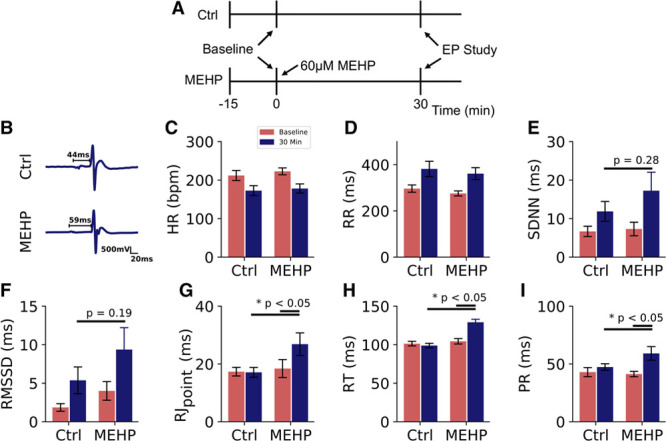
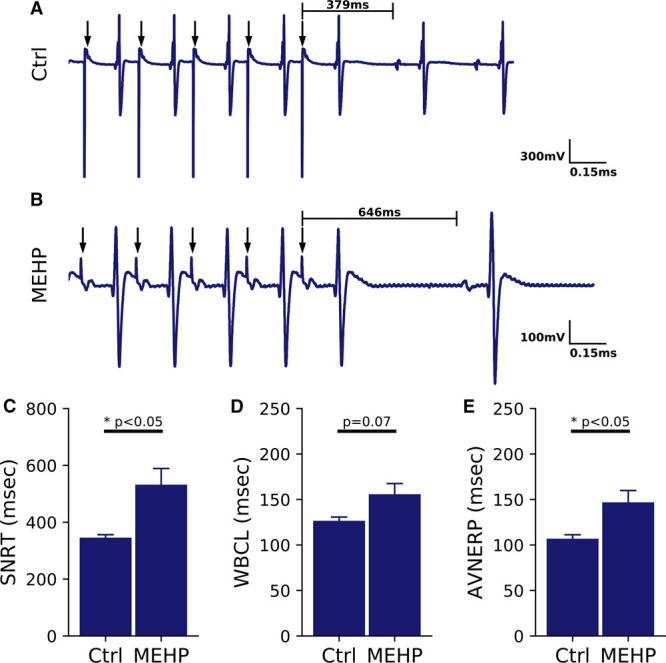
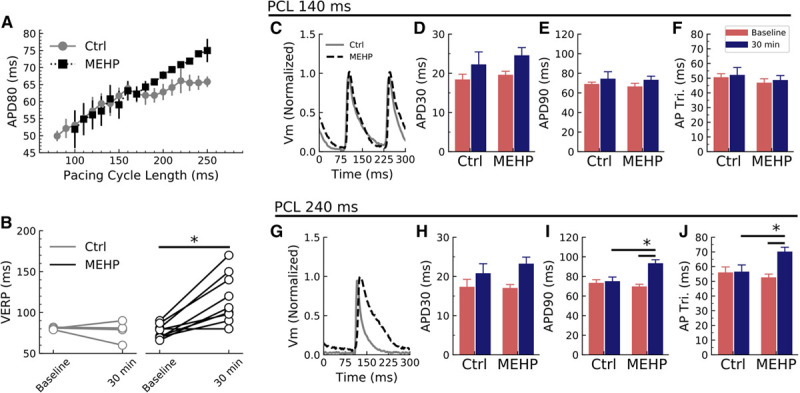
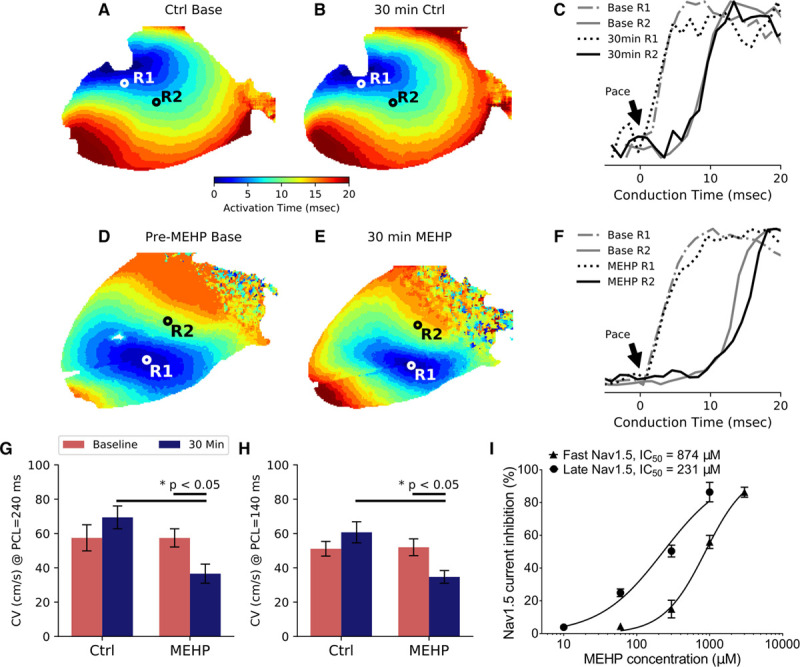
Results: Thirty-minute exposure to MEHP increased the atrioventricular node (147 versus 107 ms) and ventricular (117 versus 77.5 ms) effective refractory periods, compared with controls. Optical mapping revealed prolonged action potential duration at slower pacing cycle lengths, akin to reverse use dependence. The plateau phase of the action potential duration restitution curve steepened and became monophasic in MEHP-exposed hearts (0.18 versus 0.06 slope). Action potential duration lengthening occurred during late-phase repolarization resulting in triangulation (70.3 versus 56.6 ms). MEHP exposure also slowed epicardial conduction velocity (35 versus 60 cm/s), which may be partly explained by inhibition of Nav1.5 (874 and 231 µmol/L half-maximal inhibitory concentration, fast and late sodium current).
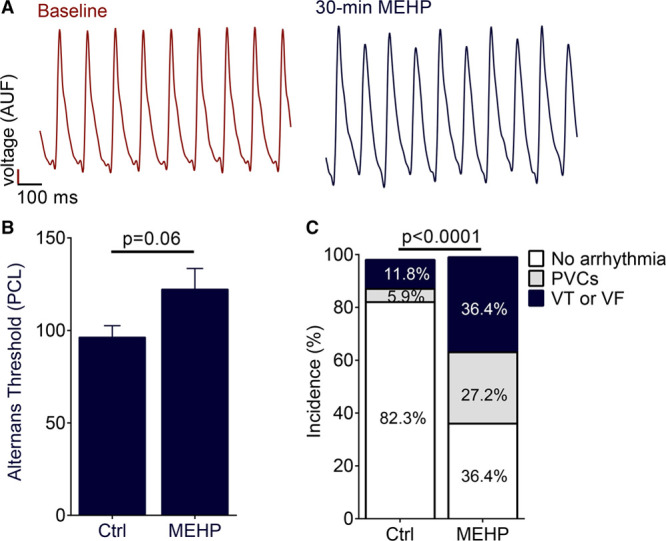
Conclusions: This study highlights the impact of acute MEHP exposure, using a clinically relevant dose, on cardiac electrophysiology in the intact heart. Heightened clinical exposure to plasticized medical products may have cardiac safety implications-given that action potential triangulation and electrical restitution modifications are a risk factor for early after depolarizations and cardiac arrhythmias.
Keywords: action potentials; electrophysiology; heart; plasticizer; plastics.
Figures
Comment in
-
Shocking Aspects of Nonconductive Plastics: Electrophysiologic Implications of Plasticizers.Circ Arrhythm Electrophysiol. 2019 Jul;12(7):e007522. doi: 10.1161/CIRCEP.119.007522. Epub 2019 Jun 28. Circ Arrhythm Electrophysiol. 2019. PMID: 31248278 No abstract available.
References
-
- Luban N, Rais-Bahrami K, Short B. I want to say one word to you–just one word–“plastics”. Transfusion. 2006;46:503–506. doi: 10.1111/j.1537-2995.2006.00766.x. - PubMed
-
- van der Meer PF, Reesink HW, Panzer S, Wong J, Ismay S, Keller A, Pink J, Buchta C, Compernolle V, Wendel S, Biagini S, Scuracchio P, Thibault L, Germain M, Georgsen J, Bégué S, Dernis D, Raspollini E, Villa S, Rebulla P, Takanashi M, de Korte D, Lozano M, Cid J, Gulliksson H, Cardigan R, Tooke C, Fung MK, Luban NL, Vassallo R, Benjamin R. Should DEHP be eliminated in blood bags? Vox Sang. 2014;106:176–195. doi: 10.1111/vox.12099. - PubMed
-
- FDA. Safety Assessment of Di(2-ethylhexyl)phthalate (DEHP) Released from PVC Medical Devices [Internet]. https://noharm-uscanada.org/sites/default/files/documents-files/116/Safe....
-
- Loff S, Kabs F, Witt K, Sartoris J, Mandl B, Niessen KH, Waag KL. Polyvinylchloride infusion lines expose infants to large amounts of toxic plasticizers. J Pediatr Surg. 2000;35:1775–1781. doi: 10.1053/jpsu.2000.19249. - PubMed
Publication types
MeSH terms
Substances
Grants and funding
LinkOut - more resources
Full Text Sources
Medical
