. 2019 Jul 2;8(13):e011366.
doi: 10.1161/JAHA.118.011366. Epub 2019 Jun 28.

Elevated Mitral Valve Pressure Gradient Is Predictive of Long-Term Outcome After Percutaneous Edge-to-Edge Mitral Valve Repair in Patients With Degenerative Mitral Regurgitation ( MR ), But Not in Functional MR

Affiliations

Elevated Mitral Valve Pressure Gradient Is Predictive of Long-Term Outcome After Percutaneous Edge-to-Edge Mitral Valve Repair in Patients With Degenerative Mitral Regurgitation ( MR ), But Not in Functional MR

Johannes Patzelt et al. J Am Heart Assoc. .

Abstract

Background This study analyzed the effects on long-term outcome of residual mitral regurgitation ( MR ) and mean mitral valve pressure gradient ( MVPG ) after percutaneous edge-to-edge mitral valve repair using the MitraClip system. Methods and Results Two hundred fifty-five patients who underwent percutaneous edge-to-edge mitral valve repair were analyzed. Kaplan-Meier and Cox regression analyses were performed to evaluate the impact of residual MR and MVPG on clinical outcome. A combined clinical end point (all-cause mortality, MV surgery, redo procedure, implantation of a left ventricular assist device) was used. After percutaneous edge-to-edge mitral valve repair, mean MVPG increased from 1.6±1.0 to 3.1±1.5 mm Hg ( P<0.001). Reduction of MR severity to ≤2+ postintervention was achieved in 98.4% of all patients. In the overall patient cohort, residual MR was predictive of the combined end point while elevated MVPG >4.4 mm Hg was not according to Kaplan-Meier and Cox regression analyses. We then analyzed the cohort with degenerative and that with functional MR separately to account for these different entities. In the cohort with degenerative MR , elevated MVPG was associated with increased occurrence of the primary end point, whereas this was not observed in the cohort with functional MR . Conclusions MVPG >4.4 mm Hg after MitraClip implantation was predictive of clinical outcome in the patient cohort with degenerative MR . In the patient cohort with functional MR , MVPG >4.4 mm Hg was not associated with increased clinical events.

Keywords: mitral stenosis; mitral valve; mitral valve regurgitation; percutaneous mitral valve repair; percutaneous treatment.


Figures
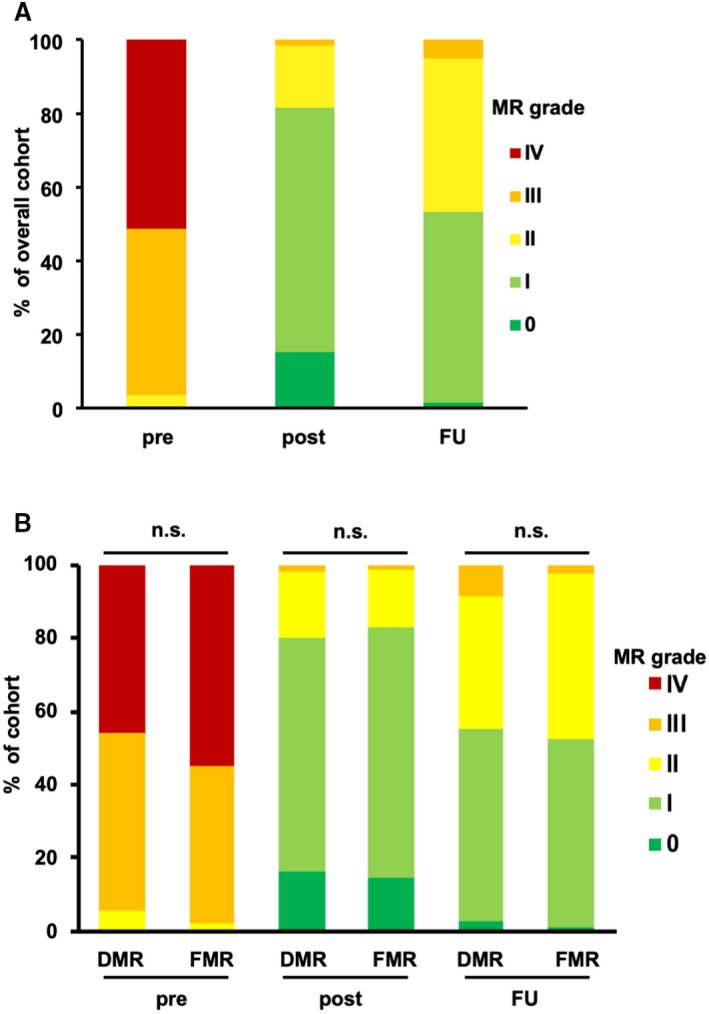
Figure 1
Figure 1
MR in the patient cohort. A, Columns indicate the fraction of different MR grades pre‐ and postintervention and at the follow‐up visit after 7.8±4.8 months. B, Columns indicate the fraction of different MR grades in the cohort of patients with DMR and FMR. There were no significant differences between the DMR and FMR cohorts with respect to grades of baseline MR (P=0.17), MR postintervention (P=0.75), or MR at follow‐up (P=0.34). DMR indicates degenerative mitral regurgitation; FMR, functional mitral regurgitation; FU, follow‐up; MR, mitral regurgitation; n.s., not significant; post, postintervention; pre, preintervention.
Figure 2
Figure 2
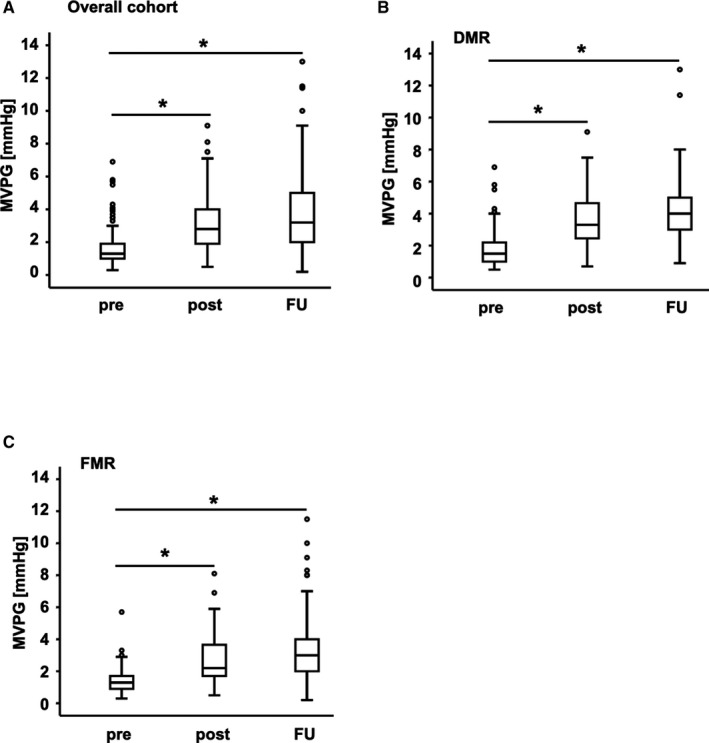
Changes in MVPG. MVPG pre‐ and postintervention and at FU. The boxes represent the 25% to 75% interquartile values for all measurements. The cross‐line marks the median of the measurements (50% quartile). The whiskers mark the smallest and largest measurements. The circles represent outliers. A, Overall cohort: MVPG increased significantly (from 1.6±1.0 mm Hg preintervention to 3.1±1.5 postintervention and to 3.8±2.1 mm Hg at FU; P<0.001). B, DMR cohort: MVPG increased from 1.8±1.2 mm Hg pre to 3.6±1.6 mm Hg post (P<0.001) and to 4.3±2.1 mm Hg at FU (P<0.001). C, FMR cohort: MVPG increased from 1.4±0.7 mm Hg pre to 2.8±1.4 mm Hg post (P<0.001) and to 3.5±2.1 mm Hg at FU (P<0.001). DMR indicates degenerative mitral regurgitation; FMR, functional mitral regurgitation; FU, follow‐up; MVPG, mitral valve pressure gradient; post, postintervention; pre, preintervention. *P<0.001.
Figure 3
Figure 3
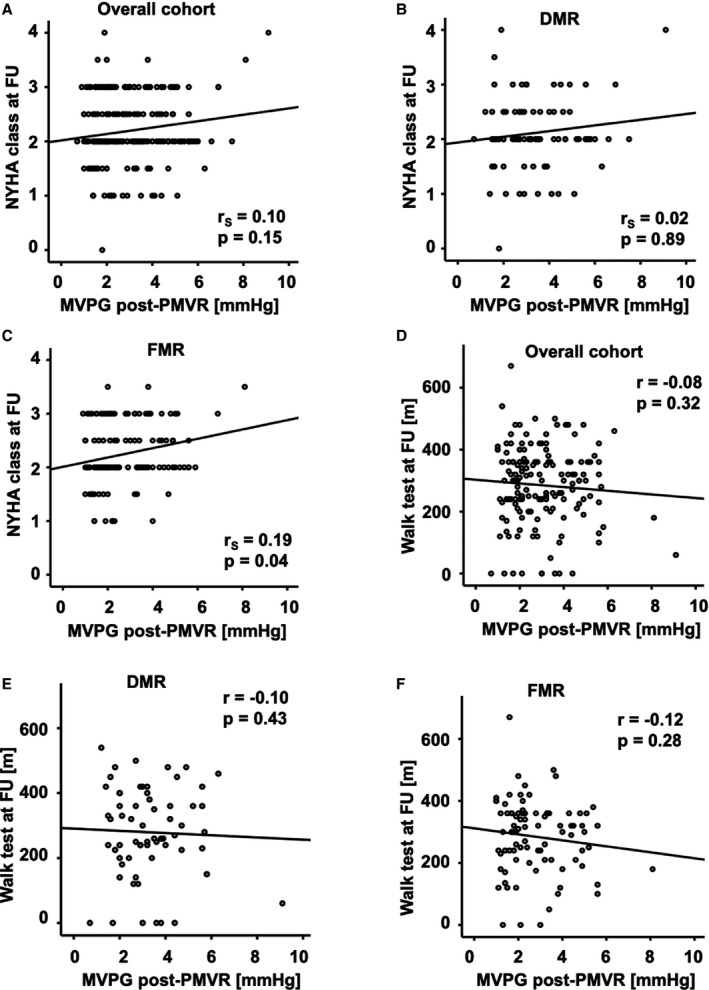
Scatter plots for correlational analysis of the association of MVPG post‐PMVR with clinical follow‐up data. A, Overall cohort: No significant correlation was observed between the MVPG postintervention and the NYHA functional class at FU (r S=0.10; P=0.15). B, DMR cohort: No significant correlation was observed between the MVPG postintervention and the NYHA functional class at FU (r S=0.02; P=0.89). C, FMR cohort: A significant correlation was observed between the MVPG postintervention and the NYHA functional class at FU (r S=0.19; P=0.04). D, Overall cohort: No significant correlation was observed between the MVPG postintervention and the walking distance in the 6 MWT at FU (r=−0.08; P=0.32). E, DMR cohort: No significant correlation was observed between the MVPG postintervention and the walking distance in the 6 MWT at FU (r=−0.10; P=0.43). F, FMR cohort: No significant correlation was observed between the MVPG postintervention and the walking distance in the 6 MWT at FU (r=−0.12; P=0.28). DMR indicates degenerative mitral regurgitation; FMR, functional mitral regurgitation; FU, follow‐up; MVPG, mitral valve pressure gradient; 6 MWT, 6‐minute walk test; NYHA, New York Heart Association; PMVR, percutaneous mitral valve repair.
Figure 4
Figure 4
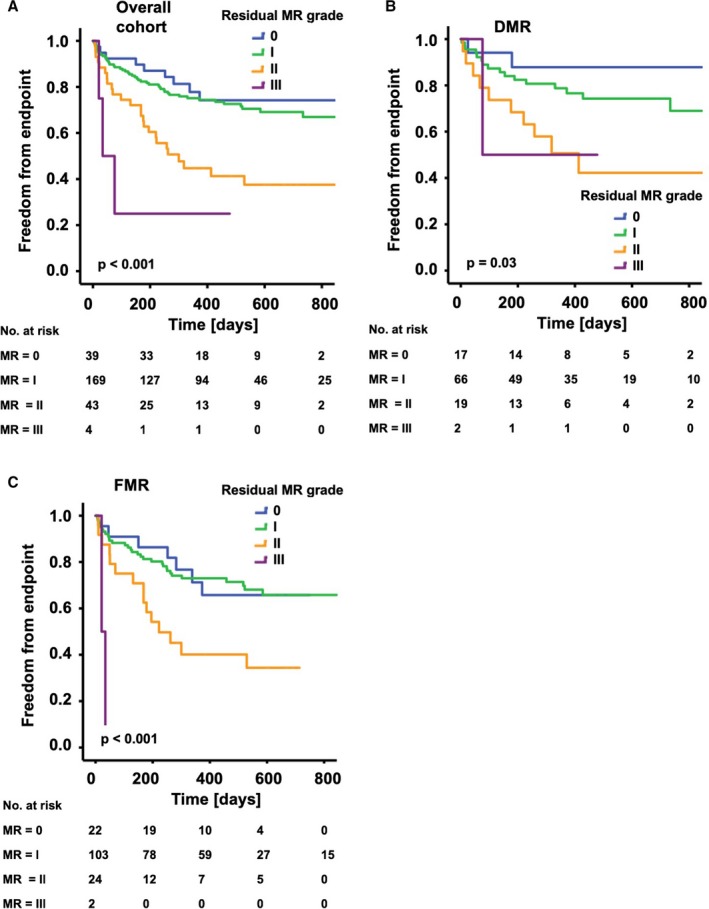
Kaplan–Meier analysis of the long‐term outcomes after PMVR according to residual MR. The graphs show freedom from the combined end point (all‐cause mortality, MV surgery, redo procedure, implantation of a LVAD) over time for patients with different grades of residual MR. A, Overall cohort: With increases in the grade of residual MR, freedom from the combined end point was significantly reduced (P<0.001). B, DMR cohort: With increases in the grade of residual MR, freedom from the combined end point was significantly reduced (P=0.03). C, FMR cohort: With increases in the grade of residual MR, freedom from the combined end point was significantly reduced (P<0.001). DMR indicates degenerative mitral regurgitation; FMR, functional mitral regurgitation; LVAD, left ventricular assist device; MR, mitral regurgitation; MV, mitral valve; PMVR, percutaneous mitral valve repair.
Figure 5
Figure 5
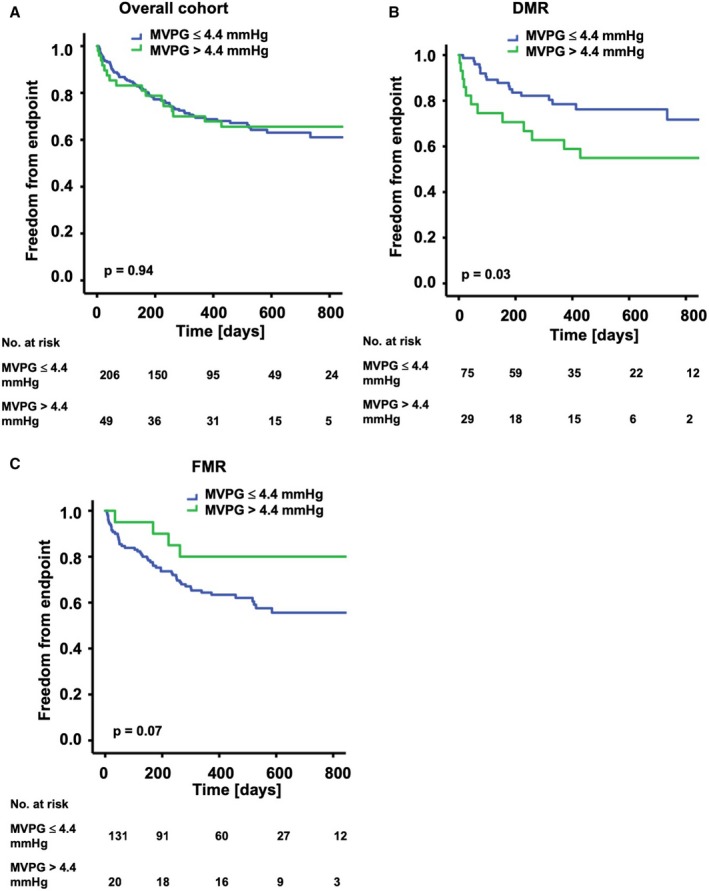
Kaplan–Meier analysis of the long‐term outcomes after PMVR according to the MVPG postintervention. The graphs show freedom from the combined end point (all‐cause mortality, MV surgery, redo procedure, implantation of a LVAD) over time for patients with MVPG >4.4 and ≤4.4 mm Hg postintervention. A, Overall cohort: No significant difference was detected between the groups (P=0.94).B, DMR cohort: A significant difference was detected between the groups (P=0.03). C, FMR cohort: No significant difference was detected between the groups (P=0.07). DMR indicates degenerative mitral regurgitation; FMR, functional mitral regurgitation; LVAD, left ventricular assist device; MV, mitral valve; MVPG, mitral valve pressure gradient; PMVR, percutaneous mitral valve repair.

References

    1. Feldman T, Kar S, Elmariah S, Smart SC, Trento A, Siegel RJ, Apruzzese P, Fail P, Rinaldi MJ, Smalling RW, Hermiller JB, Heimansohn D, Gray WA, Grayburn PA, Mack MJ, Lim DS, Ailawadi G, Herrmann HC, Acker MA, Silvestry FE, Foster E, Wang A, Glower DD, Mauri L; EVEREST II Investigators . Randomized comparison of percutaneous repair and surgery for mitral regurgitation: 5‐year results of EVEREST II. J Am Coll Cardiol. 2015;66:2844–2854. - PubMed
    1. Nickenig G, Estevez‐Loureiro R, Franzen O, Tamburino C, Vanderheyden M, Luscher TF, Moat N, Price S, Dall'Ara G, Winter R, Corti R, Grasso C, Snow TM, Jeger R, Blankenberg S, Settergren M, Tiroch K, Balzer J, Petronio AS, Buttner HJ, Ettori F, Sievert H, Fiorino MG, Claeys M, Ussia GP, Baumgartner H, Scandura S, Alamgir F, Keshavarzi F, Colombo A, Maisano F, Ebelt H, Aruta P, Lubos E, Plicht B, Schueler R, Pighi M, Di Mario C; Transcatheter Valve Treatment Sentinel Registry Investigators of the EURObservational Research Programme of the European Society of Cardiology . Percutaneous mitral valve edge‐to‐edge repair: in‐hospital results and 1‐year follow‐up of 628 patients of the 2011–2012 Pilot European Sentinel Registry. J Am Coll Cardiol. 2014;64:875–884. - PubMed
    1. Nishimura RA, Vahanian A, Eleid MF, Mack MJ. Mitral valve disease—current management and future challenges. Lancet. 2016;387:1324–1334. - PubMed
    1. Rudolph V, Huntgeburth M, von Bardeleben RS, Boekstegers P, Lubos E, Schillinger W, Ouarrak T, Eggebrecht H, Butter C, Plicht B, May A, Franzen O, Schofer J, Senges J, Baldus S. Clinical outcome of critically ill, not fully recompensated, patients undergoing MitraClip therapy. Eur J Heart Fail. 2014;16:1223–1229. - PubMed
    1. Stone GW, Lindenfeld J, Abraham WT, Kar S, Lim DS, Mishell JM, Whisenant B, Grayburn PA, Rinaldi M, Kapadia SR, Rajagopal V, Sarembock IJ, Brieke A, Marx SO, Cohen DJ, Weissman NJ, Mack MJ; Investigators C . Transcatheter mitral‐valve repair in patients with heart failure. N Engl J Med. 2018;379:2307–2318. - PubMed

Publication types

MeSH terms

LinkOut - more resources