. 2019 Jun 27;16(1):129.
doi: 10.1186/s12974-019-1528-y.

Altered gut microbiota and inflammatory cytokine responses in patients with Parkinson's disease

Affiliations

Altered gut microbiota and inflammatory cytokine responses in patients with Parkinson's disease

Chin-Hsien Lin et al. J Neuroinflammation. .

Abstract

Objective: Emerging evidence suggests that gut microbiome composition alterations affect neurodegeneration through neuroinflammation in the pathogenesis of Parkinson's disease (PD). Here, we evaluate gut microbiota alterations and host cytokine responses in a population of Taiwanese patients with PD.

Methods: Fecal microbiota communities from 80 patients with PD and 77 age and gender-matched controls were assessed by sequencing the V3-V4 region of the 16S ribosomal RNA gene. Diet and comorbidities were controlled in the analyses. Plasma concentrations of IL-1β, IL-2, IL-4, IL-6, IL-13, IL-18, GM-CSF, IFNγ, and TNFα were measured by a multiplex immunoassay and relationships between microbiota, clinical characteristics, and cytokine levels were analyzed in the PD group. We further examined the cytokine changes associated with the altered gut microbiota seen in patients with PD in another independent cohort of 120 PD patients and 120 controls.

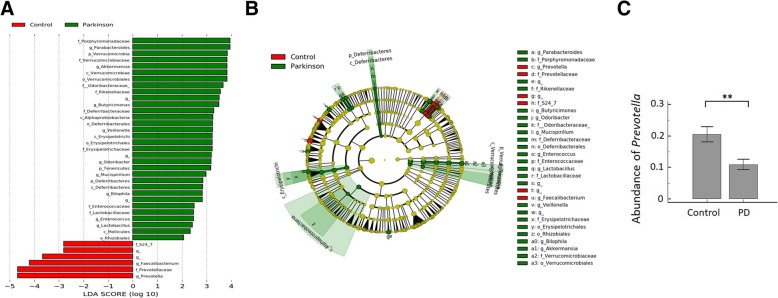
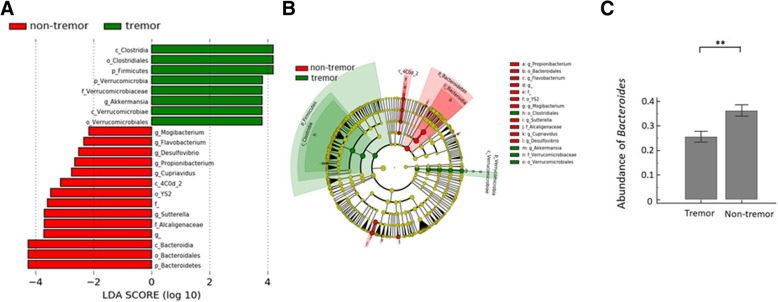
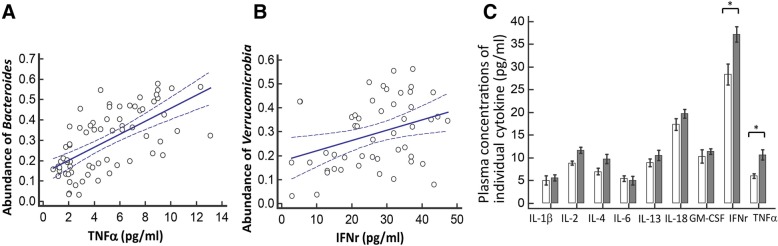
Results: Microbiota from patients with PD was altered relative to controls and dominated by Verrucomicrobia, Mucispirillum, Porphyromonas, Lactobacillus, and Parabacteroides. In contrast, Prevotella was more abundant in controls. The abundances of Bacteroides were more increased in patients with non-tremor PD subtype than patients with tremor subtype. Bacteroides abundance was correlated with motor symptom severity defined by UPDRS part III motor scores (rho = 0.637 [95% confidence interval 0.474 to 0.758], P < 0.01). Altered microbiota was correlated with plasma concentrations of IFNγ and TNFα. There was a correlation between Bacteroides and plasma level of TNFα (rho = 0.638 [95% CI: 0.102-0.887], P = 0.02); and a correlation between Verrucomicrobia abundance and plasma concentrations of IFNγ (rho = 0.545 [95% CI - 0.043-0.852], P = 0.05). The elevated plasma cytokine responses were confirmed in an additional independent 120 patients with PD and 120 controls (TNFα: PD vs. control 8.51 ± 4.63 pg/ml vs. 4.82 ± 2.23 pg/ml, P < 0.01; and IFNγ: PD vs. control: 38.45 ± 7.12 pg/ml vs. 32.79 ± 8.03 pg/ml, P = 0.03).

Conclusions: This study reveals altered gut microbiota in PD and its correlation with clinical phenotypes and severity in our population. The altered plasma cytokine profiles associated with gut microbiome composition alterations suggest aberrant immune responses may contribute to inflammatory processes in PD.

Keywords: Cytokines; Dysbiosis; Gut microbiome; Neuroinflammation; Parkinson’s disease.


Conflict of interest statement

All authors declare that they have no competing interests.

Figures
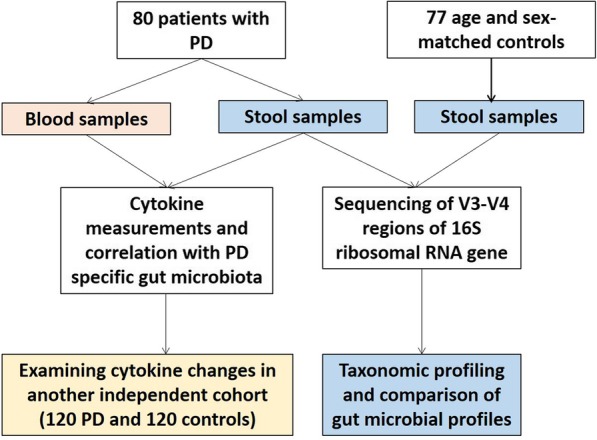
Fig. 1
Fig. 1
Flow chart and enrolled participants in the current study
Fig. 2
Fig. 2
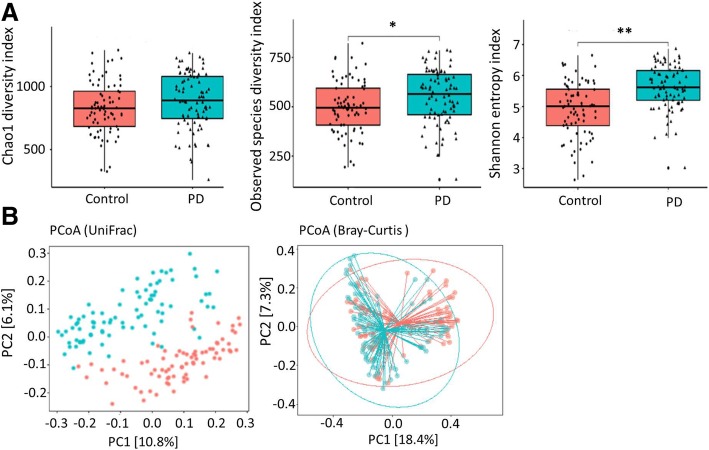
The α-diversity and β-diversity indices of the fecal microbiome in the PD and control groups. a Box plots depict differences in the fecal microbiome diversity indices between the PD and control groups according to the Chao 1 index, observed species index, and Shannon index based on OTU counts. Each box plot represents the median, interquartile range, minimum, and maximum values. OUT: operational taxonomic units (b) PCoA plots of bacterial β-diversity based on the weighted UniFrac distance (left panel) and Bray-Curtis dissimilarity (right panel) analyzed according to health status. Patients with PD and age-matched controls are colored in blue and red, respectively
Fig. 3
Fig. 3
Taxonomic differences of fecal microbiota in PD and control groups. a Linear discriminant analysis (LDA) effect size (LEfSe) analysis revealed significant bacterial differences in fecal microbiota between the PD (positive score) and control groups (negative score). LDA scores (log10) > 2 and P < 0.05 are shown. b Cladogram using the LEfSe method indicating the phylogenetic distribution of fecal microbiota associated with PD and control participants. c The relative abundance of Prevotella was significantly higher in the control group than in patients with PD. **P < 0.01
Fig. 4
Fig. 4
Taxonomic differences of fecal microbiota in tremor and non-tremor subtypes. a Linear discriminant analysis (LDA) effect size (LEfSe) analysis revealed significant bacterial differences in fecal microbiota between the tremor (positive score) and non-tremor subtypes (negative score) of PD patients. LDA scores (log10) > 2 and P < 0.05 are listed. b Cladogram using the LEfSe method indicating the phylogenetic distribution of fecal microbiota associated with tremor and non-tremor subtypes of PD patients. c The relative abundance of Bacteroides was significantly higher in the non-tremor group. **P < 0.01
Fig. 5
Fig. 5
Correlations between abundances of specific fecal microbiota and plasma levels of cytokines. a The correlation between the relative abundances of Bacterioides and plasma concentration of TNFα. b The correlation between the relative abundances of Verrucomicrobia and plasma level of IFNγ. c Plasma concentrations of individual cytokines in PD and control groups in the firsts set of the study. The error bar indicated standard error of mean (SEM). PD, Parkinson’s disease. *P < 0.05. **P < 0.01

References

    1. Kalia LV, Lang AE. Parkinson’s disease. Lancet. 2015;386:896–912. doi: 10.1016/S0140-6736(14)61393-3. - DOI - PubMed
    1. Braak H, Del Tredici K, Rüb U, de Vos RA, Jansen Steur EN, Braak E. Staging of brain pathology related to sporadic Parkinson’s disease. Neurobiol Aging. 2003;24:197–211. doi: 10.1016/S0197-4580(02)00065-9. - DOI - PubMed
    1. Abbott RD, Petrovitch H, White LR, Masaki KH, Tanner CM, Curb JD, et al. Frequency of bowel movements and the future risk of Parkinson’s disease. Neurology. 2001;57:456–462. doi: 10.1212/WNL.57.3.456. - DOI - PubMed
    1. Sampson TR, Debelius JW, Thron T, Janssen S, Shastri GG, Ilhan ZE, et al. Gut microbiota regulate motor deficits and Neuroinflammation in a model of Parkinson's disease. Cell. 2016;167:1469–1480. doi: 10.1016/j.cell.2016.11.018. - DOI - PMC - PubMed
    1. Unger MM, Spiegel J, Dillmann KU, Grundmann D, Philippeit H, Bürmann J, et al. Short chain fatty acids and gut microbiota differ between patients with Parkinson's disease and age-matched controls. Parkinsonism Relat Disord. 2016;32:66–72. doi: 10.1016/j.parkreldis.2016.08.019. - DOI - PubMed