


Thiemann disease and familial digital arthropathy - brachydactyly: two sides of the same coin?
- PMID: 31248428
- PMCID: PMC6598251
- DOI: 10.1186/s13023-019-1138-x
Thiemann disease and familial digital arthropathy - brachydactyly: two sides of the same coin?
Abstract
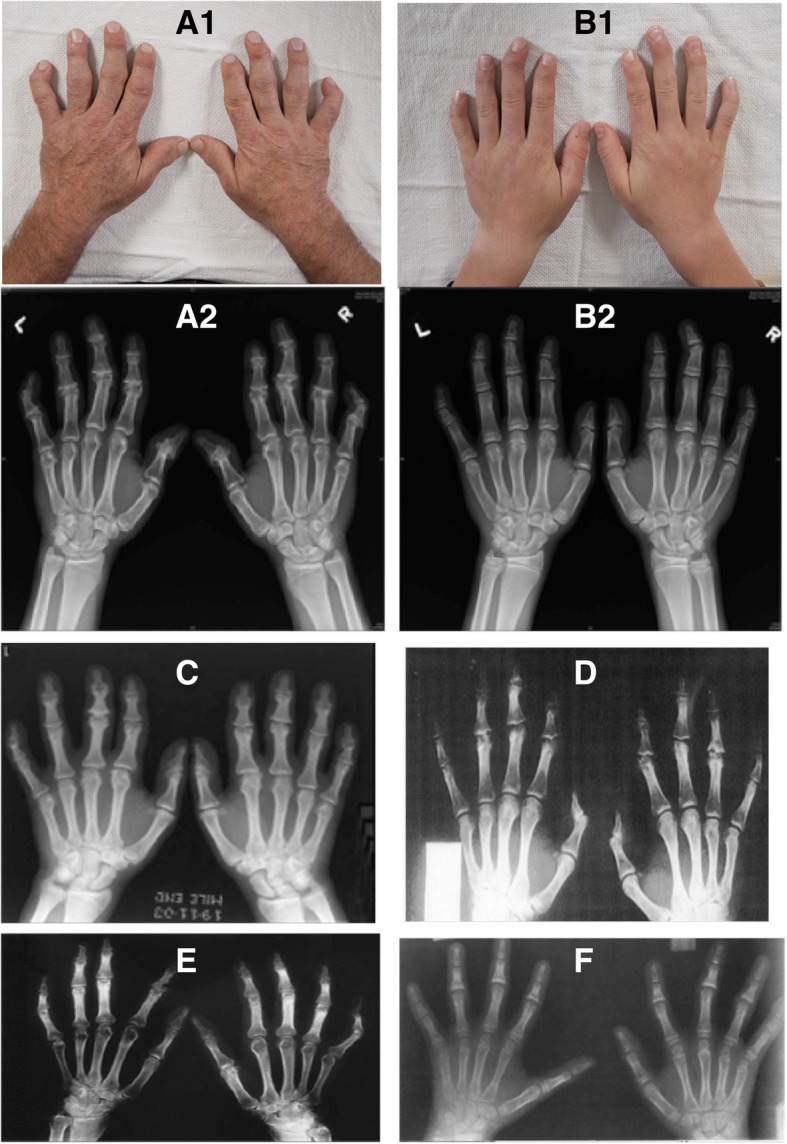
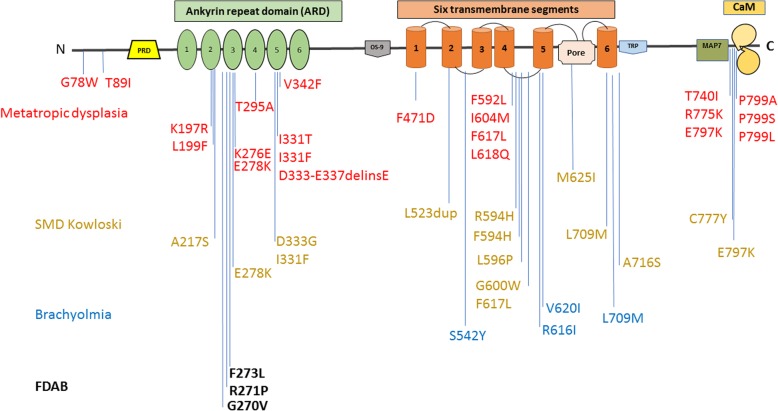
Background: Familial digital arthropathy-brachydactyly (FDAB) and Thiemann disease are non-inflammatory digital arthropathies with many phenotypic similarities. Thirty-three cases of Thiemann disease have been described so far (Mangat et al, Ann Rheum Dis 64:11-2, 2005; Ha et al, Thiemann's disease: a case Report, 2017) but no gene variants have been identified as causative to date. FDAB is reported in only a few patients and has been associated with three heterozygous missense variants in the Transient receptor potential vanilloid 4 (TRPV4) gene. We report a TRPV4 variant in a father and son referred with a diagnosis of Thiemann disease and compare the clinical and radiological features of Thiemann disease with Familial digital arthropathy-brachydactyly (FDAB). We hypothesize that these two entities may be one and the same.
Methods: We describe a father and son referred with a diagnosis of Thiemann disease who were subsequently identified with a heterozygous variant (c.809G > T) in TRPV4. The identical genetic variant was previously reported to cause FDAB. A PUBMED® database search was conducted to retrieve articles related to Thiemann disease and FDAB. We were able to review the clinical and radiological findings of nineteen individuals affected by Thiemann disease and compare them with three families affected by FDAB.
Results: Thiemann disease initially affects the proximal interphalangeal joints and primarily the middle phalangeal bases. In FDAB, the distal phalangeal joints are first affected with the middle phalangeal heads being the primary site of changes. Radial deviation has only been described in FDAB. Our analysis determined that 5 of 20 individuals affected by Thiemann disease have clinical and radiological findings that also fit well with FDAB.
Conclusion: FDAB and Thiemann disease are non-inflammatory digital arthropathies with phenotypic overlap. Although more extensive joint involvement, a distal hand joint preponderance and brachydactyly are expected in FDAB, there are striking clinical and radiological similarities between the two entities. Our analysis suggests that these two phenotypes may represent phenotypic variability of the same entity. Despite many attempts to identify other reported patients affected by Thiemann disease, we were not able to procure DNA from any of the cases to verify our findings. Genetic testing of an affected individual will be crucial in order to provide accurate reproductive genetic counselling about the autosomal dominant nature of this condition.
Keywords: Arthritis; Hand; Osteoarthritis; Osteonecrosis; TRPV4.
Conflict of interest statement
The authors declare that they have no competing interests, and all authors should confirm its accuracy.
Figures
References
-
- Thiemann H. Juvenile Epiphysenstorungen. Fortschr Geb Rontgenstr. 1909;14:79–87.
-
- Ha Kim Y, Lee J. Thiemann's disease: a case Report. 2017.
Publication types
MeSH terms
Substances
LinkOut - more resources
Full Text Sources
Medical
Molecular Biology Databases
