. 2019 Jun 12:10:568.
doi: 10.3389/fgene.2019.00568. eCollection 2019.

TYR Gene in Llamas: Polymorphisms and Expression Study in Different Color Phenotypes

Affiliations

TYR Gene in Llamas: Polymorphisms and Expression Study in Different Color Phenotypes

Melina Anello et al. Front Genet. .

Abstract

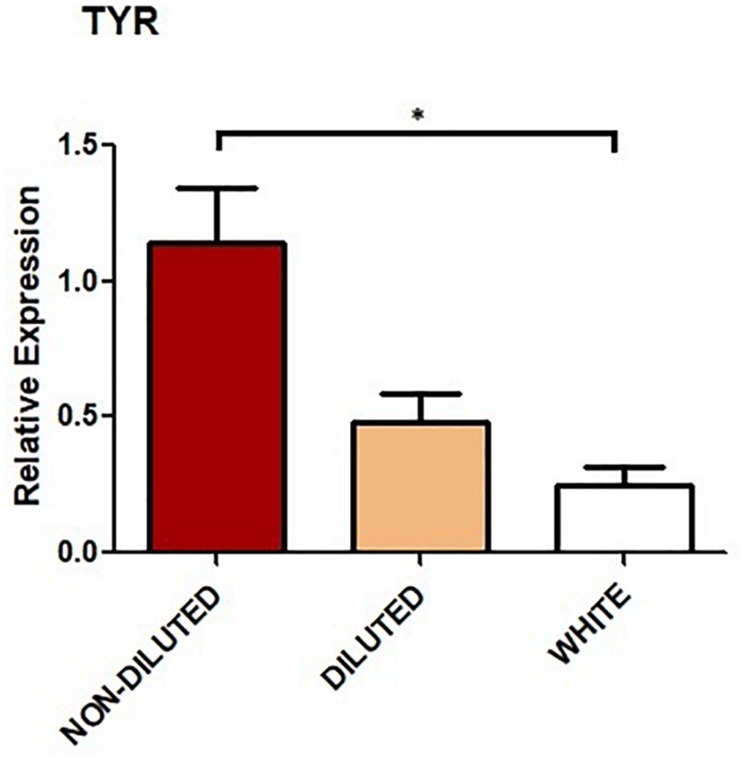
Tyrosinase, encoded by TYR gene, is an enzyme that plays a major role in mammalian pigmentation. It catalyzes the oxidation of L-dihydroxy-phenylalanine (DOPA) to DOPA quinone, a precursor of both types of melanin: eumelanin and pheomelanin. TYR is commonly known as the albino locus since mutations in this gene result in albinism in several species. However, many other TYR mutations have been found to cause diluted phenotypes, like the Himalayan or chinchilla phenotypes in mice. The llama (Lama glama) presents a wide variety of coat colors ranging from non-diluted phenotypes (eumelanic and pheomelanic), through different degrees of dilution, to white. To investigate the possible contribution of TYR gene to coat color variation in llamas, we sequenced TYR exons and their flanking regions and genotyped animals with diluted, non-diluted, and white coat, including three blue-eyed white individuals. Moreover, we analyzed mRNA expression levels in skin biopsies by qPCR. TYR coding region presented nine SNPs, of which three were non-synonymous, c.428A > G, c.859G > T, and c.1490G > T. We also identified seven polymorphisms in non-coding regions, including two microsatellites, an homopolymeric repeat, and five SNPs: one in the promoter region (c.1-26C > T), two in the 3'-UTR, and two flanking the exons. Although no complete association was found between coat color and SNPs, c.1-26C > T was partially associated to diluted phenotypes. Additionally, the frequency of the G allele from c.428A > G was significantly higher in white compared to non-diluted. Results from qPCR showed that expression levels of TYR in white llamas were significantly lower (p < 0.05) than those in diluted and non-diluted phenotypes. Screening for variation in regulatory regions of TYR did not reveal polymorphisms that explain such differences. However, data from this study showed that TYR expression levels play a role in llama pigmentation.

Keywords: Lama glama; coat color; dilution; expression; polymorphisms; tyrosinase.


Figures
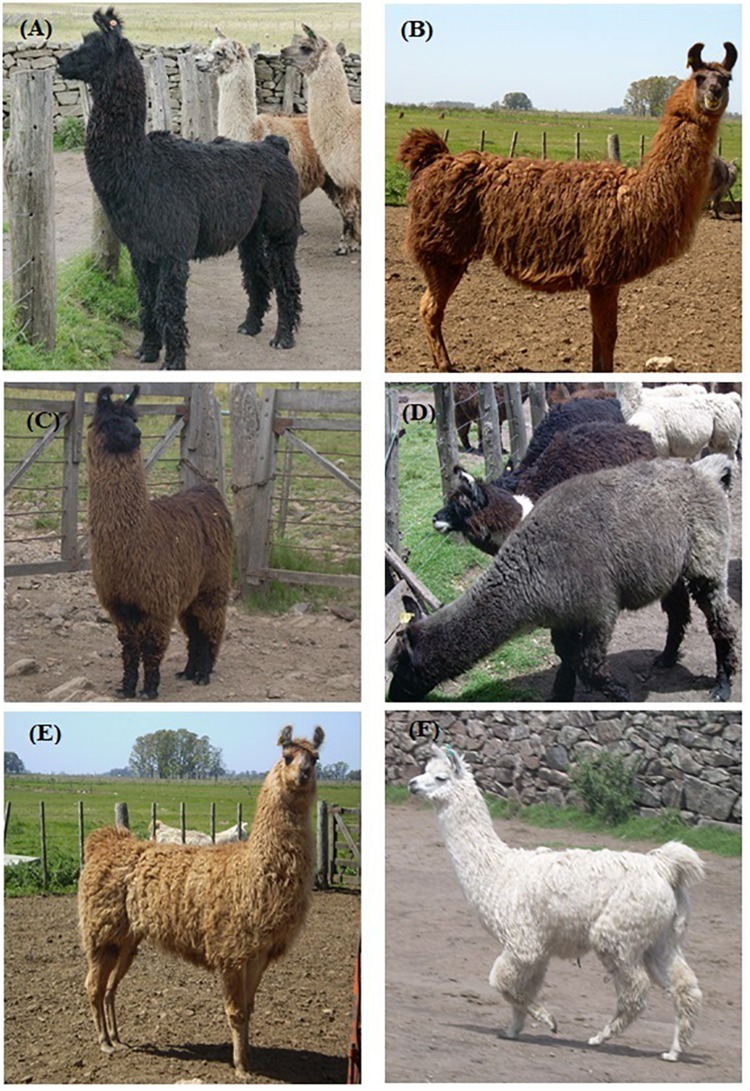
FIGURE 1
FIGURE 1
Photographs of llamas illustrating color phenotypes included in this study. (A) Black, (B) Red, (C) Black Face, (D) Gray, (E) Fawn, and (F) White.
FIGURE 2
FIGURE 2
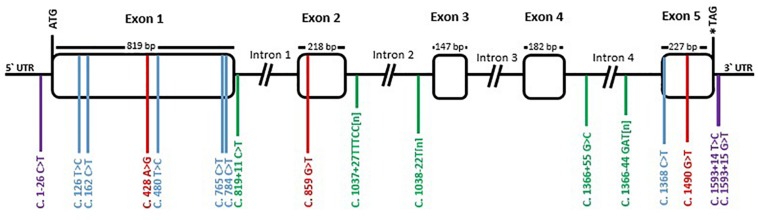
Schematic representation of TYR gene with its polymorphism’s distribution in llamas. Rectangular boxes correspond to exons while introns and non-translated regions are represented by black lines. Positions +1 was assigned to the translation initiation site (ATG codon) and * indicates the stop codon. Polymorphisms numbering is relative to the coding DNA sequence and indicated by transversal colored lines. Violet correspond to mutations in the UTR regions, blue correspond to synonymous mutation in the coding region, red to non-synonymous mutations, and green to intronic mutations.
FIGURE 3
FIGURE 3
Relative expression of TYR in the skin of llamas. Bar graphs show mean values. Error bars represent standard error (SE). Three biological replicates were analyzed for each color group. Asterisk indicates statistically significant differences (p < 0.05).
FIGURE 4
FIGURE 4
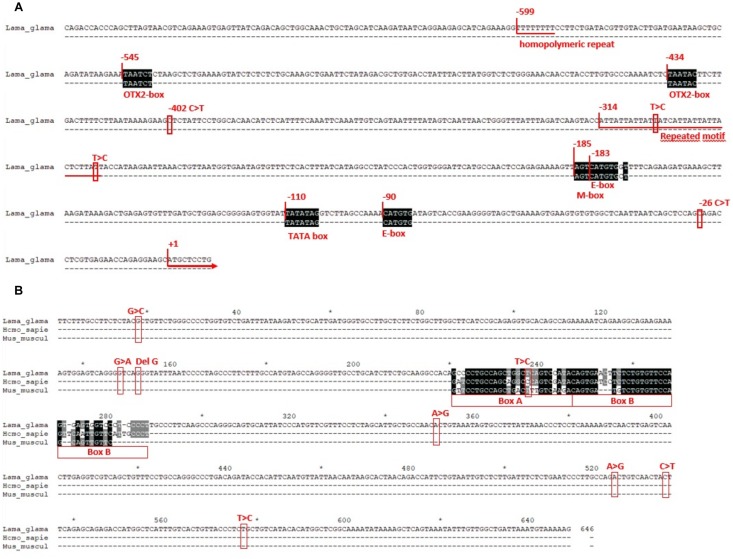
(A) Proximal promoter region of TYR gene. Positions +1 were assigned to the translation initiation site (ATG codon). Regulatory elements are aligned with its consensus sequence in black blocks and named underneath. Numbers above the elements indicate relative positions. Red squares indicate the location of the SNPs found in llamas and the repeated elements are underlined. (B) TYR LCR region. Nucleotide positions (from 1 to 646) are indicated in black above the sequence. Number 1 was arbitrarily designed to the first nucleotide showed. Boxes A and B are aligned to the ones of mouse and human (X76647 and AY180962) and the variation found in llamas is squared in red color.

References

    1. Aigner B., Besenfelder U., Müller M., Brem G. (2000). Tyrosinase gene variants in different rabbit strains. Mamm. Genome 11 700–702. 10.1007/s003350010120 - DOI - PubMed
    1. Anello M., Daverio M. S., Silbestro M. B., Vidal-Rioja L., Di Rocco F. (2019). Characterization and expression analysis of KIT and MITF-M genes in llamas and their relation to white coat color. Anim. Genet. 50 1–7. 10.1111/age.12769 - DOI - PubMed
    1. Anistoroaei R., Fredholm M., Christensen K., Leeb T. (2008). Albinism in the American mink (Neovison vison) is associated with a tyrosinase nonsense mutation. Anim. Genet. 39 645–648. 10.1111/j.1365-2052.2008.01788.x - DOI - PubMed
    1. Bateman A., Martin M. J., O’Donovan C., Magrane M., Alpi E., Antunes R., et al. (2017). UniProt: the universal protein knowledgebase. Nucleic Acids Res. 45 D158–D169. 10.1093/nar/gkw1099 - DOI - PMC - PubMed
    1. Beermann F., Orlow S. J., Lamoreux M. L. (2004). The Tyr (albino) locus of the laboratory mouse. Mamm. Genome 15 749–758. 10.1007/s00335-004-4002-4008 - DOI - PubMed

LinkOut - more resources