Review
. 2019 May 22:2019:3632169.
doi: 10.1155/2019/3632169. eCollection 2019.

Autophagy Dysfunction, Cellular Senescence, and Abnormal Immune-Inflammatory Responses in AMD: From Mechanisms to Therapeutic Potential

Affiliations
Review

Autophagy Dysfunction, Cellular Senescence, and Abnormal Immune-Inflammatory Responses in AMD: From Mechanisms to Therapeutic Potential

Shoubi Wang et al. Oxid Med Cell Longev. .

Abstract

Age-related macular degeneration (AMD) is a blinding disease caused by multiple factors and is the primary cause of vision loss in the elderly. The morbidity of AMD increases every year. Currently, there is no effective treatment option for AMD. Intravitreal injection of antivascular endothelial growth factor (anti-VEGF) is currently the most widely used therapy, but it only aims at neovascularization, which is an intermediate pathological phenomenon of wet AMD, not at the etiological treatment. Anti-VEGF therapy can only temporarily delay the degeneration process of wet AMD, and AMD is easy to relapse after drug withdrawal. Therefore, it is urgent to deepen our understanding of the pathophysiological processes underlying AMD and to identify integrated or new strategies for AMD prevention and treatment. Recent studies have found that autophagy dysfunction in retinal pigment epithelial (RPE) cells, cellular senescence, and abnormal immune-inflammatory responses play key roles in the pathogenesis of AMD. For many age-related diseases, the main focus is currently the clearing of senescent cells (SNCs) as an antiaging treatment, thereby delaying diseases. However, in AMD, there is no relevant antiaging application. This review will discuss the pathogenesis of AMD and how interactions among RPE autophagy dysfunction, cellular senescence, and abnormal immune-inflammatory responses are involved in AMD, and it will summarize the three antiaging strategies that have been developed, with the aim of providing important information for the integrated prevention and treatment of AMD and laying the ground work for the application of antiaging strategies in AMD treatment.


Figures
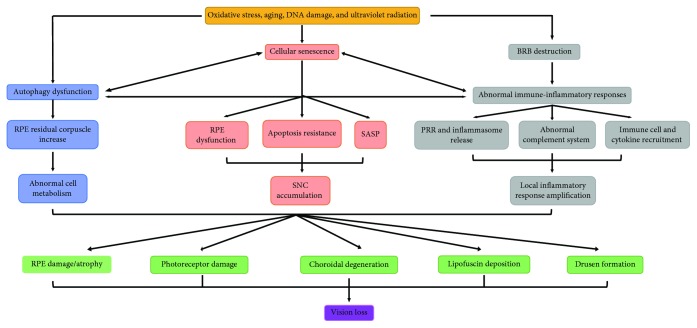
Figure 1
Figure 1
The relationship of RPE cell autophagy dysfunction, cellular senescence, and abnormal immune-inflammatory response in AMD. Oxidative stress, aging, DNA damage, and ultraviolet radiation can lead to RPE cell autophagy dysfunction, cellular senescence, and BRB destruction. Autophagy dysfunction results in the decreased clearance of RPE cells and increased intracellular residual corpuscles, which interferes with cell metabolism. Senescent RPE cells lead to cell dysfunction and promote the senescence of surrounding cells by secreting SASP. Moreover, SNCs are apoptosis resistant, failing to enter programmed cell death and aggregating instead. The destruction of the BRB could activate an abnormal immune-inflammatory response of the retina and lead to the release of PRRs and inflammasomes, the activation of immune cells and cytokines, and the activation of abnormalities of the complement system, which could further amplify the local inflammatory response. These factors interact with each other, causing lipofuscin deposition, drusen formation, RPE cell injury or atrophy, photoreceptor damage, choroid degeneration, and ultimately, loss of vision.
Figure 2
Figure 2
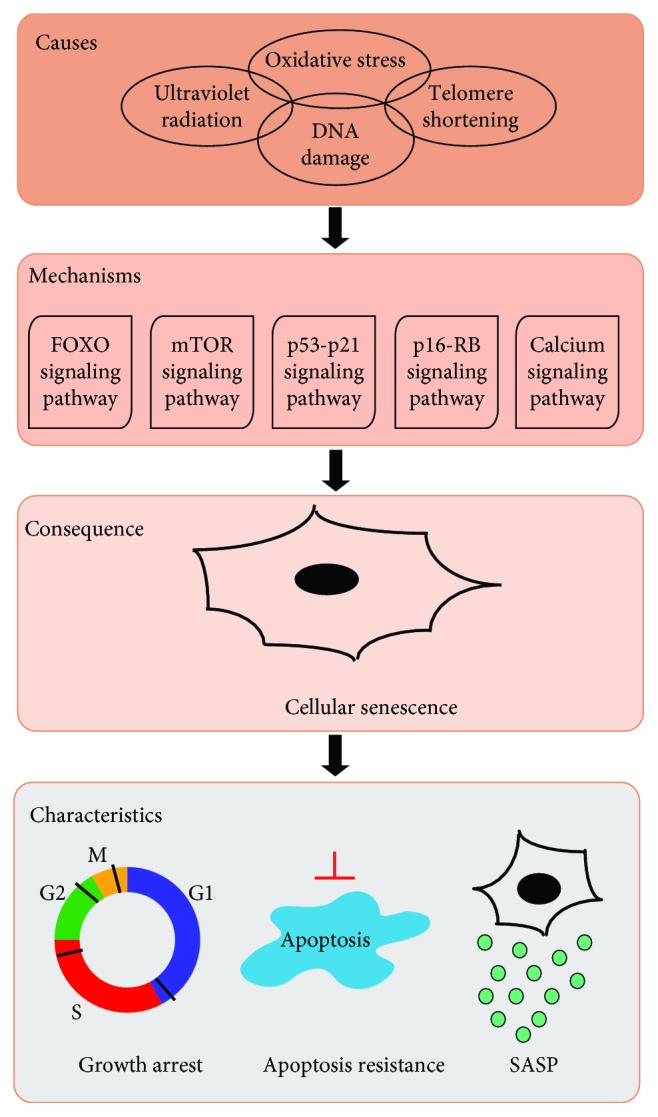
An overview of cellular senescence. A variety of stimuli, such as oxidative stress, DNA damage, ultraviolet radiation, and telomere shortening can induce a series of reactions, including the activation of the FOXO signaling pathway, the mTOR signaling pathway, the p53-p21 signaling pathway, the p16-Rb signaling pathway, and the calcium signaling pathway, ultimately leading to cellular senescence. SNCs have several primary characteristics, such as growth arrest, apoptosis resistance, and SASP secretion.

References

    1. Datta S., Cano M., Ebrahimi K., Wang L., Handa J. T. The impact of oxidative stress and inflammation on RPE degeneration in non-neovascular AMD. Progress in Retinal and Eye Research. 2017;60:201–218. doi: 10.1016/j.preteyeres.2017.03.002. - DOI - PMC - PubMed
    1. Johansson I., Monsen V. T., Pettersen K., et al. The marine n-3 PUFA DHA evokes cytoprotection against oxidative stress and protein misfolding by inducing autophagy and NFE2L2 in human retinal pigment epithelial cells. Autophagy. 2015;11(9):1636–1651. doi: 10.1080/15548627.2015.1061170. - DOI - PMC - PubMed
    1. Blasiak J., Piechota M., Pawlowska E., Szatkowska M., Sikora E., Kaarniranta K. Cellular senescence in age-related macular degeneration: can autophagy and DNA damage response play a role? Oxidative Medicine and Cellular Longevity. 2017;2017:15. doi: 10.1155/2017/5293258.5293258 - DOI - PMC - PubMed
    1. Kozhevnikova O. S., Korbolina E. E., Ershov N. I., Kolosova N. G. Rat retinal transcriptome: effects of aging and AMD-like retinopathy. Cell Cycle. 2013;12(11):1745–1761. doi: 10.4161/cc.24825. - DOI - PMC - PubMed
    1. Blasiak J., Glowacki S., Kauppinen A., Kaarniranta K. Mitochondrial and nuclear DNA damage and repair in age-related macular degeneration. International Journal of Molecular Sciences. 2013;14(2):2996–3010. doi: 10.3390/ijms14022996. - DOI - PMC - PubMed

MeSH terms

Substances