


Use of Targeted High-Throughput Sequencing for Genetic Classification of Patients with Bleeding Diathesis and Suspected Platelet Disorder
- PMID: 31249973
- PMCID: PMC6524924
- DOI: 10.1055/s-0038-1676813
Use of Targeted High-Throughput Sequencing for Genetic Classification of Patients with Bleeding Diathesis and Suspected Platelet Disorder
Abstract
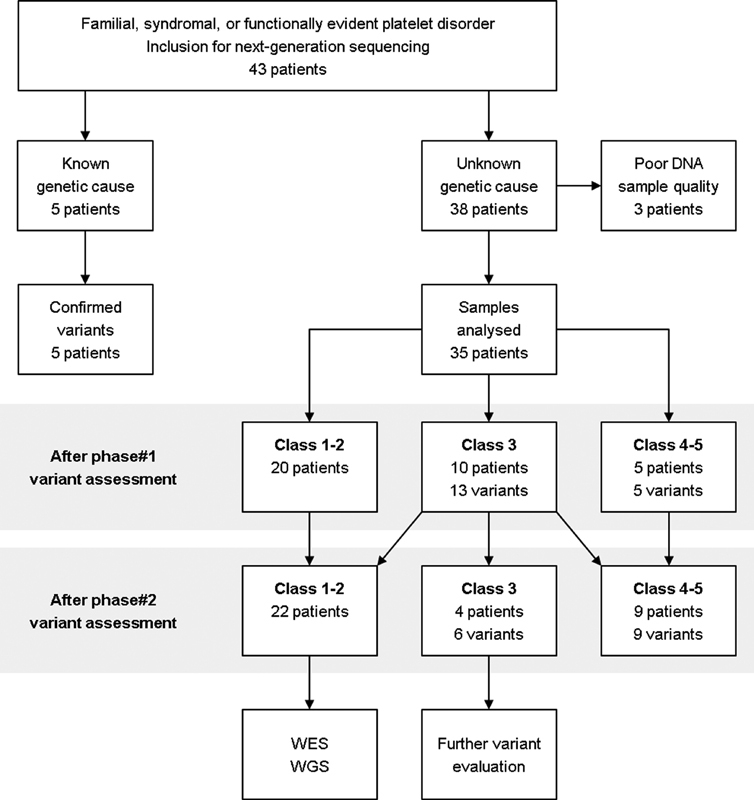
Inherited platelet disorders (IPD) form a rare and heterogeneous disease entity that is present in about 8% of patients with non-acquired bleeding diathesis. Identification of the defective cellular pathway is an important criterion for stratifying the patient's individual risk profile and for choosing personalized therapeutic options. While costs of high-throughput sequencing technologies have rapidly declined over the last decade, molecular genetic diagnosis of bleeding and platelet disorders is getting more and more suitable within the diagnostic algorithms. In this study, we developed, verified, and evaluated a targeted, panel-based next-generation sequencing approach comprising 59 genes associated with IPD for a cohort of 38 patients with a history of recurrent bleeding episodes and functionally suspected, but so far genetically undefined IPD. DNA samples from five patients with genetically defined IPD with disease-causing variants in WAS , RBM8A , FERMT3 , P2YR12 , and MYH9 served as controls during the validation process. In 40% of 35 patients analyzed, we were able to finally detect 15 variants, eight of which were novel, in 11 genes, ACTN1 , AP3B1 , GFI1B , HPS1 , HPS4 , HPS6 , MPL , MYH9 , TBXA2R , TPM4 , and TUBB1 , and classified them according to current guidelines. Apart from seven variants of uncertain significance in 11% of patients, nine variants were classified as likely pathogenic or pathogenic providing a molecular diagnosis for 26% of patients. This report also emphasizes on potentials and pitfalls of this tool and prospectively proposes its rational implementation within the diagnostic algorithms of IPD.
Keywords: molecular genetics; next-generation sequencing; platelet function disorder; thrombocytopathy; thrombocytopenia.
Conflict of interest statement
Figures
References
-
- Nurden A T, Nurden P. Congenital platelet disorders and understanding of platelet function. Br J Haematol. 2014;165(02):165–178. - PubMed
-
- Balduini C L, Melazzini F, Pecci A. Inherited thrombocytopenias - recent advances in clinical and molecular aspects. Platelets. 2017;28(01):3–13. - PubMed
-
- Sivapalaratnam S, Collins J, Gomez K. Diagnosis of inherited bleeding disorders in the genomic era. Br J Haematol. 2017;179(03):363–376. - PubMed
-
- Nurden A T, Freson K, Seligsohn U. Inherited platelet disorders. Haemophilia. 2012;18 04:154–160. - PubMed
LinkOut - more resources
Full Text Sources
Medical
Research Materials
Miscellaneous
