


Radiomics-based prediction of microsatellite instability in colorectal cancer at initial computed tomography evaluation
- PMID: 31250180
- PMCID: PMC6824954
- DOI: 10.1007/s00261-019-02117-w
Radiomics-based prediction of microsatellite instability in colorectal cancer at initial computed tomography evaluation
Abstract
Purpose: To predict microsatellite instability (MSI) status of colon cancer on preoperative CT imaging using radiomic analysis.
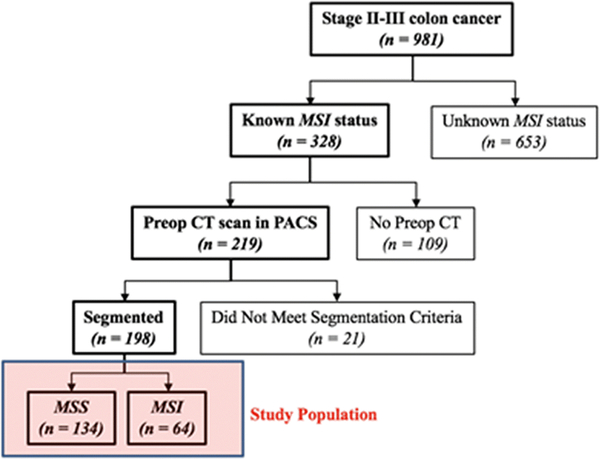
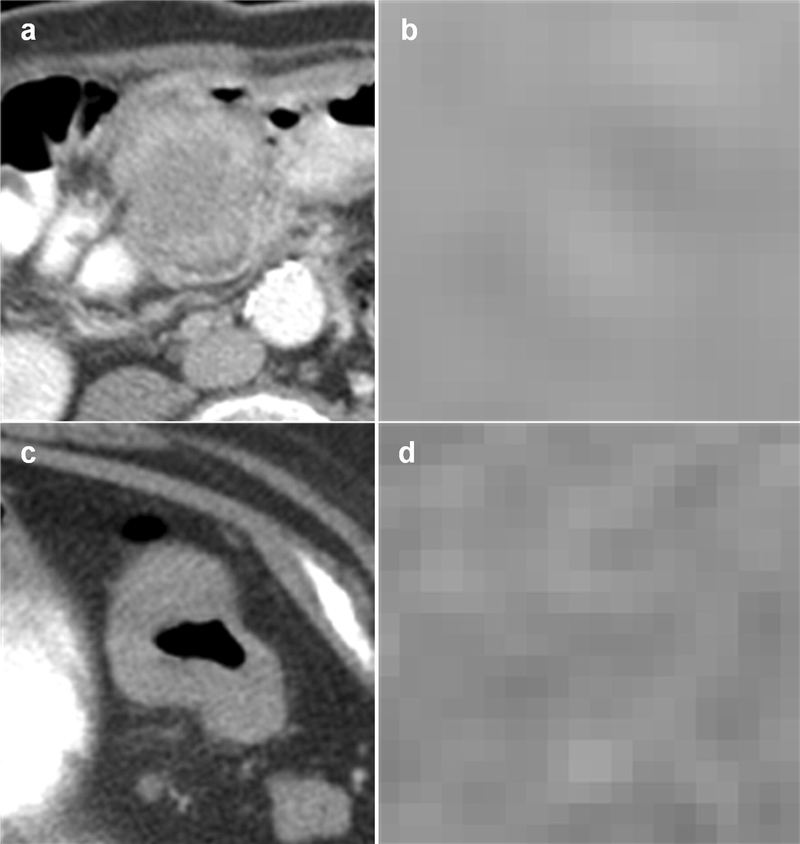
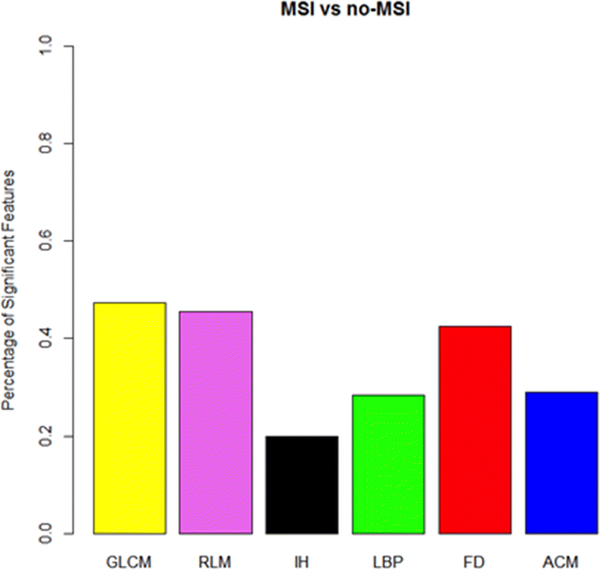
Methods: This retrospective study involved radiomic analysis of preoperative CT imaging of patients who underwent resection of stage II-III colon cancer from 2004 to 2012. A radiologist blinded to MSI status manually segmented the tumor region on CT images. 254 Intensity-based radiomic features were extracted from the tumor region. Three prediction models were developed with (1) only clinical features, (2) only radiomic features, and (3) "combined" clinical and radiomic features. Patients were randomly separated into training (n = 139) and test (n = 59) sets. The model was constructed from training data only; the test set was reserved for validation only. Model performance was evaluated using AUC, sensitivity, specificity, PPV, and NPV.
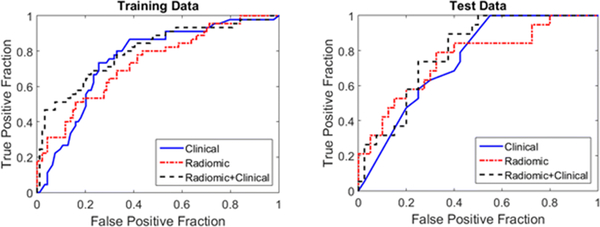
Results: Of the total 198 patients, 134 (68%) patients had microsatellite stable tumors and 64 (32%) patients had MSI tumors. The combined model performed slightly better than the other models, predicting MSI with an AUC of 0.80 for the training set and 0.79 for the test set (specificity = 96.8% and 92.5%, respectively), whereas the model with only clinical features achieved an AUC of 0.74 and the model with only radiomic features achieved an AUC of 0.76. The model with clinical features alone had the lowest specificity (70%) compared with the model with radiomic features alone (95%) and the combined model (92.5%).
Conclusions: Preoperative prediction of MSI status via radiomic analysis of preoperative CT adds specificity to clinical assessment and could contribute to personalized treatment selection.
Keywords: Colon; Colonic neoplasms; Immunotherapy; Microsatellite instability; Microsatellite repeats.
Conflict of interest statement
Conflict of Interest: The authors declare that they have no conflict of interest.
Figures
References
-
- Cox VL, Saeed Bamashmos AA, Foo WC et al. (2018) Lynch Syndrome: Genomics Update and Imaging Review. Radiographics 38:483–499 - PubMed
-
- Andre T, Boni C, Mounedji-Boudiaf L et al. (2004) Oxaliplatin, fluorouracil, and leucovorin as adjuvant treatment for colon cancer. N Engl J Med 350:2343–2351 - PubMed
-
- Zauber NP, Sabbath-Solitare M, Marotta S, Perera LP, Bishop DT (2006) Adequacy of colonoscopic biopsy specimens for molecular analysis: a comparative study with colectomy tissue. Diagn Mol Pathol 15:162–168 - PubMed
