


Consistent alterations in faecal microbiomes of patients with primary sclerosing cholangitis independent of associated colitis
- PMID: 31250469
- PMCID: PMC6899739
- DOI: 10.1111/apt.15375
Consistent alterations in faecal microbiomes of patients with primary sclerosing cholangitis independent of associated colitis
Abstract
Background: Single-centre studies reported alterations of faecal microbiota in patients with primary sclerosing cholangitis (PSC). As regional factors may affect microbial communities, it is unclear if a microbial signature of PSC exists across different geographical regions.
Aim: To identify a robust microbial signature of PSC independent of geography and environmental influences.
Methods: We included 388 individuals (median age, 47 years; range, 15-78) from Germany and Norway in the study, 137 patients with PSC (n = 75 with colitis), 118 with ulcerative colitis (UC) and 133 healthy controls. Faecal microbiomes were analysed by 16S rRNA gene sequencing (V1-V2). Differences in relative abundances of single taxa were subjected to a meta-analysis.
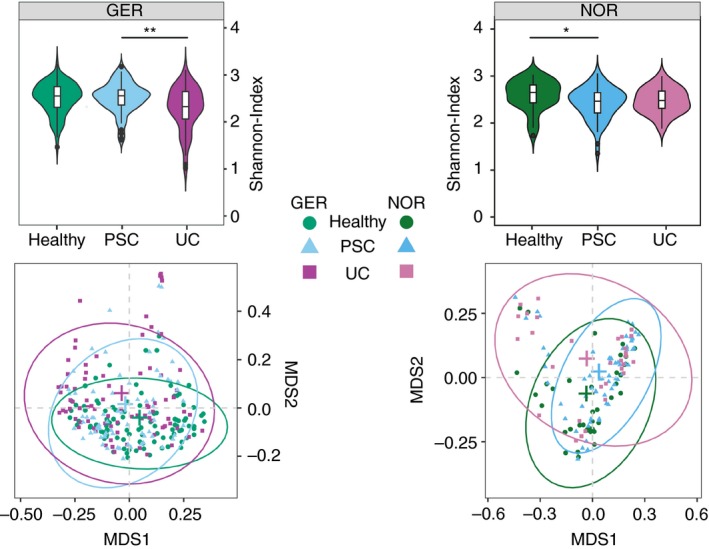
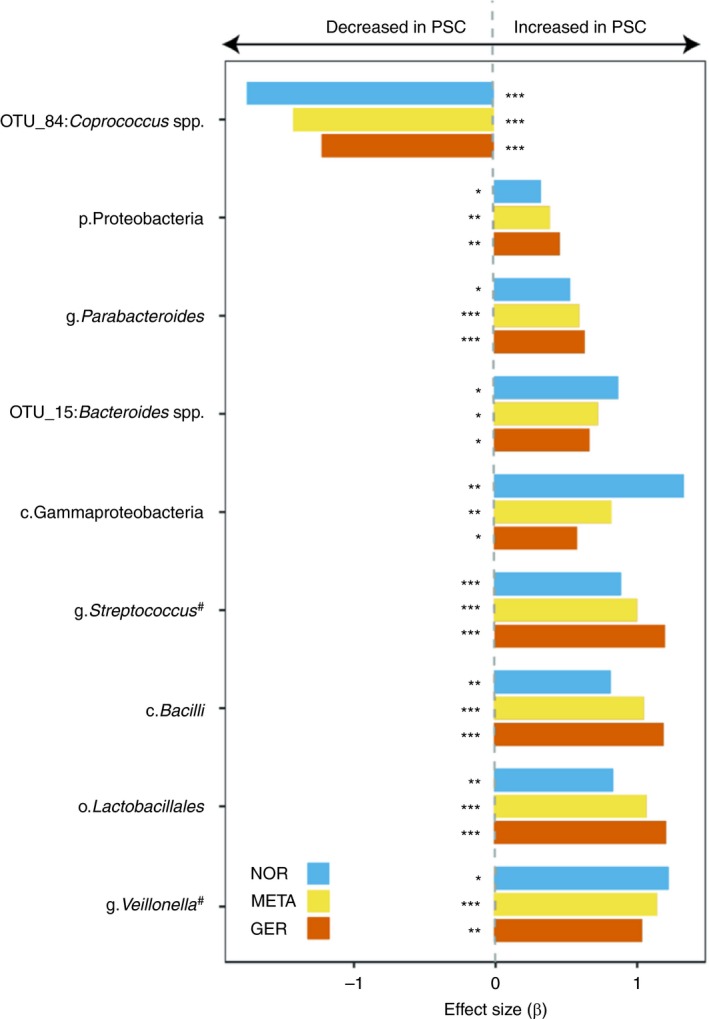
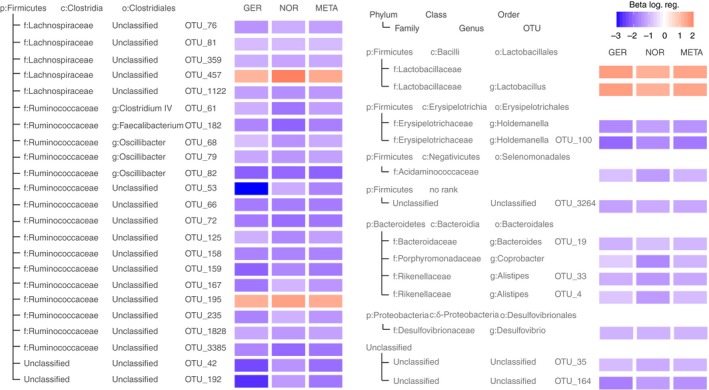
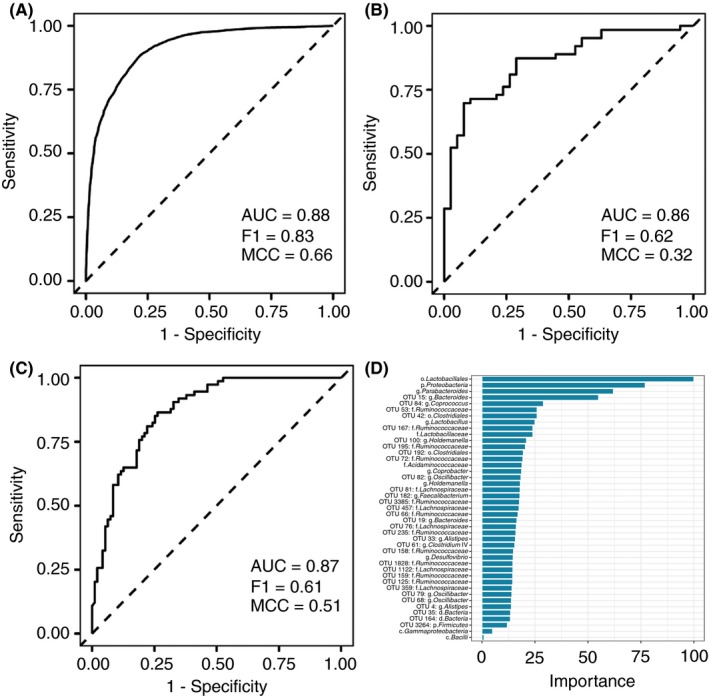
Results: In both cohorts, microbiota composition (beta-diversity) differed between PSC patients and controls (P < 0.001). Random forests classification discriminated PSC patients from controls in both geographical cohorts with an average area under the curve of 0.88. Compared to healthy controls, many new cohort-spanning alterations were identified in PSC, such as an increase of Proteobacteria and the bile-tolerant genus Parabacteroides, which were detected independent from geographical region. Associated colitis only had minor effects on microbiota composition, suggesting that PSC itself drives the faecal microbiota changes observed.
Conclusion: Compared to healthy controls, numerous microbiota alterations are reproducible in PSC patients across geographical regions, clearly pointing towards a microbiota composition that is shaped by the disease itself and not by environmental factors. These reproducibly altered microbial populations might provide future insights into the pathophysiology of PSC.
© 2019 The Authors. Alimentary Pharmacology & Therapeutics Published by John Wiley & Sons Ltd.
Figures
Comment in
-
Editorial: gut microbial profile associated with primary sclerosing cholangitis-what is new and how do we progress from here?Aliment Pharmacol Ther. 2019 Sep;50(5):605-606. doi: 10.1111/apt.15424. Aliment Pharmacol Ther. 2019. PMID: 31414544 No abstract available.
-
Editorial: gut microbial profile associated with primary sclerosing cholangitis-what is new and how do we progress from here? Authors' reply.Aliment Pharmacol Ther. 2019 Sep;50(5):606-607. doi: 10.1111/apt.15434. Aliment Pharmacol Ther. 2019. PMID: 31414547 Free PMC article.
References
-
- Karlsen TH, Folseraas T, Thorburn D, Vesterhus M. Primary sclerosing cholangitis ‐ a comprehensive review. J Hepatol. 2017;67:1298‐1323. - PubMed
-
- Boonstra K, Weersma RK, van Erpecum KJ, et al. Population‐based epidemiology, malignancy risk, and outcome of primary sclerosing cholangitis. Hepatology. 2013;58:2045‐2055. - PubMed
-
- Tischendorf J, Hecker H, Krüger M, Manns MP, Meier PN. Characterization, outcome, and prognosis in 273 patients with primary sclerosing cholangitis: A single center study. Am J Gastroenterol. 2007;102:107‐114. - PubMed
-
- Chapman R, Fevery J, Kalloo A, et al. Diagnosis and management of primary sclerosing cholangitis. Hepatology. 2010;51:660‐678. - PubMed
Publication types
MeSH terms
Substances
Grants and funding
LinkOut - more resources
Full Text Sources
Medical