


Integration of Gender-Affirming Primary Care and Peer Navigation With HIV Prevention and Treatment Services to Improve the Health of Transgender Women: Protocol for a Prospective Longitudinal Cohort Study
- PMID: 31250829
- PMCID: PMC6620883
- DOI: 10.2196/14091
Integration of Gender-Affirming Primary Care and Peer Navigation With HIV Prevention and Treatment Services to Improve the Health of Transgender Women: Protocol for a Prospective Longitudinal Cohort Study
Abstract
Background: Public health strategies are urgently needed to improve HIV disparities among transgender women, including holistic intervention approaches that address those health needs prioritized by the community. Hormone therapy is the primary method by which many transgender women medically achieve gender affirmation. Peer navigation has been shown to be effective to engage and retain underserved populations living with HIV in stable primary medical care.
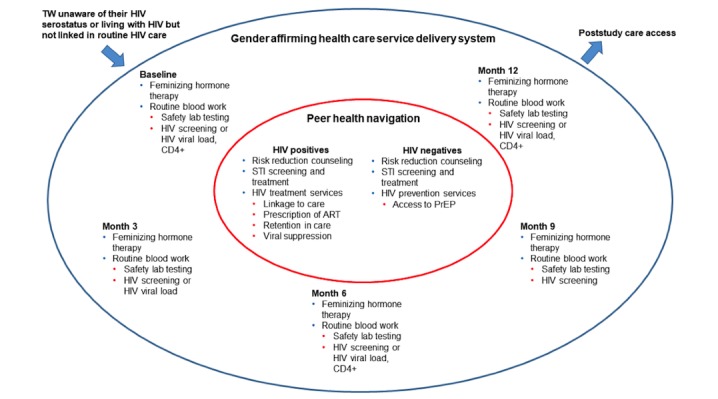
Objective: This study aims to assess the feasibility and acceptability of an integrated innovative HIV service delivery model designed to improve HIV prevention and care by combining gender-affirming primary care and peer navigation with HIV prevention and treatment services.
Methods: A 12-month, nonrandomized, single-arm cohort study was implemented in Lima, Peru, among adult individuals, assigned a male sex at birth, who identified themselves as transgender women, regardless of initiation or completion of medical gender affirmation, and who were unaware of their HIV serostatus or were living with HIV but not engaged in HIV treatment. HIV-negative participants received quarterly HIV testing and were offered to initiate pre-exposure prophylaxis. HIV-positive participants were offered to initiate antiretroviral treatment and underwent quarterly plasma HIV-1 RNA and peripheral CD4+ lymphocyte cell count monitoring. All participants received feminizing hormone therapy and adherence counseling and education on their use. Peer health navigation facilitated retention in care by visiting participants at home, work, or socialization venues, or by contacting them by social media and phone.
Results: Patient recruitment started in October 2016 and finished in March 2017. The cohort ended follow-up on March 2018. Data analysis is currently underway.
Conclusions: Innovative and culturally sensitive strategies to improve access to HIV prevention and treatment services for transgender women are vital to curb the burden of HIV epidemic for this key population. Findings of this intervention will inform future policies and research, including evaluation of its efficacy in a randomized controlled trial.
Trial registration: ClinicalTrials.gov NCT03757117; https://clinicaltrials.gov/ct2/show/NCT03757117.
International registered report identifier (irrid): DERR1-10.2196/14091.
Keywords: HIV; Peru; culturally competent care; health services; patient navigation; retention in care; transgender persons.
©Javier R Lama, Kenneth H Mayer, Amaya G Perez-Brumer, Leyla Huerta, Hugo Sanchez, Jesse L Clark, Jorge Sanchez, Sari L Reisner. Originally published in JMIR Research Protocols (http://www.researchprotocols.org), 27.06.2019.
Conflict of interest statement
Conflicts of Interest: None declared.
Figures
References
-
- Silva-Santisteban A, Eng S, de la Iglesia G, Falistocco C, Mazin R. HIV prevention among transgender women in Latin America: implementation, gaps and challenges. J Int AIDS Soc. 2016 Jul;19(3 Suppl 2):20799. doi: 10.7448/IAS.19.3.20799. http://europepmc.org/abstract/MED/27431470 - DOI - PMC - PubMed
-
- Sanchez J, Lama JR, Kusunoki L, Manrique H, Goicochea P, Lucchetti A, Rouillon M, Pun M, Suarez L, Montano S, Sanchez JL, Tabet S, Hughes JP, Celum C. HIV-1, sexually transmitted infections, and sexual behavior trends among men who have sex with men in Lima, Peru. J Acquir Immune Defic Syndr. 2007 Apr 15;44(5):578–85. doi: 10.1097/QAI.0b013e318033ff82. - DOI - PubMed
-
- Silva-Santisteban A, Raymond HF, Salazar X, Villayzan J, Leon S, McFarland W, Caceres CF. Understanding the HIV/AIDS epidemic in transgender women of Lima, Peru: results from a sero-epidemiologic study using respondent driven sampling. AIDS Behav. 2012 May;16(4):872–81. doi: 10.1007/s10461-011-0053-5. - DOI - PubMed
-
- Clark JL, Konda KA, Silva-Santisteban A, Peinado J, Lama JR, Kusunoki L, Perez-Brumer A, Pun M, Cabello R, Sebastian JL, Suarez-Ognio L, Sanchez J. Sampling methodologies for epidemiologic surveillance of men who have sex with men and transgender women in Latin America: an empiric comparison of convenience sampling, time space sampling, and respondent driven sampling. AIDS Behav. 2014 Dec;18(12):2338–48. doi: 10.1007/s10461-013-0680-0. http://europepmc.org/abstract/MED/24362754 - DOI - PMC - PubMed
Associated data
Grants and funding
LinkOut - more resources
Full Text Sources
Medical
Research Materials
