Disrupted Oxytocin-Appetite Signaling in Females With Anorexia Nervosa
- PMID: 31251345
- PMCID: PMC6734487
- DOI: 10.1210/jc.2019-00926
Disrupted Oxytocin-Appetite Signaling in Females With Anorexia Nervosa
Abstract
Context: In healthy females, oxytocin levels decrease postmeal, corresponding to increased satiety. The postprandial response of oxytocin in females with anorexia nervosa (AN)/atypical AN is unknown.
Objectives: To determine the pattern of postprandial serum oxytocin levels in females with AN/atypical AN, relationship with appetite, and effect of weight, eating behavior, and endogenous estrogen status.
Design: Cross-sectional.
Setting: Clinical research center.
Participants: 67 women (36 with AN [<85% expected body weight (EBW)]; 31 with atypical AN [≥ 85% EBW)]), age 22.4 ± 0.9 (mean ± SEM) years, categorized by weight, restricting vs binge/purge behavior, and estrogen status.
Interventions: Standardized mixed meal.
Main outcome measurements: Blood sampling for oxytocin occurred fasting and 30, 60, and 120 minutes postmeal. Subjective appetite was assessed using visual analog scales.
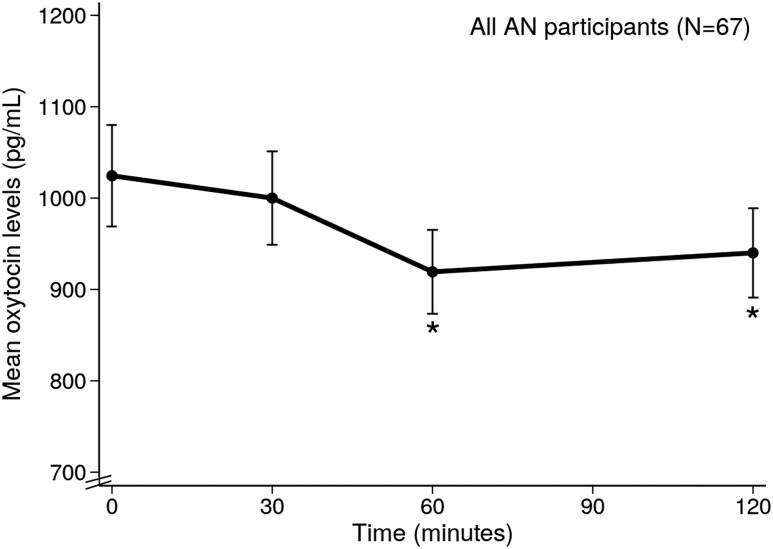
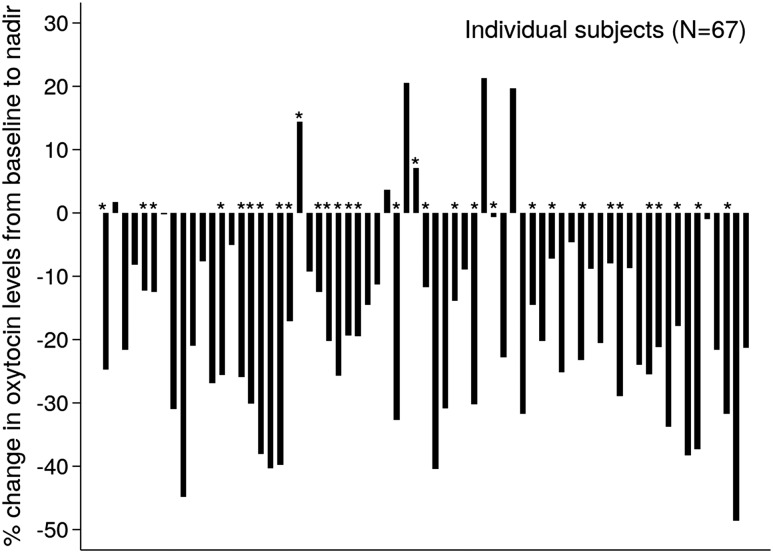
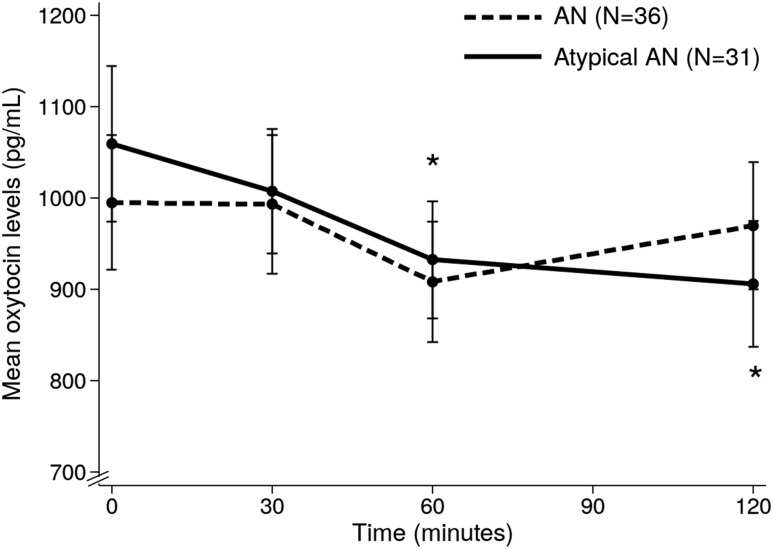
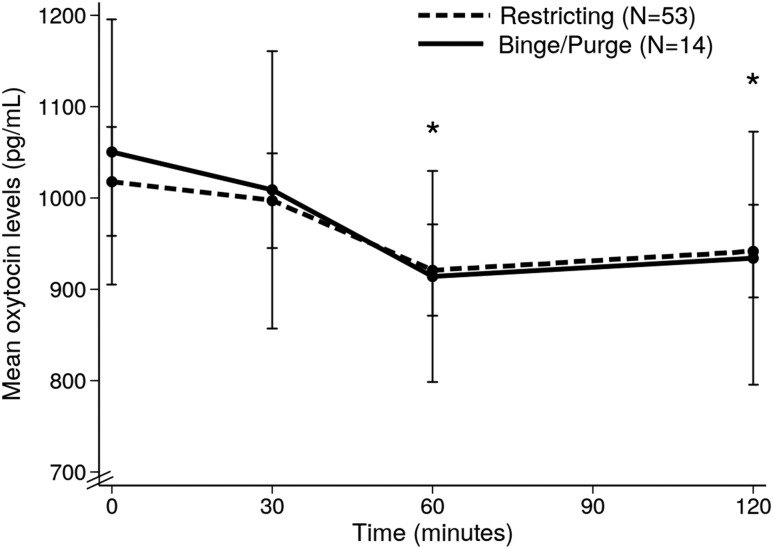
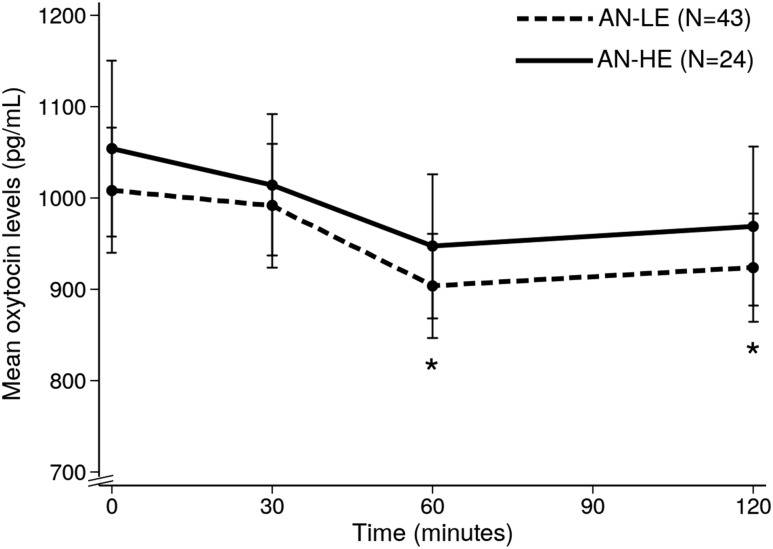
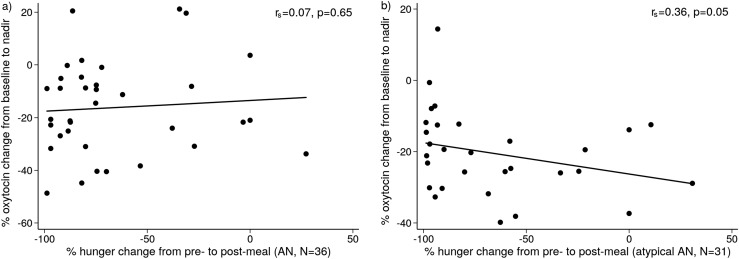
Results: In females with AN/atypical AN, oxytocin levels decreased from fasting to 60 (P = 0.002) and 120 (P = 0.005) minutes postmeal. The decrease in oxytocin from fasting to 120 minutes was greater in females with atypical AN than AN (P = 0.027) and did not differ by restricting vs binge/purge behavior or estrogen status. Controlling for caloric intake, the decrease in oxytocin was inversely related to the decrease in hunger postmeal in females with atypical AN (P = 0.04).
Conclusions: In females with AN/atypical AN, oxytocin levels decrease postmeal, as established in healthy females. Weight, but not restricting vs binge/purging nor endogenous estrogen status, affects postprandial oxytocin levels. The postprandial change in serum oxytocin levels is related to appetite in females with atypical AN only, suggesting a disconnect between oxytocin secretion and appetite in the undernourished state.
Copyright © 2019 Endocrine Society.
Figures
References
-
- American Psychiatric Association. Diagnostic and Statistical Manual of Mental Disorders. 5th ed. Washington, DC: American Psychiatric Association.
-
- Bulik C. One half of patients with anorexia nervosa fully recovered after 21 years but the other half had a chronic or lethal course. Evid Based Ment Health. 2002;5(2):59. - PubMed
-
- Zipfel S, Löwe B, Reas DL, Deter HC, Herzog W. Long-term prognosis in anorexia nervosa: lessons from a 21-year follow-up study. Lancet. 2000;355(9205):721–722. - PubMed
-
- Fichter MM, Quadflieg N. Six-year course and outcome of anorexia nervosa. Int J Eat Disord. 1999;26(4):359–385. - PubMed