Cortisol awakening response in children and adolescents with autism spectrum disorder: a systematic review and meta-analysis
- PMID: 31253603
- PMCID: PMC10270439
- DOI: 10.1136/ebmental-2019-300098
Cortisol awakening response in children and adolescents with autism spectrum disorder: a systematic review and meta-analysis
Abstract
Background: The cortisol awakening response (CAR) is characterised by an increase in cortisol in the 30 to 60 min after waking. Research has found significant associations between an atypical CAR and symptoms of stress and anxiety in typically developing (TD) children and adolescents. A number of studies have explored the CAR in autism spectrum disorder (ASD), but no evidence synthesis is available to date.
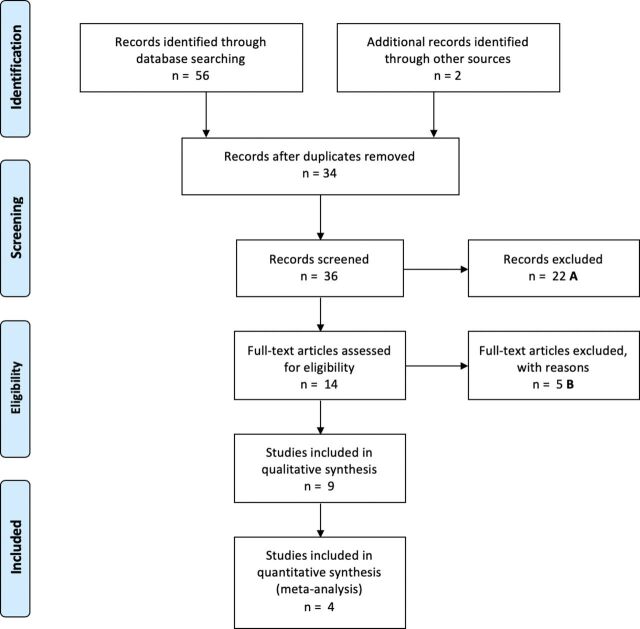
Objective and methods: Based on a preregistered protocol (PROSPERO: CRD42017051187), we carried out a systematic review (SR) and meta-analysis (MA) of CAR studies to explore potential significant differences between children and adolescents with ASD and TD controls. Web of Science, PubMed and PsychInfo were searched until January 2019. A random-effects model was used to pool studies and we used the Newcastle-Ottawa scale (NOS) to assess study quality and risk of bias.
Findings: The SR retrieved a total of nine studies, with mixed findings on the comparison of the CAR between children and adolescents with ASD and TD controls. The MA, based on four studies (ASD; n=117 and TD n=118), suggested no differences between the CAR in ASD and TD populations (SMD: -0.21, 95% CI -0.49 to 0.08). In terms of NOS items, no study specified Representativeness of the cases and Non-response rate. DISCUSSION AND CLINICAL IMPLICATIONS: Given the relatively few studies and lack of appropriately matched TD controls, additional research is needed to further understand and recommend the utility of the CAR as a reliable marker to differentiate ASD and TD.
Keywords: anxiety disorders.
© Author(s) (or their employer(s)) 2019. No commercial re-use. See rights and permissions. Published by BMJ.
Conflict of interest statement
Competing interests: None declared.
Figures

References
-
- Brugha T, Cooper S, Gullon-Scott FJ, et al. Autism spectrum disorder. Adult psychiatric morbidity survey. NHS Digital 2014.
-
- Murray C, Kovshoff H, Brown A, et al. Exploring the anxiety and depression profile in individuals diagnosed with an autism spectrum disorder in adulthood. Res Autism Spectr Disord 2019;58:1–8. 10.1016/j.rasd.2018.11.002 - DOI
Publication types
MeSH terms
Substances
LinkOut - more resources
Full Text Sources
Medical
Research Materials