. 2019 Jun 28;10(1):2878.
doi: 10.1038/s41467-019-10757-1.

Transcriptome and organellar sequencing highlights the complex origin and diversification of allotetraploid Brassica napus

Affiliations

Transcriptome and organellar sequencing highlights the complex origin and diversification of allotetraploid Brassica napus

Hong An et al. Nat Commun. .

Abstract

Brassica napus, an allotetraploid crop, is hypothesized to be a hybrid from unknown varieties of Brassica rapa and Brassica oleracea. Despite the economic importance of B. napus, much is unresolved regarding its phylogenomic relationships, genetic structure, and diversification. Here we conduct a comprehensive study among diverse accessions from 183 B. napus (including rapeseed, rutabaga, and Siberian kale), 112 B. rapa, and 62 B. oleracea and its wild relatives. Using RNA-seq of B. napus accessions, we define the genetic diversity and sub-genome variance of six genetic clusters. Nuclear and organellar phylogenies for B. napus and its progenitors reveal varying patterns of inheritance and post-formation introgression. We discern regions with signatures of selective sweeps and detect 8,187 differentially expressed genes with implications for B. napus diversification. This study highlights the complex origin and evolution of B. napus providing insights that can further facilitate B. napus breeding and germplasm preservation.


Conflict of interest statement

The authors declare no competing interests.

Figures
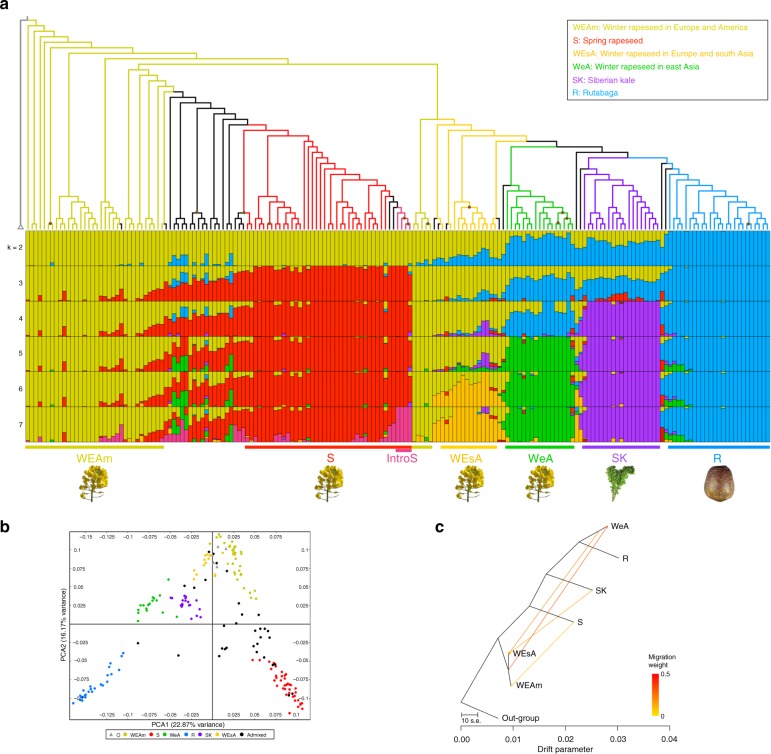
Fig. 1
Fig. 1
Population genetics analyses of 183 B. napus accessions. a Genetic structure and maximum-likelihood phylogeny of B. napus. Five other species from Brassicaceae used to root the phylogenetic tree are shown as a single branch. The fastSTRUCTURE ancestry kinship (K) is shown from 2 to 7. Colors indicate different genetic clusters. Yellow: WEAm; Red: S; Orange: WEsA; Green: WeA; Purple: SK; Blue: R; Pink: IntroS (Introgressed spring rapeseed); Black: genetically diverse accessions; Dark grey: outgroup. Brown dot: bootstrap support values <70%. b Principal component analysis of the 183 B. napus and five outgroup accessions. The B. napus color chart is the same as in a. Grey triangles were added to represent outgroups. c Treemix analysis of the six B. napus genetic clusters. Arrows represent the direction of migrations. Source data of Fig. 1a are provided as a Source Data file
Fig. 2
Fig. 2
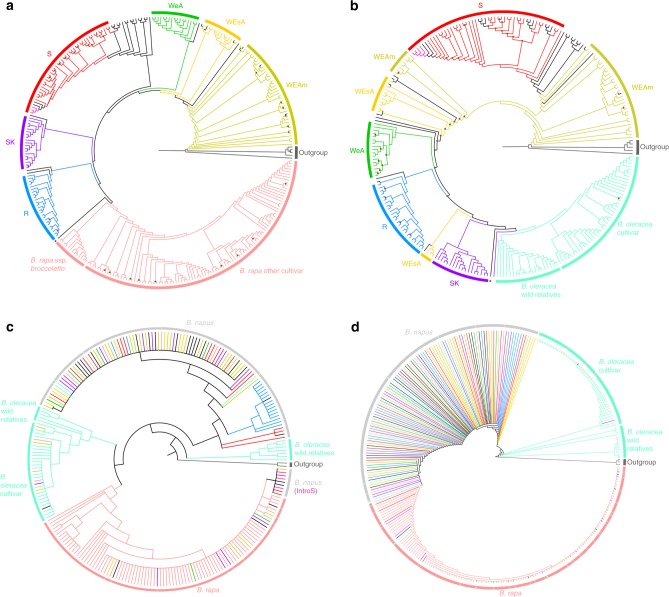
Phylogenetic analyses of B. napus and its progenitors. Maximum-likelihood phylogenetic tree constructed among: a B. napus and B. rapa based on the A sub-genome (24,193 SNPs); b B. napus, B. oleracea, and wild C species based on the C sub-genome (23,387 SNPs); c Chloroplast phylogeny of B. napus and all its progenitor species (B. rapa, B. oleracea, and wild C species) using 62 chloroplast genes; d Mitochondria phylogeny of B. napus and all its progenitor species using 42 mitochondrial genes. *: resynthesized B. napus accession New Hakuran; WEAm: Winter rapeseed in Europe and America; S spring rapeseed, WEsA winter rapeseed in Europe and South Asia, WeA winter rapeseed in East Asia, SK Siberian kale, R rutabaga, IntroS Introgressed spring rapeseed. Brown dot: bootstrap support values <70%; c, d were made with a bootstrap cut off value of 70%
Fig. 3
Fig. 3
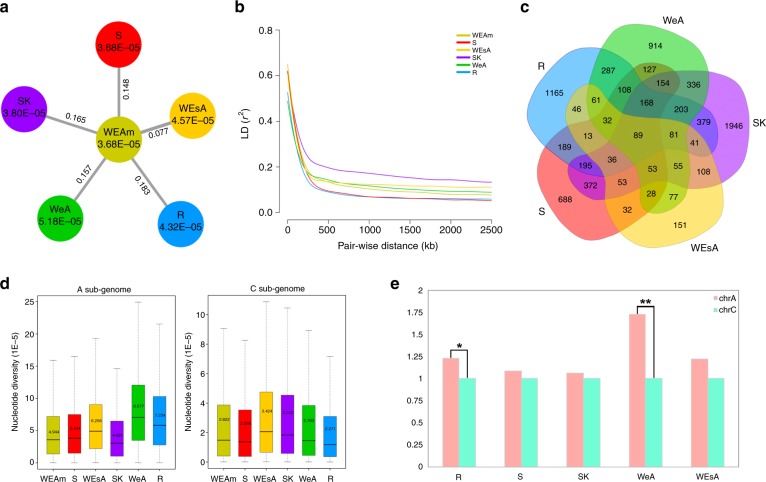
Comparison of different B. napus genetic clusters. a Nucleotide diversity and FST across six genetic clusters. The value in each circle shows nucleotide diversity for this cluster; the value on each line represents the FST between WEAm and another cluster. b Decay of linkage disequilibrium (LD) in each genetic cluster measured by r2. c Venn diagram of differentially expressed genes (DEGs) between WEAm and other genetic clusters. d Nucleotide diversity in each genetic cluster based on separated A and C sub-genomes. The box represents the interquartile range. Band inside each box represents median. Number inside each box represents the mean value. The whiskers represent the minimum and maximum values. e The ratio of (DEGs in A sub-genome)/(DEGs in C sub-genome). *p-value < 0.05 (χ2 test); **p-value < 0.01 (χ2 test). 372,546 SNPs were used for all the analysis in a, b, d. Source data of Fig. 3e are provided as a Source Data file
Fig. 4
Fig. 4
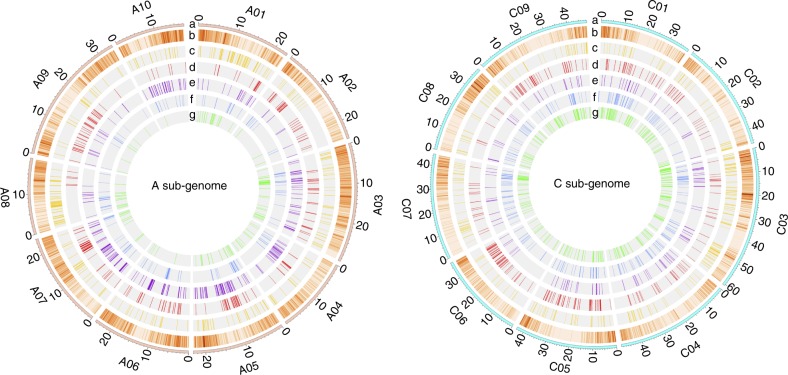
Selective sweep regions among different genetic clusters. Left panel is A sub-genome and right panel is C sub-genome, each with rings labeled ag. a A and C chromosomes of B. napus. b SNP density within a 200 kb window across each chromosome. c–g selective sweep regions. Colors indicate different genetic clusters. Red: S; Orange: WEsA; Green: WeA; Purple: SK; Blue: R
Fig. 5
Fig. 5
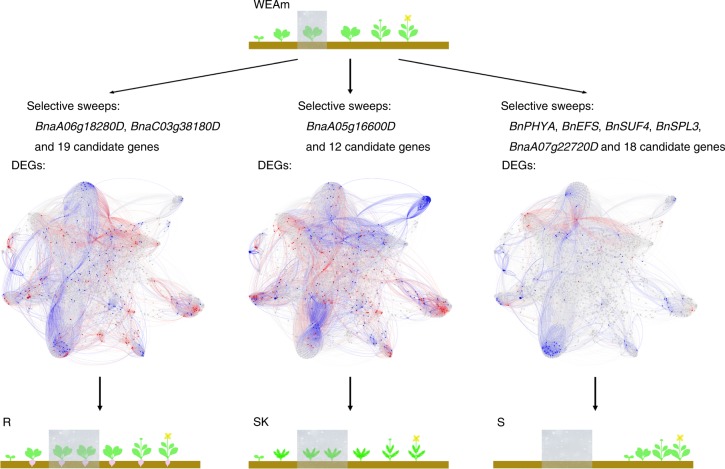
Different diversification processes of B. napus. Plant cartoons were modified from Schiessl et al. (2017) and show the growth cycle of different B. napus, the grey rectangle indicates winter (vernalization). The networks represent biochemical reactions that are catalyzed by enzymes (three middle panels); the colors of the nodes (reactions) in the metabolic networks represent the difference in expression of the B. napus genes that are orthologs to the A. thaliana genes encoding the enzymes for these reactions. Red: overexpressed comparing to WEAm; Blue: underexpressed comparing to WEAm; Grey: no unique DEGs detected. WEAm: Winter rapeseed in Europe and America, S: spring rapeseed, SK: Siberian kale, R: rutabaga

References

    1. Chalhoub B, et al. Early allopolyploid evolution in the post-Neolithic Brassica napus oilseed genome. Science. 2014;345:950–953. doi: 10.1126/science.1253435. - DOI - PubMed
    1. Kimber, D. S. & McGregor, D. I. (eds.). Brassica oilseeds: production and utilization (National Institute of Agricultural Botany, Cambridge, 1995).
    1. Lu K, et al. Whole-genome resequencing reveals Brassica napus origin and genetic loci involved in its improvement. Nat. Commun. 2019;10:1154. doi: 10.1038/s41467-019-09134-9. - DOI - PMC - PubMed
    1. Havlickova L, et al. Validation of an updated Associative Transcriptomics platform for the polyploid crop species Brassica napus by dissection of the genetic architecture of erucic acid and tocopherol isoform variation in seeds. Plant J. 2018;93:181–192. doi: 10.1111/tpj.13767. - DOI - PMC - PubMed
    1. USDA. Oilseeds: world markets and trade. https://downloads.usda.library.cornell.edu/usda-esmis/files/tx31qh68h/ng... (2018).

Publication types