


Cache Valley virus: A scoping review of the global evidence
- PMID: 31254324
- PMCID: PMC6851749
- DOI: 10.1111/zph.12621
Cache Valley virus: A scoping review of the global evidence
Abstract
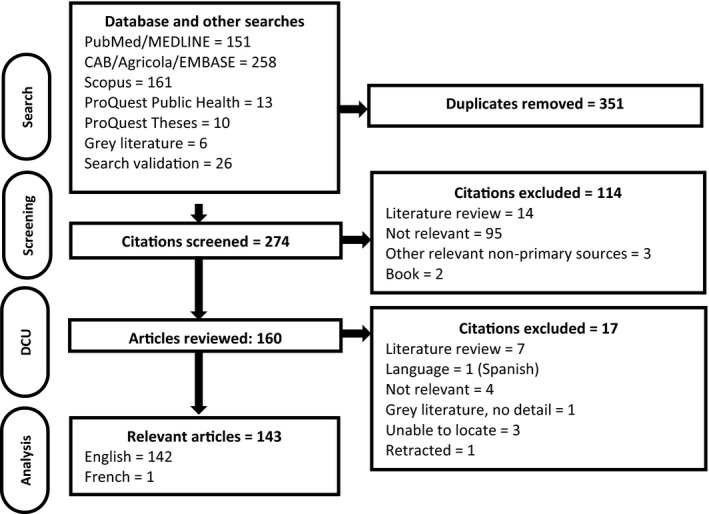
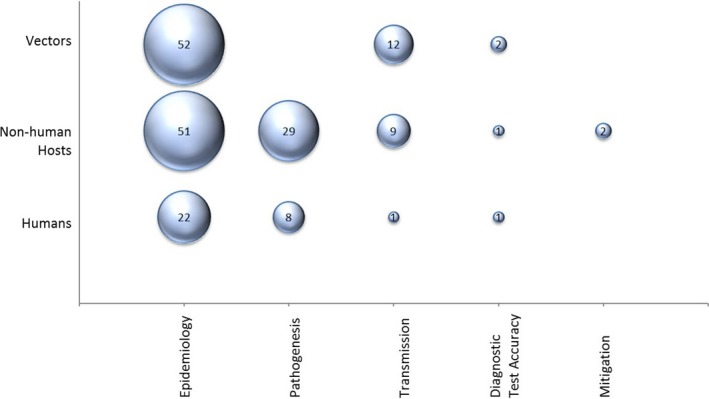
Cache Valley virus (CVV) is a mosquito-borne RNA virus detected throughout North America, Central America and parts of South America. A limited number of human case reports have described severe illness. CVV infection has been associated with outbreaks of congenital defects in small ruminants in Canada and the United States. A scoping review was conducted to identify, characterize and summarize research on CVV, and to identify research gaps. A structured search was conducted in eight electronic databases, with additional search verification and grey literature investigation. All captured studies were independently appraised by two reviewers for relevance and data characterization. The review captured 143 relevant studies investigating CVV epidemiology (n = 104), pathogenesis (n = 37), viral characteristics (n = 24), transmission (n = 14), diagnostic test performance (n = 8) and mitigation strategies (n = 2). Evidence of CVV infection was found in mosquito studies (n = 47), and serological evidence of exposure was demonstrated in animals (n = 41), as well as human (n = 20) studies. In sheep, five outbreaks of birth defects following asymptomatic dam CVV infection during the first 50 days of pregnancy were reported. Only six human cases of CVV-associated illness were captured, with case symptoms described as initially non-specific, progressing to more severe clinical signs (e.g., meningitis). No research was identified investigating treatment, societal knowledge and risk perception, economic burden or predictive models related to the impact of climate change on CVV. CVV circulates in mosquito and animal species across a large area of the Americas. Small ruminants are the only animals in which CVV-associated clinical disease has been extensively studied. It is likely that human cases are under-reported or misdiagnosed. Future research should focus on the impact of CVV infection in human and animal populations.
Keywords: vector-borne diseases; viral pathogens; zoonoses.
© 2019 The Authors. Zoonoses and Public Health Published by Blackwell Verlag GmbH.
Conflict of interest statement
The authors have no conflict of interest to declare.
Figures
References
-
- Aitken, T. H. , & Spence, L. (1963). Virus transmission studies with Trinidadian mosquitoes. III. Cache Valley virus. West Indian Medical Journal, 12, 128–132. - PubMed
-
- Andreadis, T. G. , Armstrong, P. M. , Anderson, J. F. , & Main, A. J. (2014). Spatial‐temporal analysis of Cache Valley virus (Bunyaviridae: Orthobunyavirus) infection in anopheline and culicine mosquitoes (diptera: Culicidae) in the northeastern United States, 1997–2012. Vector‐Borne and Zoonotic Diseases, 14, 763–773. 10.1089/vbz.2014.1669 - DOI - PMC - PubMed
Publication types
MeSH terms
LinkOut - more resources
Full Text Sources
