


Racial differences in the relationship between alcohol/pregnancy policies and birth outcomes and prenatal care utilization: A legal epidemiology study
- PMID: 31255852
- PMCID: PMC6774667
- DOI: 10.1016/j.drugalcdep.2019.04.020
Racial differences in the relationship between alcohol/pregnancy policies and birth outcomes and prenatal care utilization: A legal epidemiology study
Abstract
Objectives: State policies regarding alcohol use during pregnancy (alcohol/pregnancy policies) have been in effect for more than 40 years. Previous research finds some policies increase adverse birth outcomes and decrease prenatal care utilization. This research examines whether effects of alcohol/pregnancy policies vary by race; the general hypothesis is that health benefits of policies are concentrated among White women and health harms of policies are concentrated among Black women.
Methods: This study uses 1972-2015 Vital Statistics data and policy data from NIAAA's Alcohol Policy Information System and original legal research. The dataset includes more than 150 million singleton births. Outcomes are preterm birth (PTB), low birthweight (LBW), and prenatal care utilization. Logistic regression models include raceXpolicy interaction terms as main predictors, adjust for individual- and state-level controls, include fixed effects for state, year and state-specific time trends, and account for clustering by state.
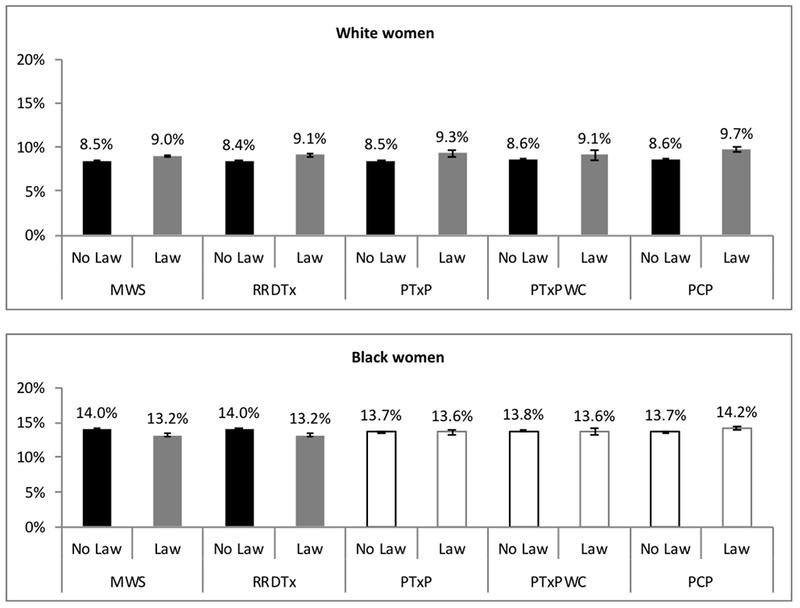
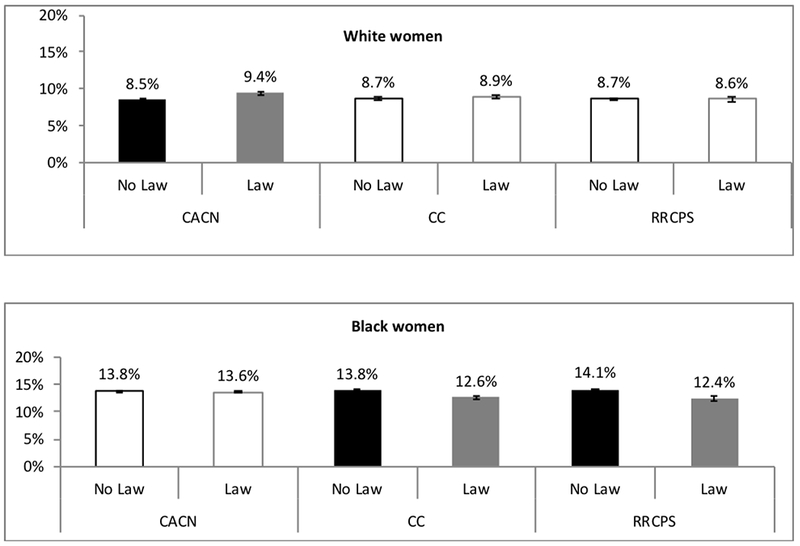
Results: The impact of alcohol/pregnancy policies varied by race for preterm birth, varied in a few cases for low birthweight, and generally did not vary for prenatal care utilization. The hypothesis regarding the direction of differential effects was not supported. Six policies had an adverse impact on PTB and/or LBW for White women. Findings differed for Black women; for Black women, four policies had a beneficial impact for PTB and one had an adverse impact for LBW.
Conclusions: The impact of alcohol/pregnancy policies on birth outcomes varies by race. Future research should explore why some policies appear to have opposite effects for White v. Black women.
Keywords: Alcohol; Legal epidemiology; Pregnancy; Race.
Copyright © 2019 Elsevier B.V. All rights reserved.
Conflict of interest statement
Conflict of Interest
The authors have no conflicts of interest, financial or otherwise, to declare.
Figures
References
-
- Behrman RE, Stith Butler A (Eds.), 2007. Preterm birth: Causes, consequences, and prevention. Institute of Medicine, National Academies Press, Washington, D.C. - PubMed
-
- Centers for Disease Control and Prevention, 2010. Birthweight and gestation. Centers for Disease Control and Prevention, Atlanta, GA.
-
- Centers for Disease Control and Prevention, HRSA, 2000. Healthy people 2010: Maternal, infant, and child health. Centers for Disease Control and Prevention, Atlanta, GA.
-
- Chasnoff IJ, Landress HJ, Barrett ME, 1990. The prevalence of illicit-drug or alcohol use during pregnancy and discrepancies in mandatory reporting in Pinellas County, Florida. N. Engl. J. Med 322, 1202–1206. - PubMed
-
- Cil G, 2017. Effects of posted point-of-sale warnings on alcohol consumption during pregnancy and on birth outcomes. J. Health Econ 53, 131–155. - PubMed
Publication types
MeSH terms
Grants and funding
LinkOut - more resources
Full Text Sources
Medical
