


Predictors of transportation delay in patients with suspected ST-elevation-myocardial infarction in the VIENNA-STEMI network
- PMID: 31256260
- PMCID: PMC7042186
- DOI: 10.1007/s00392-019-01520-z
Predictors of transportation delay in patients with suspected ST-elevation-myocardial infarction in the VIENNA-STEMI network
Abstract
Objective: The emergency medical service (EMS) provides rapid pre-hospital diagnosis and transportation in ST-elevation myocardial infarction (STEMI) systems of care. Aim of the study was to assess temporal and regional characteristics of EMS-related delays in a metropolitan STEMI network.
Methods: Patient call-to-arrival of EMS at site (call-to-site), transportation time from site to hospital (site-to-door), call-to-door, patient's location, month, weekday, and hour of EMS activation were recorded in 4751 patients referred to a tertiary center with suspicion of STEMI.
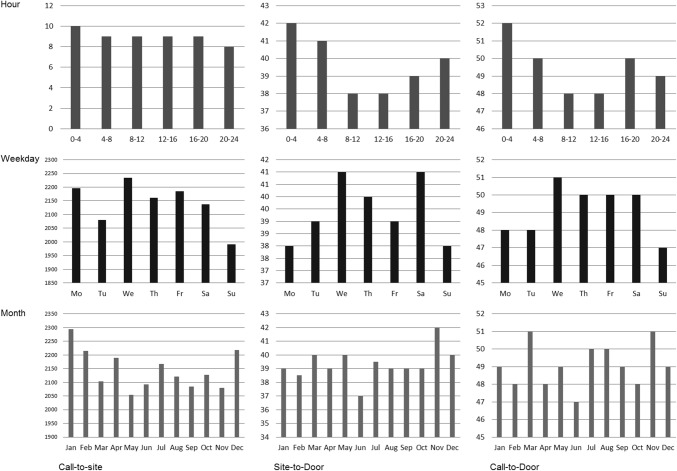
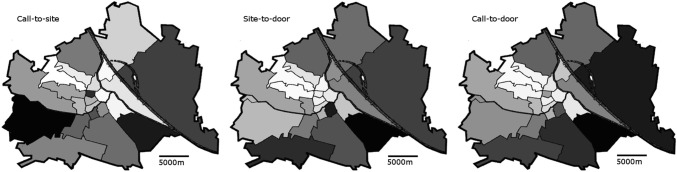
Results: Median call-to-site, site-to-door, and call-to-door times were 9 (7-12), 39 (31-48), and 49 (41-59) minutes, respectively. The shortest transportation times were noted between 08:00 and 16:00 and in general on Sundays. They were significantly prolonged between midnight and 04:00, whereby the longest difference did not exceed 4 min in median. Patient's site of call had a major impact on transportation times, which were shorter in Central and Western districts as compared to Southern and Eastern districts of Vienna (p < 0.001 between-group difference for call-to-site, site-to-door, and call-to-door). After multivariable adjustment, patient's site of call was an independent predictor of call-to-site delay (p < 0.001). Moreover, age and hour of EMS activation were the strongest predictors of call-to-site, site-to-door, and call-to-door delays (p < 0.05).
Conclusion: In our Viennese STEMI network, the strongest determinants of pre-hospital EMS-related transportation delays were patient's site of call, patient's age, and hour of EMS activation. Due to the significant but small median time delays, which are within the guideline-recommended time intervals, no impact on clinical outcome can be expected.
Keywords: EMS; Emergency medical system; ST-elevation myocardial infarction; STEMI; System delay; Transportation delay.
Conflict of interest statement
The authors declare that there is no conflict of interest.
Figures
References
-
- Ibanez B, James S, Agewall S, Antunes MJ, Bucciarelli-Ducci C, Bueno H, Caforio ALP, Crea F, Goudevenos JA, Halvorsen S, Hindricks G, Kastrati A, Lenzen MJ, Prescott E, Roffi M, Valgimigli M, Varenhorst C, Vranckx P, Widimsky P. 2017 ESC Guidelines for the management of acute myocardial infarction in patients presenting with ST-segment elevation: the task force for the management of acute myocardial infarction in patients presenting with ST-segment elevation of the European Society of Cardiology (ESC) Eur Heart J. 2017;15:15. doi: 10.1093/eurheartj/ehx393. - DOI - PubMed
-
- Huber K, Goldstein P, Danchin N, Fox KA, Welsh R, Granger CB, Henry T, Gersh BJ. Enhancing the efficacy of delivering reperfusion therapy: A European and North American experience with ST-segment elevation myocardial infarction networks. Am Heart J. 2013;165(2):123–132. doi: 10.1016/j.ahj.2012.10.032. - DOI - PubMed
-
- Zahler D, Lee-Rozenfeld K, Ravid D, Rozenbaum Z, Banai S, Keren G, Shacham Y. Relation of lowering door-to-balloon time and mortality in ST segment elevation myocardial infarction patients undergoing percutaneous coronary intervention. Clin Res Cardiol. 2019 doi: 10.1007/s00392-019-01438-6. - DOI - PubMed
-
- Knot J, Widimsky P, Wijns W, Stenestrand U, Kristensen SD, Van THA, Weidinger F, Janzon M, Norgaard BL, Soerensen JT, van de Wetering H, Thygesen K, Bergsten PA, Digerfeldt C, Potgieter A, Tomer N, Fajadet J. How to set up an effective national primary angioplasty network: lessons learned from five European countries. EuroIntervention. 2009;5(3):301–309. - PubMed
MeSH terms
LinkOut - more resources
Full Text Sources
Medical
Miscellaneous
