Review
. 2019 Aug;20(2):1479-1487.
doi: 10.3892/mmr.2019.10374. Epub 2019 Jun 11.

Cholinesterase inhibitors as Alzheimer's therapeutics (Review)

Affiliations
Review

Cholinesterase inhibitors as Alzheimer's therapeutics (Review)

Kamlesh Sharma. Mol Med Rep. 2019 Aug.

Abstract

Alzheimer's disease (AD) is one of the most common forms of dementia. AD is a chronic syndrome of the central nervous system that causes a decline in cognitive function and language ability. Cholinergic deficiency is associated with AD, and various cholinesterase inhibitors have been developed for the treatment of AD, including naturally‑derived inhibitors, synthetic analogues and hybrids. Currently, the available drugs for AD are predominantly cholinesterase inhibitors. However, the efficacy of these drugs is limited as they may cause adverse side effects and are not able to completely arrest the progression of the disease. Since AD is multifactorial disease, dual and multi‑target inhibitors have been developed. The clinical applications and the limitations of the inhibitors used to treat AD are discussed in the present review. Additionally, this review presents the current status and future directions for the development of novel drugs with reduced toxicity and preserved pharmacological activity.


Figures

Figure 1.
Figure 1.
Schematic representation of AChE catalysis. AChE, acetylcholinesterase.
Figure 2.
Figure 2.
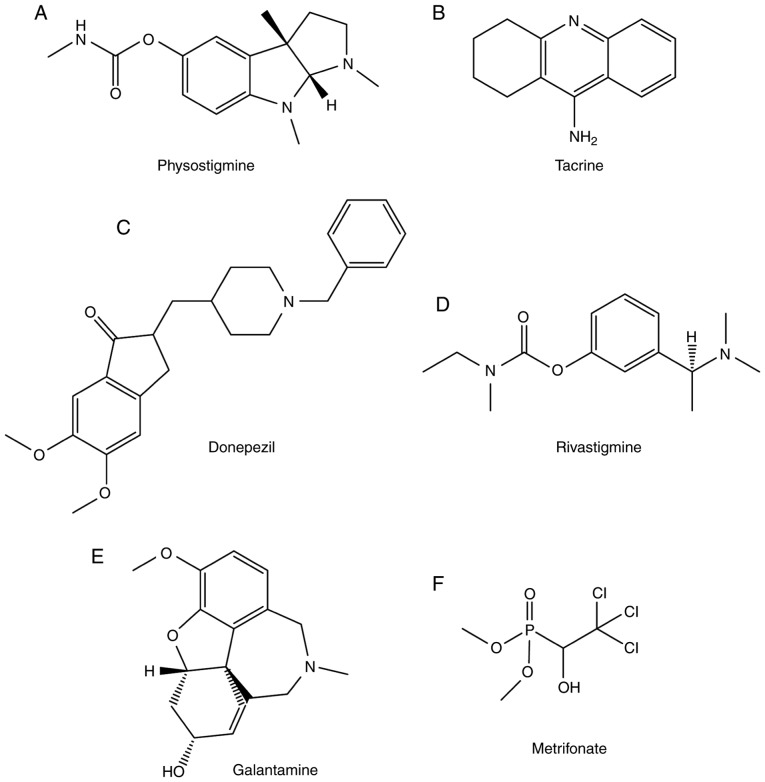
Traditional cholinesterase inhibitors. The molecular structures of (A) physostigmine, (B) tacrine, (C) donepezil, (D) rivastigmine, (E) galantamine and (F) metrifonate are presented.
Figure 3.
Figure 3.
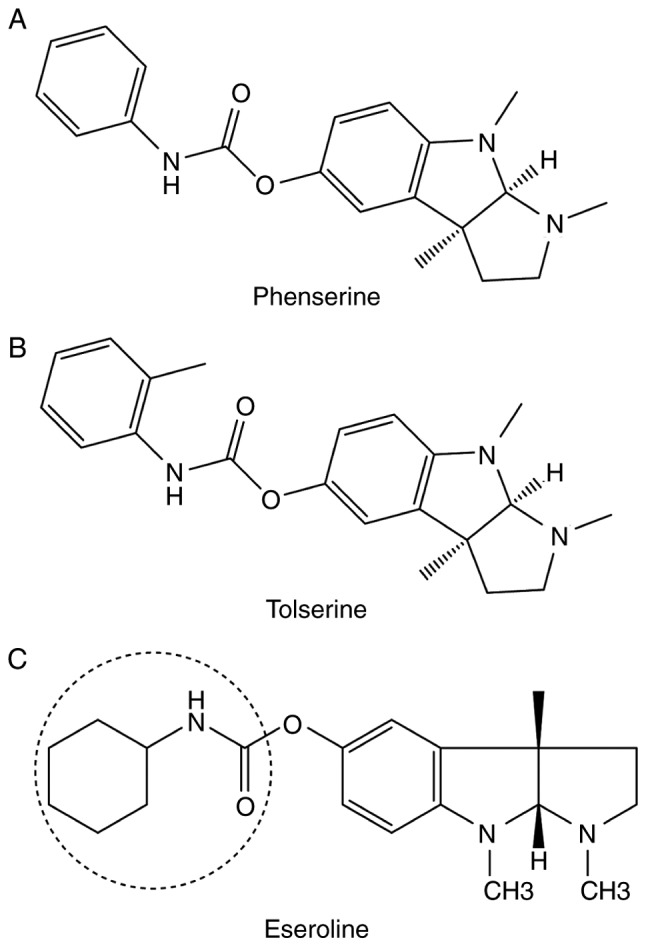
Novel cholinesterase inhibitors. The molecular structures of (A) phenserine, (B) tolserine and (C) eseroline are presented. The circle indicates the active moiety of eseroline.
Figure 4.
Figure 4.
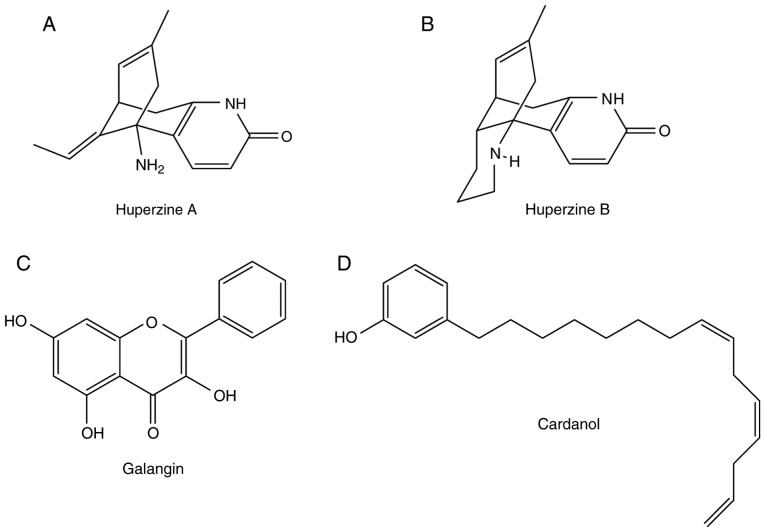
Naturally-derived cholinesterase inhibitors. The molecular structures of (A) huperzine A, (B) huperzine B, (C) galangin and (D) cardanol are presented.
Figure 5.
Figure 5.
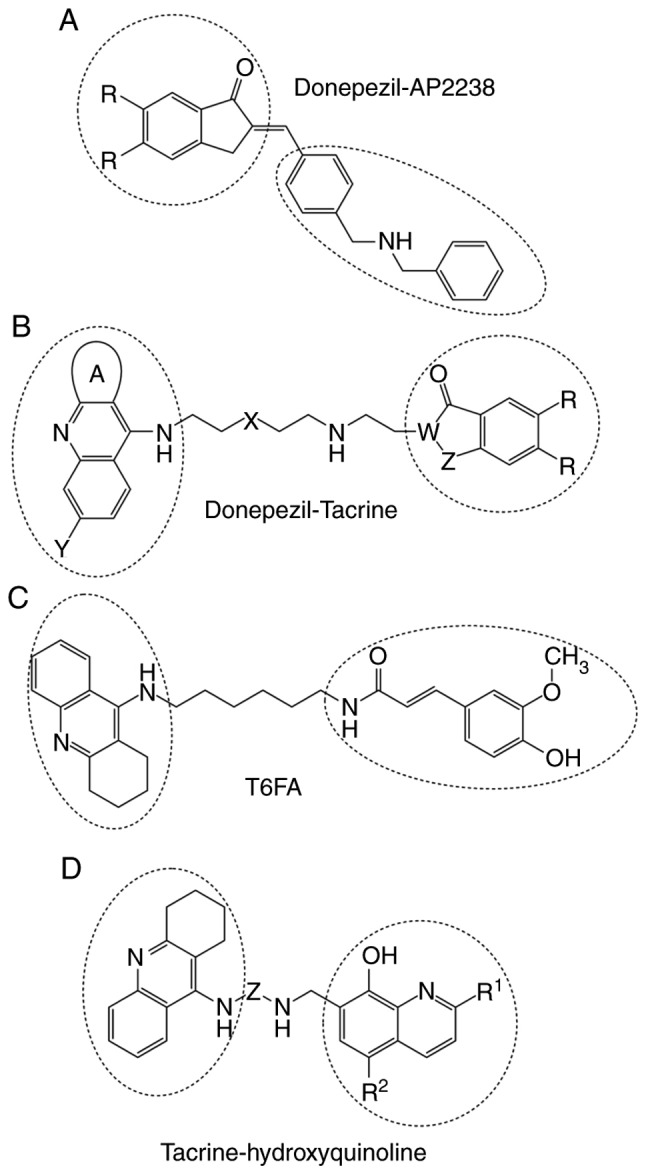
Hybrid cholinesterase inhibitors. The molecular structures of (A) donepezil-AP2238, (B) donepezil-tacrine, (C) T6FA and (D) tacrine-hydroxyquinoline are presented. The drugs forming the hybrids are indicated by circles.
Figure 6.
Figure 6.
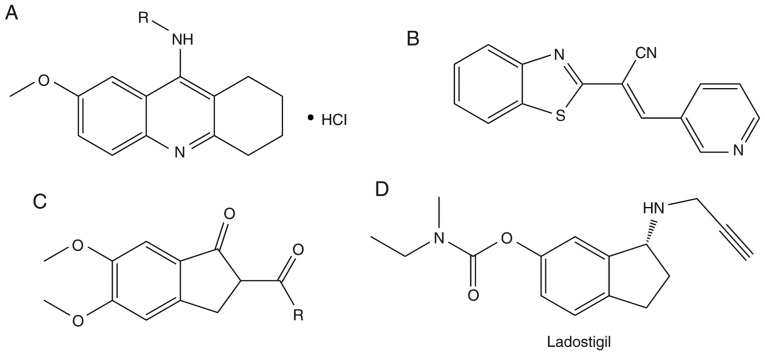
Synthetic analogues of cholinesterase inhibitors. (A) Tacrine analogue, (B) heteroarylacrylonitrile derivative, (C) indenyl derivative and (D) Ladostigil.

References

    1. Khachaturian ZS. Diagnosis of alzheimer's disease. Arch Neurol. 1985;42:1097–1105. doi: 10.1001/archneur.1985.04060100083029. - DOI - PubMed
    1. Kuhn D. New horizons. Contemporary longterm care. 2003;26:25–26. - PubMed
    1. Cheng ST. Cognitive reserve and the prevention of dementia: The role of physical and cognitive activities. Curr Psychiatry Rep. 2016;18:85. doi: 10.1007/s11920-016-0721-2. - DOI - PMC - PubMed
    1. Silman I, Sussman JL. Acetylcholinesterase: Classical and non-classical functions and pharmacology. Curr Opin Pharmacol. 2005;5:293–302. doi: 10.1016/j.coph.2005.01.014. - DOI - PubMed
    1. Bartus RT, Dean RL, III, Beer B, Lippa AS. The cholinergic hypothesis of geriatric memory dysfunction. Science. 1982;217:408–417. doi: 10.1126/science.7046051. - DOI - PubMed

MeSH terms