Herpesvirus acts with the cytoskeleton and promotes cancer progression
- PMID: 31258722
- PMCID: PMC6584404
- DOI: 10.7150/jca.30222
Herpesvirus acts with the cytoskeleton and promotes cancer progression
Abstract
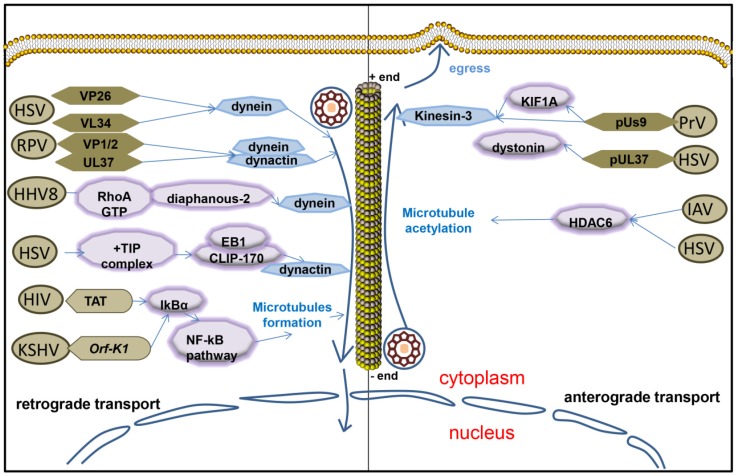
The cytoskeleton is a complex fibrous reticular structure composed of microfilaments, microtubules and intermediate filaments. These components coordinate morphology support and intracellular transport that is involved in a variety of cell activities, such as cell proliferation, migration and differentiation. In addition, the cytoskeleton also plays an important role in viral infection. During an infection by a Herpesvirus, the virus utilizes microfilaments to enter cells and travel to the nucleus by microtubules; the viral DNA replicates with the help of host microfilaments; and the virus particles start assembling with a capsid in the cytoplasm before egress. The cytoskeleton changes in cells infected with Herpesvirus are made to either counteract or obey the virus, thereby promote cell transforming into cancerous ones. This article aims to clarify the interaction between the virus and cytoskeleton components in the process of Herpesvirus infection and the molecular motor, cytoskeleton-associated proteins and drugs that play an important role in the process of a Herpesvirus infection and carcinogenesis process.
Keywords: Herpesvirus; cancer; cytoskeleton; drugs; infection.
Conflict of interest statement
Competing Interests: The authors have declared that no competing interest exists.
Figures

References
-
- Roizman B, Carmichael LE, Deinhardt F. et al. Herpesviridae. Intervirology. 1981;16:201–17. - PubMed
-
- Dang L, Teng M, Li HZ. et al. Marek's disease virus type 1 encoded analog of miR-155 promotes proliferation of chicken embryo fibroblast and DF-1 cells by targeting hnRNPAB. Vet Microbiol. 2017;207:210–8. - PubMed
-
- Li L, Gu B, Zhou F. et al. Human herpesvirus 6A infects human embryonic fibroblasts and induces G2/M arrest and cell death. J Med Virol. 2012;84:657–63. - PubMed
-
- Tu C, Zeng Z, Qi P. et al. Identification of genomic alterations in nasopharyngeal carcinoma and nasopharyngeal carcinoma-derived Epstein-Barr virus by whole-genome sequencing. Carcinogenesis. 2018;39:1517–28. - PubMed
Publication types
LinkOut - more resources
Full Text Sources