. 2019 Jun 28;5(6):eaav6187.
doi: 10.1126/sciadv.aav6187. eCollection 2019 Jun.

Autofocals: Evaluating gaze-contingent eyeglasses for presbyopes

Affiliations

Autofocals: Evaluating gaze-contingent eyeglasses for presbyopes

Nitish Padmanaban et al. Sci Adv. .

Abstract

As humans age, they gradually lose the ability to accommodate, or refocus, to near distances because of the stiffening of the crystalline lens. This condition, known as presbyopia, affects nearly 20% of people worldwide. We design and build a new presbyopia correction, autofocals, to externally mimic the natural accommodation response, combining eye tracker and depth sensor data to automatically drive focus-tunable lenses. We evaluated 19 users on visual acuity, contrast sensitivity, and a refocusing task. Autofocals exhibit better visual acuity when compared to monovision and progressive lenses while maintaining similar contrast sensitivity. On the refocusing task, autofocals are faster and, compared to progressives, also significantly more accurate. In a separate study, a majority of 23 of 37 users ranked autofocals as the best correction in terms of ease of refocusing. Our work demonstrates the superiority of autofocals over current forms of presbyopia correction and could affect the lives of millions.


Figures
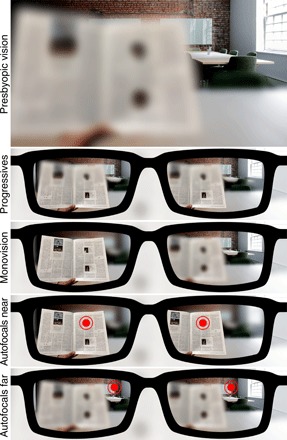
Fig. 1
Fig. 1. Typical presbyopic vision with various methods of correction.
Without any correction, near distances are blurry. Progressives and monovision allow focus to both near and far distances by either splitting up the field of view or using different eyes for each distance, as illustrated. Autofocals use information from each eye’s gaze to dynamically update the focus to near or far. (Foreground image: Nitish Padmanaban, Stanford; background image: https://pxhere.com/en/photo/1383278).
Fig. 2
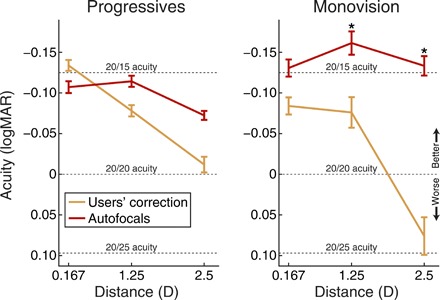
Fig. 2. Acuity measurements for presbyopes wearing their own correction compared to wearing autofocals.
(Left) Average acuities for users that typically wear progressive lens either using their own correction or while wearing autofocals. (Right) Average acuities for monovision wearers using their own correction or wearing autofocals. Autofocals are, on average, better than the users’ own corrections at nearly all compared distances and are comparable to progressives at the farthest distance. Asterisks indicate significance at the *P = 0.05 level. Error bars represent SE.
Fig. 3
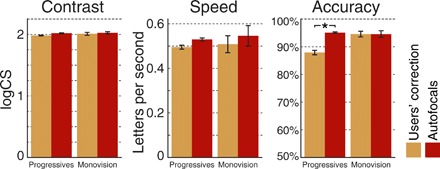
Fig. 3. Contrast sensitivity and task performance for presbyopes wearing their own correction compared to wearing autofocals.
(Left) Average log contrast sensitivities (logCS) grouped by users’ usual correction (progressives or monovision) and whether they were wearing their own correction or autofocals. All corrections perform similarly. (Middle) The average speed and (right) accuracy for the refocusing task, grouped by usual correction and whether they used autofocals. Baseline for accuracy is set to 50%, corresponding to random guessing. Autofocals are faster on average than user’s own corrections while not sacrificing accuracy, and are significantly better for accuracy than progressives (*P < 0.05). Error bars represent SE.
Fig. 4
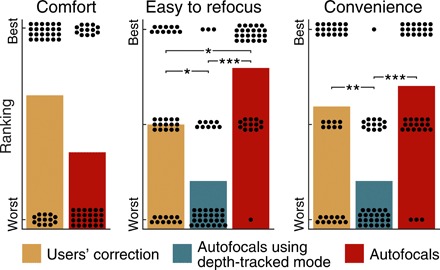
Fig. 4. Rankings from the three preference questions.
Each black dot represents a user ranking. (Left) The users’ own corrections are more physically comfortable, even with only a short period of wear. Some prefer autofocals, citing lack of a need to crane their necks back. (Middle) On the other hand, the ease of refocus question shows a clear preference for autofocals, especially over the depth-tracked mode (i.e., eye tracking disabled). (Right) Autofocals are also preferred for convenience, although only slightly over their current correction. Again, the depth-tracked mode fares poorly. Significance is indicated at the *P = 0.05, **P = 0.01, and ***P = 0.001 levels.
Fig. 5
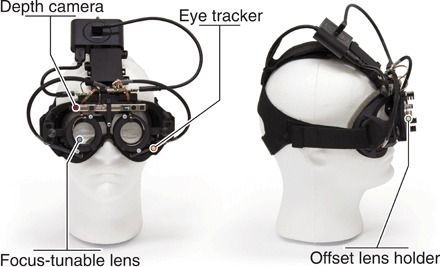
Fig. 5. Front and side views of our autofocal prototype.
The RealSense R200 depth camera, the Optotune EL-30-45 focus-tunable lenses, the offset lens holders for prescription correction, and the Pupil Labs eye trackers are shown. (Photo credit: Nitish Padmanaban, Stanford).

References

    1. Duane A., Normal values of the accommodation at all ages. JAMA 59, 1010–1013 (1912).
    1. Holden B. A., Fricke T. R., Ho S. M., Wong R., Schlenther G., Cronjé S., Burnett A., Papas E., Naidoo K. S., Frick K. D., Global vision impairment due to uncorrected presbyopia. Arch. Ophthalmol. 126, 1731–1739 (2008). - PubMed
    1. UN DESA, World Population Prospects: The 2017 Revision, Key Findings and Advance Tables (United Nations Department Of Economic And Social Affairs, 2017).
    1. Charman W. N., Developments in the correction of presbyopia I: Spectacle and contact lenses. Ophthalmic Physiol. Opt. 34, 8–29 (2014). - PubMed
    1. Lord S. R., Dayhew J., Howland A., Multifocal glasses impair edge-contrast sensitivity and depth perception and increase the risk of falls in older people. J. Am. Geriatr. Soc. 50, 1760–1766 (2002). - PubMed

Publication types