


Evaluating construct equivalence of youth depression measures across multiple measures and multiple studies
- PMID: 31259571
- PMCID: PMC6716510
- DOI: 10.1037/pas0000737
Evaluating construct equivalence of youth depression measures across multiple measures and multiple studies
Abstract
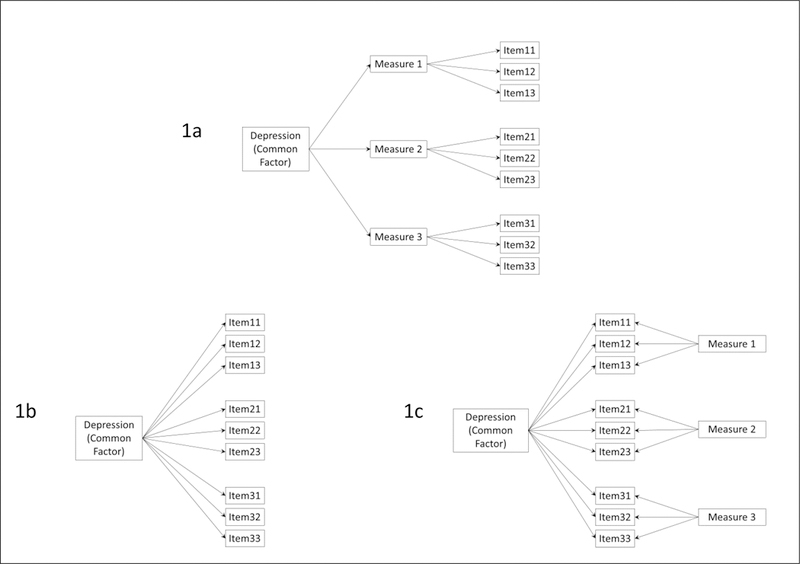
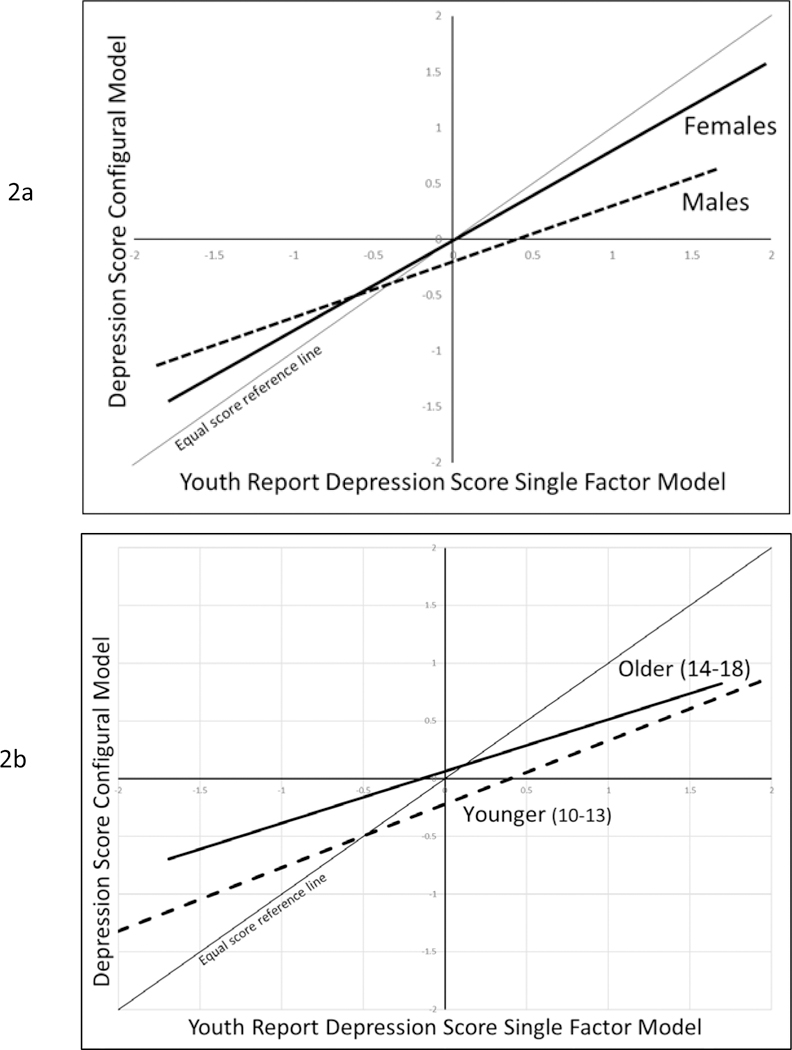
Construct equivalence of measures across studies is necessary for synthesizing results when combining data in meta-analysis or integrative data analysis. We discuss several assumptions required for construct equivalence, and review methods using individual-level data and item response theory (IRT) analysis for detecting or adjusting for violations of these assumptions. We apply IRT to data from 7 measures of depressive symptoms for 4,283 youth from 16 randomized prevention trials. Findings indicate that these data violate assumptions of conditional independence. Bifactor IRT models find that depression measures contain substantial reporter variance, and indicate that a single common factor model would be substantially biased. Separate analyses of ratings by youth find stronger evidence for construct equivalence, but factor invariance across sex and age does not hold. We conclude that data synthesis studies employing measures of youth depression should analyze results separately by reporter, explore more complex approaches to integrate these different perspectives, and explore methods that adjust for sex and age differences in item functioning. (PsycINFO Database Record (c) 2019 APA, all rights reserved).
Figures
Similar articles
-
Comparing five depression measures in depressed Chinese patients using item response theory: an examination of item properties, measurement precision and score comparability.Health Qual Life Outcomes. 2017 Apr 4;15(1):60. doi: 10.1186/s12955-017-0631-y. Health Qual Life Outcomes. 2017. PMID: 28372559 Free PMC article.
-
Measuring depression over time . . . Or not? Lack of unidimensionality and longitudinal measurement invariance in four common rating scales of depression.Psychol Assess. 2016 Nov;28(11):1354-1367. doi: 10.1037/pas0000275. Epub 2016 Jan 28. Psychol Assess. 2016. PMID: 26821198
-
Measurement invariance and psychometric analysis of Kutcher Adolescent Depression Scale across gender and marital status.J Affect Disord. 2019 Jun 15;253:394-401. doi: 10.1016/j.jad.2019.05.010. Epub 2019 May 6. J Affect Disord. 2019. PMID: 31103804
-
Matching IRT Models to Patient-Reported Outcomes Constructs: The Graded Response and Log-Logistic Models for Scaling Depression.Psychometrika. 2021 Sep;86(3):800-824. doi: 10.1007/s11336-021-09802-0. Epub 2021 Aug 31. Psychometrika. 2021. PMID: 34463910 Free PMC article. Review.
-
An essay on measurement and factorial invariance.Med Care. 2006 Nov;44(11 Suppl 3):S69-77. doi: 10.1097/01.mlr.0000245438.73837.89. Med Care. 2006. PMID: 17060838 Review.
Cited by
-
The Impact of Sparse Datasets When Harmonizing Data from Studies with Different Measures of the Same Construct.Prev Sci. 2024 Aug;25(6):989-1002. doi: 10.1007/s11121-024-01704-8. Epub 2024 Jul 18. Prev Sci. 2024. PMID: 39023719
-
Design and methodology for an integrative data analysis of coping power: Direct and indirect effects on adolescent suicidality.Contemp Clin Trials. 2022 Apr;115:106705. doi: 10.1016/j.cct.2022.106705. Epub 2022 Feb 14. Contemp Clin Trials. 2022. PMID: 35176503 Free PMC article.
-
Trends in parent-rated emotional symptoms, conduct problems, and hyperactivity/inattention among U.S. children and adolescents, 2004-2019.J Affect Disord. 2022 Feb 15;299:294-297. doi: 10.1016/j.jad.2021.12.024. Epub 2021 Dec 12. J Affect Disord. 2022. PMID: 34910959 Free PMC article.
-
Harmonizing Social, Emotional, and Behavioral Constructs in Prevention Science: Digging into the Weeds of Aligning Disparate Measures.Prev Sci. 2023 Nov;24(8):1581-1594. doi: 10.1007/s11121-022-01467-0. Epub 2023 Feb 8. Prev Sci. 2023. PMID: 36753042
-
Conceptual, methodological, and measurement factors that disqualify use of measurement invariance techniques to detect informant discrepancies in youth mental health assessments.Front Psychol. 2022 Aug 2;13:931296. doi: 10.3389/fpsyg.2022.931296. eCollection 2022. Front Psychol. 2022. PMID: 35983202 Free PMC article. Review.
References
-
- Achenbach TM (1991). Manual for the Child Behavior Checklist/4–18 and 1991 Profile. Burlington, VT: Department of Psychology.
-
- Achenbach TM (1991). Manual for the Youth Self Report and 1991 Profile. Burlington, VT: Department of Psychology.
-
- Asparouhov T, & Muthén BO (2012). Comparison of computational methods for high dimensional item factor analysis. MPLUS Technical Report. https://www.statmodel.com/download/HighDimension11.pdf
-
- Asparouhov T, & Muthén B (2014). Multiple-Group Factor Analysis Alignment. Structural Equation Modeling, 21(4), 495–508. doi:10.1080/10705511.2014.919210 - DOI
