


Intimate partner violence and associated factors among pregnant women attending antenatal care service in Debre Markos town health facilities, Northwest Ethiopia
- PMID: 31260469
- PMCID: PMC6602189
- DOI: 10.1371/journal.pone.0218722
Intimate partner violence and associated factors among pregnant women attending antenatal care service in Debre Markos town health facilities, Northwest Ethiopia
Abstract
Background: Intimate partner violence is a thoughtful public health concern and human rights violation towards pregnant women for it has a significant negative health effect on the life of both the mother and her fetus. However, there is a scanty of information about the extent of intimate partner violence during pregnancy in Ethiopia, particularly in the study area. Therefore, the current study was conducted to determine the prevalence of intimate partner violence among pregnant women attending antenatal care and identify associated factors that cause it.
Methods: An institution based cross-sectional study was conducted on 409 pregnant women who were attending antenatal care service in Debre Markos town from March 17, 2018 -April 28, 2018. Systematic random sampling technique was used to select study participants. A pre-tested structured questionnaire was used to collect the data. Bivariable and Multivariable logistic regression models were done. Adjusted odds ratio with 95% confidence interval was used to identify factors associated with intimate partner violence during pregnancy.
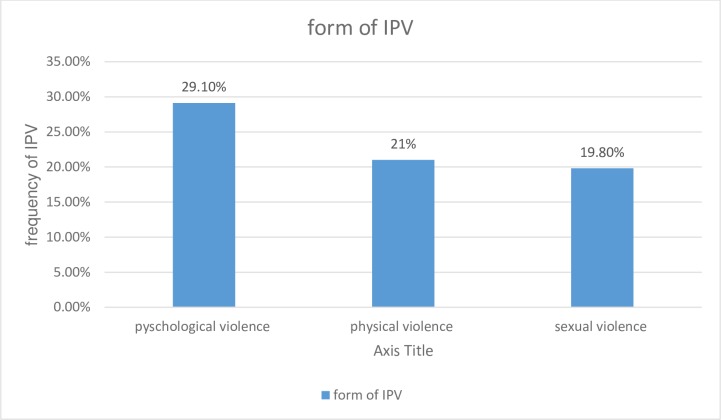
Results: The prevalence of intimate partner violence during current pregnancy was found to be 41.1% (95% confidence interval (CI): 36.0-46.0). Of this, the prevalence of psychological, physical, and sexual violence was 29.1%, 21%, 19.8% respectively. Lower educational status of partners (AOR = 3.26, 95%CI: 1.45-7.36), rural residency (AOR = 4.04, 95%CI: 1.17-13.93), frequent alcohol abuse by partner (AOR = 4.79, 95% CI: 2.08-11.04), early initiation of antenatal care (AOR = 0.44, 95% CI: 0.24-0.81), the age of women between 17-26 years (Adjusted odds ratio (AOR) = 0.21, 95%CI: 0.09-0.49),choice of partner by the women only (AOR = 3.26,95% CI:1.24-8.57) were statistically significant factors associated with intimate partner violence towards pregnant women.
Conclusions: In this study, the prevalence of intimate partner violence during pregnancy is found to be high. As a result, interventions that would address the above mentioned factors need to be implemented.
Conflict of interest statement
The authors have declared that no competing interests exist.
Figures
References
-
- Donovan B., et al. , Intimate partner violence during pregnancy and the risk for adverse infant outcomes: a systematic review and meta‐analysis. BJOG: An International Journal of Obstetrics & Gynaecology, 2016. 123(8): p. 1289–1299. - PubMed
-
- Declaration, B. Platform for Action in Fourth World Conference on Women. 1995.
-
- Garcia-Moreno C., et al. , Prevalence of intimate partner violence: findings from the WHO multi-country study on women's health and domestic violence. The lancet, 2006. 368(9543): p. 1260–1269. - PubMed
-
- da Costa Marques D.F., Intimate Partner Violence During Pregnancy. 2012.
MeSH terms
LinkOut - more resources
Full Text Sources
Medical
Research Materials
Miscellaneous
