


Aristolochic Acid and Immunotherapy for Urothelial Carcinoma: Directions for unmet Needs
- PMID: 31261684
- PMCID: PMC6650931
- DOI: 10.3390/ijms20133162
Aristolochic Acid and Immunotherapy for Urothelial Carcinoma: Directions for unmet Needs
Abstract
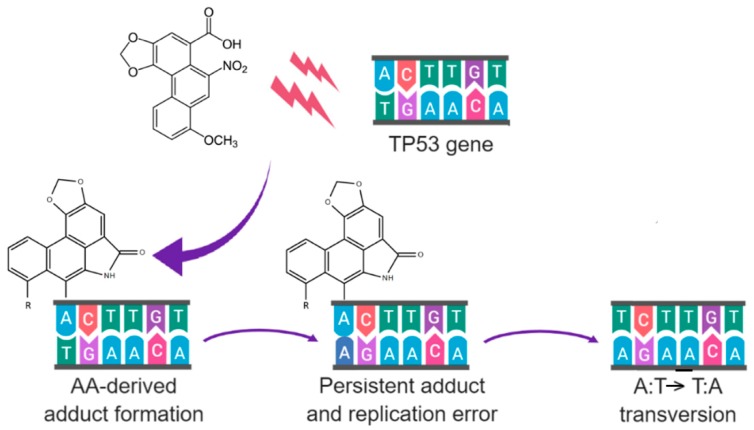
Urothelial carcinoma of the bladder (UCB) and upper tracts (UTUC) used to share management with similar principles. However, their genetic and epigenetic differences along with different responses to immunotherapy were recently identified, which are reminiscent of their distinct etiologies. Different from the variety of environmental factors relating to UCB, UTUC is best known for its close relationship with exposure to aristolochic acid (AA). AA is believed to cause its carcinogenicity through forming DNA adducts of deoxyadenosine-aristolactam, as well as A:T → T:A transversions in the TP53 tumor suppressor gene. Since recent findings suggested that cancers with higher somatic mutations are associated with better treatment responses upon immune checkpoint blockade, UTUC and AA-related biomarkers reasonably serve as good candidates, as well as a potential prognostic predictor for the flourishing immunotherapy. This review covers the current state of the literature on the clinical response of UTUC and UCB receiving immunotherapy and points out directions for refinement regarding patient selection.
Keywords: aristolochic acid; immune checkpoint inhibitors; mutation load; upper tract urothelial carcinoma; urothelial carcinoma of the bladder.
Conflict of interest statement
The authors declare no conflict of interest.
Figures
References
-
- Rouprêt M., Babjuk M., Comperat E., Zigeuner R., Sylvester R.J., Burger M., Cowan N.C., Böhle A., van Rhijn B.W., Kaasinen E. European association of urology guidelines on upper urinary tract urothelial cell carcinoma: 2015 update. Eur. Urol. 2015;68:868–879. doi: 10.1016/j.eururo.2015.06.044. - DOI - PubMed
Publication types
MeSH terms
Substances
Grants and funding
LinkOut - more resources
Full Text Sources
Medical
Research Materials
Miscellaneous
