. 2019 Jul 1;9(1):9467.
doi: 10.1038/s41598-019-45768-x.

A novel method for rapid detection of a Helicobacter pylori infection using a γ-glutamyltranspeptidase-activatable fluorescent probe

Affiliations

A novel method for rapid detection of a Helicobacter pylori infection using a γ-glutamyltranspeptidase-activatable fluorescent probe

Taro Akashi et al. Sci Rep. .

Abstract

A γ-glutamyl hydroxymethyl rhodamine green probe (gGlu-HMRG) reacts with γ-glutamyltranspeptidase (GGT) and immediately produces fluorescence, is clinically applied for real-time cancers' visualization. Since Helicobacter pylori produces GGT, this study aimed to investigate whether gGlu-HMRG can be used to detect H. pylori infections. A wild-type H. pylori strain and the ggt gene-disrupted mutant were cultured and treated with gGlu-HMRG. This fluorescent probe assay was used to quantify GGT activity of H. pylori ex vivo using gastric biopsy specimens. The H. pylori diagnostic capabilities of the assay were determined from altered fluorescence intensity (FI) values at 5 min (FIV-5) and 15 minutes (FIV-15). Distinct fluorescence was identified in wild H. pylori strain, using gGlu-HMRG, whereas no fluorescence was observed in ggt gene-disrupted mutant strain. On ex vivo imaging of gGlu-HMRG, fluorescence intensity increased markedly with time in H. pylori-positive specimens; however, the H. pylori-negative specimens displayed a slight increase in FI. FIV-5 and FIV-15 differed significantly between H. pylori-positive and -negative specimens. FIV-15 differed significantly between H. pylori-positive and -eradicated group. This assay sensitivity and specificity were 75.0% and 83.3% in the antrum and 82.6% and 89.5% in the stomach body. GGT-activatable fluorescence probe is applicable for rapid diagnosis of H. pylori.


Conflict of interest statement

The authors declare no competing interests.

Figures
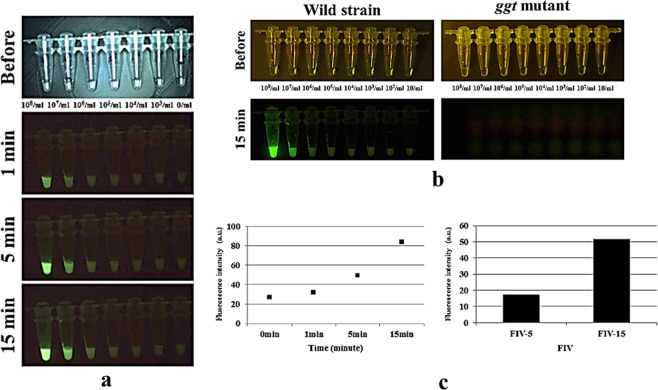
Figure 1
Figure 1
(a) The H. pylori strain 26695 and the ggt gene-disrupted mutant strain were cultured and reacted with 50 μM of γ-glutamyl hydroxymethyl rhodamine green probe (gGlu-HRMG) in phosphate-buffered saline (PBS). Experiments were performed at densities ranging from 10 cells/ml to 108 cells/ml. The wild-type H. pylori strain emitted green fluorescence over time. (b) The ggt-gene disrupted mutant strain emitted nil fluorescence upon gGlu-HMRG exposure for 15 min, even at high cell densities. (c) Fluorescence intensity (FI) remained unchanged at 1 min. FI increased at 5 and more distinctly at 15 min, displaying substantial alterations in FIV-5 and FIV-15; values obtained by subtracting FI 5 min after treatment with gGlu-HMRG, FIV-15; FI at 15 min after treatment with gGlu-HMRG, respectively, are observed.
Figure 2
Figure 2
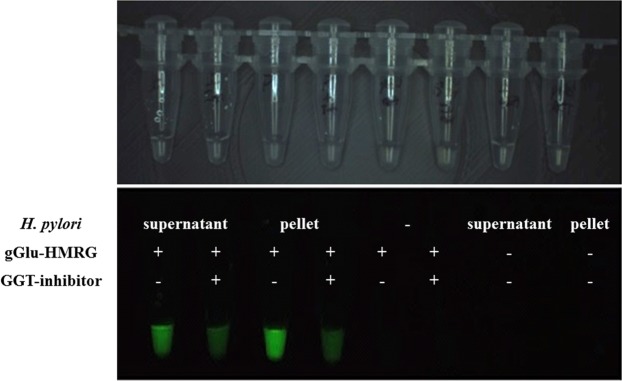
The wild-type laboratory strain was centrifuged and separated into supernatant and pellet fractions. Each fraction was treated with 50 μM of gGlu-HMRG with or without an inhibitor of γ-glutamyltranspeptidase (GGT). Addition of the GGT inhibitor suppressed green fluorescence by the wild-type strain. Fluorescence was observed in both fractions, albeit at a greater intensity in the former.
Figure 3
Figure 3
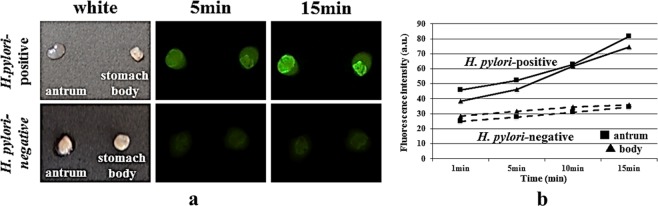
(a) Gastric biopsy specimens were treated with 50 μM gGlu-HMRG, one obtained from the antrum and the other from the stomach body. In specimens obtained from a H. pylori-positive patient, the fluorescent signal was immediately detected no more than 5 min after treatment with gGlu-HMRG, and strong fluorescence was emitted both in antral and stomach body specimens. However, in specimens from obtained from a H. pylori-negative patient, the fluorescence was rather weak, irrespective of sampling sites. (b) Fluorescence intensity increased with time, increasing substantially at 15 min after gGlu-HMRG treatment and increasing slightly in H. pylori-negative specimens.
Figure 4
Figure 4
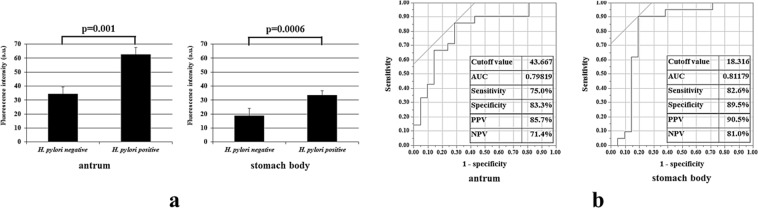
(a) The values obtained by subtracting FI at 1 min after treatment with gGlu-HMRG from FI at 15 min (defined as FIV-15) were compared between the H. pylori-negative and the H.pylori–positive group. There were significant differences in FIV-15 between the 2 groups both in antral and the stomach body specimens. (b) The optimum threshold for FIV-15 was determined for the antrum and stomach body via receiver operating characteristic curve analysis. AUC: Area under the Curve, PPV: Positive Predictive Value, NPV: Negative Predictive Value.
Figure 5
Figure 5
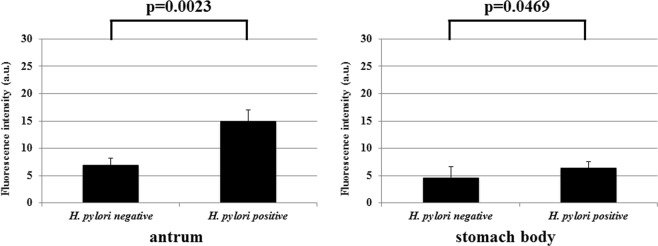
The values obtained by subtracting FI at 1 min after treatment with gGlu-HMRG from FI at 5 min (defined as FIV-5) were compared between the H. pylori-negative group and the H.pylori-positive patients. There were significant differences in FIV-5 between the 2 groups in both antral and the stomach body specimens.
Figure 6
Figure 6
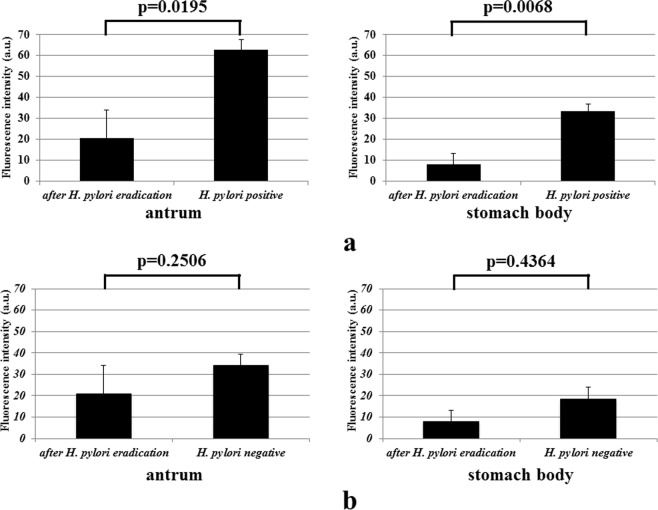
(a) The FIV-15 of specimens obtained from the H. pylori-positive group were significantly greater than the FI of specimens obtained from the H. pylori-eradicated group upon assessment of antral (left panel) and the stomach body (right panel) specimens. (b) There were no significant FIV-15 between the H. pylori-eradicated group and the H. pylori-negative group.
Figure 7
Figure 7
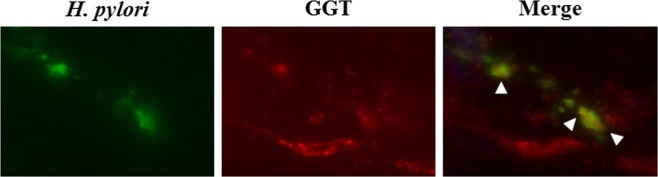
Double-immunofluorescence staining was performed to assess the expression of H. pylori GGT in H. pylori-positive stomach biopsy specimens. Using the H. pylori-positive antral biopsy specimens, H. pylori fluorescence (green fluorescence) and GGT (red) were detected. Co-localization between portions of H. pylori and GGT is shown using arrow heads.

References

    1. Kunutsor SK. Gamma-glutamyltransferase-friend or foe within? Liver. Int. 2016;36:1723–1734. doi: 10.1111/liv.13221. - DOI - PubMed
    1. Pompella A, De Tata V, Paolicchi A, Zunino F. Expression of gamma-glutamyltransferase in cancer cells and its significance in drug resistance. Biochem. Pharmacol. 2006;71:231–238. doi: 10.1016/j.bcp.2005.10.005. - DOI - PubMed
    1. Sugano K, et al. Kyoto global consensus report on Helicobacter pylori gastritis. Gut. 2015;64:1353–1367. doi: 10.1136/gutjnl-2015-309252. - DOI - PMC - PubMed
    1. Shibayama K, et al. A novel apoptosis-inducing protein from Helicobacter pylori. Mol. Microbiol. 2003;47:443–451. doi: 10.1046/j.1365-2958.2003.03305.x. - DOI - PubMed
    1. Ricci V, Giannouli M, Romano M, Zarrilli R. Helicobacter pylori gamma-glutamyl transpeptidase and its pathogenic role. World. J. Gastroenterol. 2014;20:630–638. doi: 10.3748/wjg.v20.i3.630. - DOI - PMC - PubMed