. 2019 Oct;4(10):1671-1679.
doi: 10.1038/s41564-019-0482-x. Epub 2019 Jul 1.

Structural basis for influenza virus NS1 protein block of mRNA nuclear export

Affiliations

Structural basis for influenza virus NS1 protein block of mRNA nuclear export

Ke Zhang et al. Nat Microbiol. 2019 Oct.

Abstract

Influenza viruses antagonize key immune defence mechanisms via the virulence factor non-structural protein 1 (NS1). A key mechanism of virulence by NS1 is blocking nuclear export of host messenger RNAs, including those encoding immune factors1-3; however, the direct cellular target of NS1 and the mechanism of host mRNA export inhibition are not known. Here, we identify the target of NS1 as the mRNA export receptor complex, nuclear RNA export factor 1-nuclear transport factor 2-related export protein 1 (NXF1-NXT1), which is the principal receptor mediating docking and translocation of mRNAs through the nuclear pore complex via interactions with nucleoporins4,5. We determined the crystal structure of NS1 in complex with NXF1-NXT1 at 3.8 Å resolution. The structure reveals that NS1 prevents binding of NXF1-NXT1 to nucleoporins, thereby inhibiting mRNA export through the nuclear pore complex into the cytoplasm for translation. We demonstrate that a mutant influenza virus deficient in binding NXF1-NXT1 does not block host mRNA export and is attenuated. This attenuation is marked by the release of mRNAs encoding immune factors from the nucleus. In sum, our study uncovers the molecular basis of a major nuclear function of influenza NS1 protein that causes potent blockage of host gene expression and contributes to inhibition of host immunity.


Conflict of interest statement

Competing interests

The authors declare no competing interests.

Figures
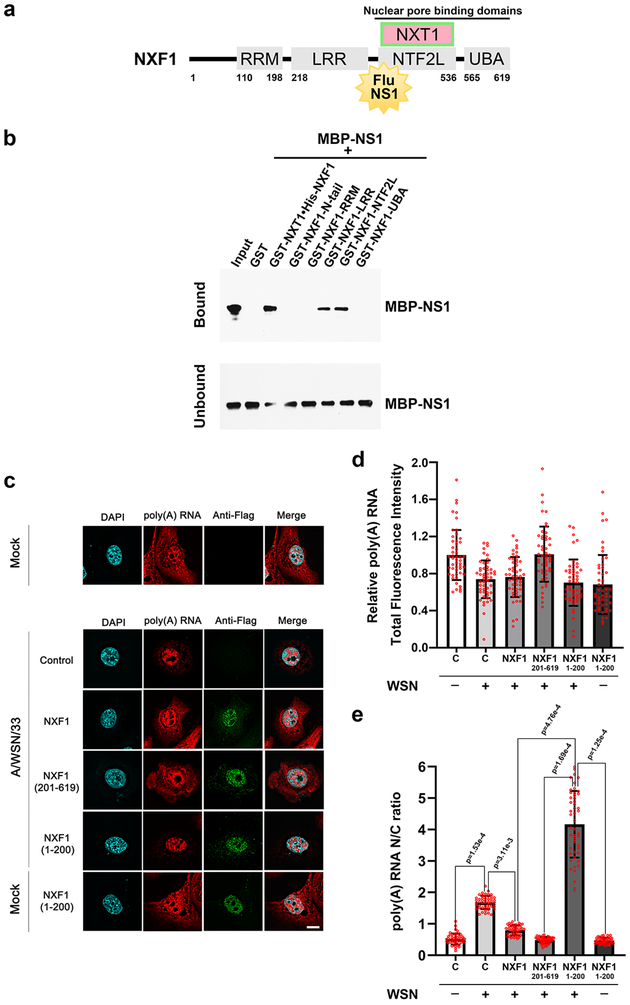
Fig. 1 |
Fig. 1 |. Influenza A virus NS1 protein binds the nucleoporin-binding domain of NXF1 to block host mRNA nuclear export.
a, Schematic representation of NXF1 domains: N-terminal RNA recognition motif (RRM), leucine-rich repeat (LRR) domain, nuclear transport factor 2-like domain (NTF2L) and ubiquitin-associated (UBA) domain. Also shown is the NXT1 protein that forms a heterodimer with NXF1. b, In vitro GST-pull down assays show that purified NS1 protein directly binds to the LRR and NTF2L domains of NXF1. n=3. c-e, HBECs were transfected with vector control, or Flag-NXF1, or Flag-NXF1(1–200), or Flag-NXF1(201–619) and mock infected or infected with A/WSN/1933. Samples were subjected to immunofluorescence with anti-Flag antibody to label expressed proteins and RNA-FISH to detect poly(A) RNA (c). Viral M mRNA was also labeled by RNA-FISH to identify infected cells (Supplementary Fig. 2). Fluorescence intensity of poly(A) RNA was quantified in whole cells (d) or in the nucleus and cytoplasm to determine nuclear to cytoplasmic ratios (e). Scale bar =10 μM. Values (d-e) are mean ± sd of 50 cells that were counted in three independent experiments. The p-values were calculated using the unpaired, two-tailed Student’s t-test.
Fig. 2 |
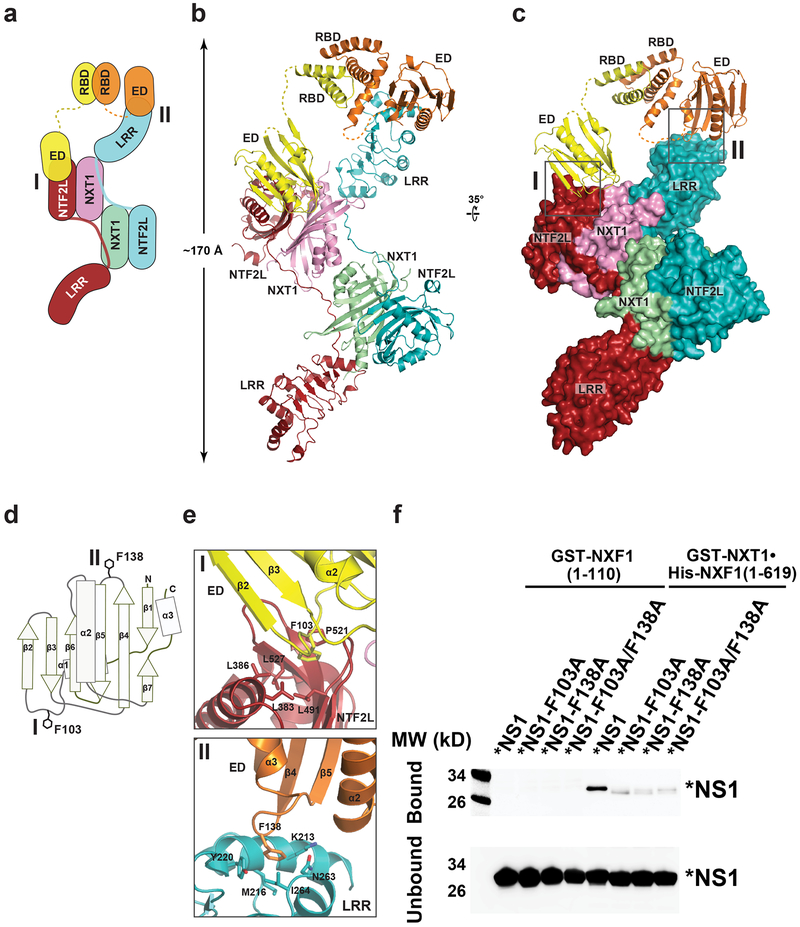
Fig. 2 |. Structure of a 2:2:2 complex of *NS1•NXF1117–619•NXT1.
a, Schematic diagram of the *NS1•NXF1117–619•NXT1 complex. *NS1 binds to NXF1117–619•NXT1 through two interfaces, I and II. b, c, Overall structure of *NS1•NXF1117–619•NXT1 in two orientations, colored as in (a). Insets illustrate the *NS1-NXF1117–619•NXT1 binding interfaces, and are expanded in (e). d, Schematic diagram of the NS1-ED domain. e, Expanded views of Interface I and II, viewed as in (c). f, In vitro GST-Pull down assays with NXF1•NXT1 and * NS1 or *NS1 with mutations on the NXF1 binding site shown in (e). Purified GST-NXT1•His-NXF1 was incubated with purified *NS1, *NS1-F103A, *NS1-F138A, or *NS1-F103A/F138A. NS1 was detected by western blot and showed diminished interaction upon mutations on the NXF1 binding site. The N-terminal domain of GST-NXF1(1–110) was used as control. n=3.
Fig. 3 |
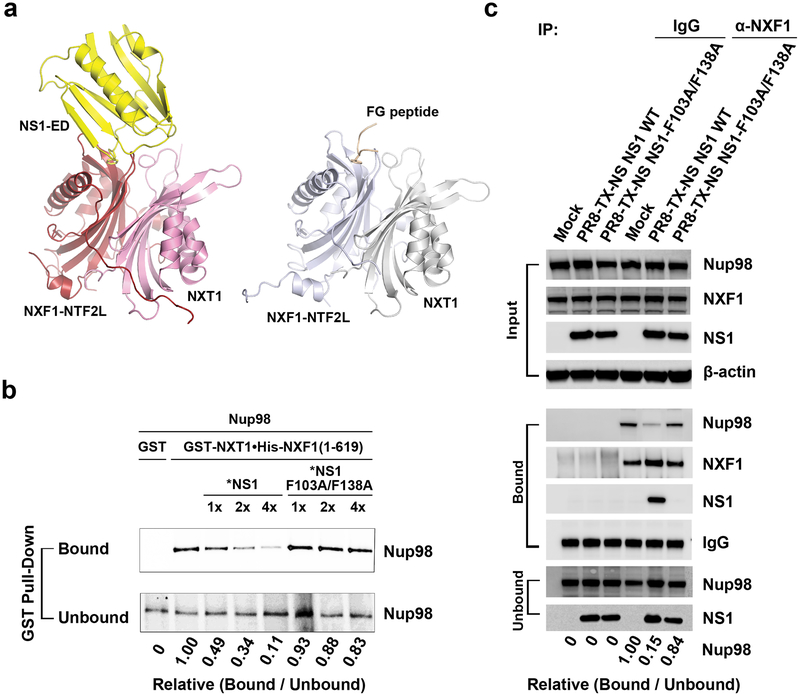
Fig. 3 |. NS1 blocks binding of the FG nucleoporin Nup98 to NXF1•NXT1 in vitro and in influenza infected cells.
a, Structural comparison of the binding of NS1 and nucleoporin FG peptide (PDB ID 1JN5) to the NTF2L domain. b, Competition between NS1 and Nup98 for NXF1•NXT1 binding in vitro. In vitro binding assays were performed with purified recombinant GST-NXT1•His-NXF1 and *NS1 or *NS1-F103A/F138A, and in vitro transcribed and translated Nup98 labeled with 35S-Met. Relative bound proteins were determined by densitometry. n=3. c, Competition between NS1 and Nup98 for NXF1•NXT1 binding in influenza infected cells. Total cell lysates from A549 cells non-infected or infected with PR8-TX-NS NS1 WT or PR8-TX-NS NS1-F103A/F138A for 6h were immunoprecipitated with anti-NXF1 antibody or mouse IgG as control. Western blot was performed to detect the depicted proteins. Relative bound proteins were determined by densitometry. n=3.
Fig. 4 |
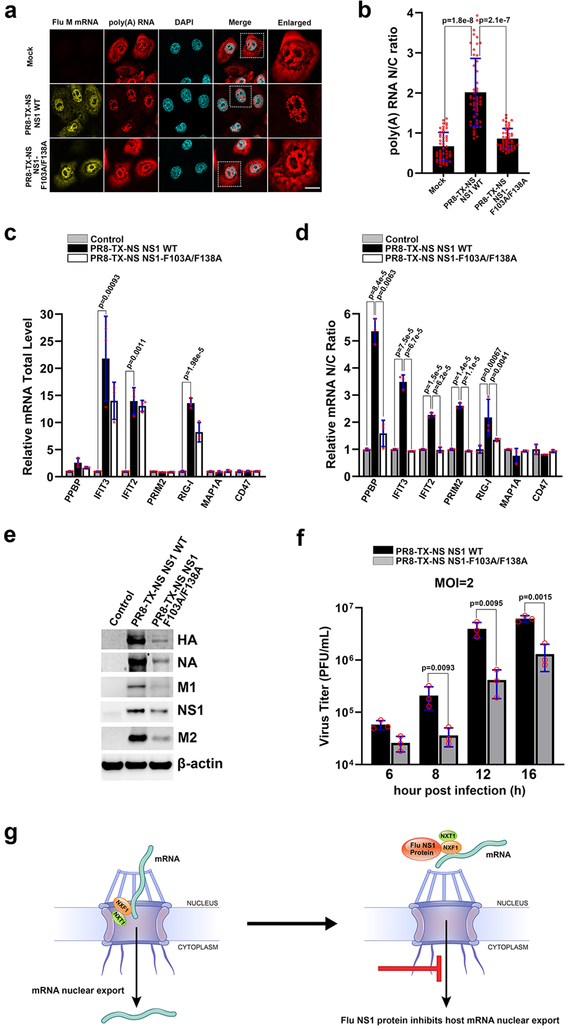
Fig. 4 |. Influenza virus mutant on the NXF1 binding site of NS1 allows nuclear export of host mRNAs and is attenuated.
a, HBECs were mock infected or ~ 100% infected with PR8-TX-NS NS1 WT or PR8-TX-NS NS1-F103A/F138A for 30h. Samples were subjected to RNA-FISH to detect viral M mRNA and poly(A) RNA. White square marks the enlarged panel on the right. Scale bar =10 μM. b, Quantification of fluorescence intensity in the nucleus and cytoplasm of samples in (a) followed by determination of nuclear to cytoplasmic ratios. Values are mean ± sd of 50 cells counted for each condition in three independent experiments. c, d, A549 cells were mock infected or infected with PR8-TX-NS NS1 WT or PR8-TX-NS NS1-F103A/F138A at MOI 2 for 6h. RNA was purified from total cell lysates (c) or from nuclear or cytoplasmic fractions (d). mRNAs selected based on transcriptome analysis shown in Supplementary Table 3 were quantified by qPCR. n=3. e, Cells were infected as in (c) except that infection lasted for 8h. Total cell lysates were subjected to western blot to detect the depicted proteins. n=3. f, Cells were infected as in (c) except that infection was performed for the indicated time points. Viral titers were measured in culture supernatants by plaque assay. n=3. The p-values (b, c, d, and f) were calculated using the unpaired, two-tailed Student’s t-test. g, Model for NS1-mediated inhibition of cellular mRNA nuclear export.

References

    1. Satterly N et al. Influenza virus targets the mRNA export machinery and the nuclear pore complex. Proc Natl Acad Sci U S A 104, 1853–1858, (2007). - PMC - PubMed
    1. Zhang L et al. Inhibition of Pyrimidine Synthesis Reverses Viral Virulence Factor-Mediated Block of mRNA Nuclear Export J. Cell Biol. 196, 315–326, (2012. ). - PMC - PubMed
    1. Qiu Y & Krug RM The influenza virus NS1 protein is a poly(A)-binding protein that inhibits nuclear export of mRNAs containing poly(A). J Virol 68, 2425–2432, (1994). - PMC - PubMed
    1. Carmody SR & Wente SR mRNA nuclear export at a glance. J Cell Sci 122, 1933–1937, (2009). - PMC - PubMed
    1. Stewart M Nuclear export of mRNA. Trends Biochem Sci 35, 609–617, (2010). - PubMed

Publication types

MeSH terms