Comment
. 2019 Jun 25:18:1176935119859863.
doi: 10.1177/1176935119859863. eCollection 2019.

Rewiring of the Transcription Factor Network in Acute Myeloid Leukemia

Affiliations
Comment

Rewiring of the Transcription Factor Network in Acute Myeloid Leukemia

Salam A Assi et al. Cancer Inform. .

Abstract

Acute myeloid leukemia (AML) is a highly heterogeneous cancer associated with different patterns of gene expression determined by the nature of their DNA mutations. These mutations mostly act to deregulate gene expression by various mechanisms at the level of the nucleus. By performing genome-wide epigenetic profiling of cis-regulatory elements, we found that AML encompasses different mutation-specific subclasses associated with the rewiring of the gene regulatory networks that drive differentiation into different directions away from normal myeloid development. By integrating epigenetic profiles with gene expression and chromatin conformation data, we defined pathways within gene regulation networks that were differentially rewired within each mutation-specific subclass of AML. This analysis revealed 2 major classes of AML: one class defined by mutations in signaling molecules that activate AP-1 via the mitogen-activated protein (MAP) kinase pathway and a second class defined by mutations within genes encoding transcription factors such as RUNX1/CBFβ and C/EBPα. By identifying specific DNA motifs protected from DNase I digestion at cis-regulatory elements, we were able to infer candidate transcription factors bound to these motifs. These integrated analyses allowed the identification of AML subtype-specific core regulatory networks that are required for AML development and maintenance, which could now be targeted in personalized therapies.

Keywords: AP-1; Acute myeloid leukemia; CEBPA; DNA mutation; DNase; FLT3; RUNX1; gene expression; gene regulation; network; transcription factor.


Conflict of interest statement

Declaration of Conflicting Interests:The author(s) declared no potential conflicts of interest with respect to the research, authorship, and/or publication of this article.

Figures
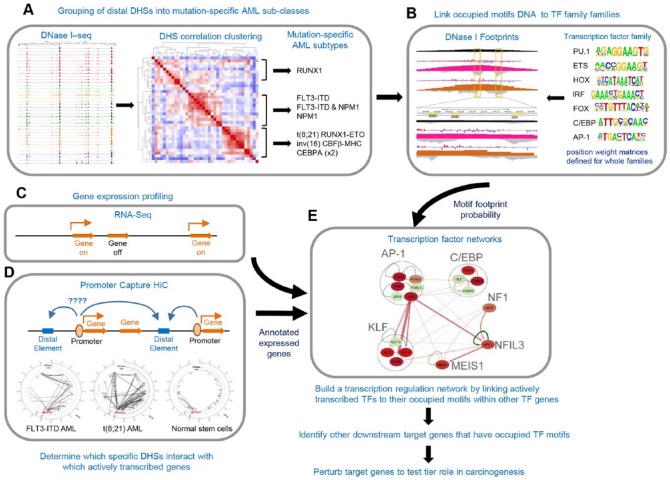
Figure 1.
Figure 1.
Overview of the AML mutation-specific TF network pipeline. Global mapping of DHSs allows for the identification of discrete subsets of DHSs associated with specific classes of mutations. High-read depth DNaseI-Seq can be used to infer occupancy of TF motifs within DHSs. Parallel RNA-Seq data can be used to identify which potential specific TF family members are likely to be bound to the occupied TF motifs. Regulatory networks can then be constructed using promoter capture HiC data to infer which DHSs and TFs are likely to be regulating which active genes. AML indicates acute myeloid leukemia; DHS, DNase I hypersensitive site; TF, transcription factor.
Figure 2.
Figure 2.
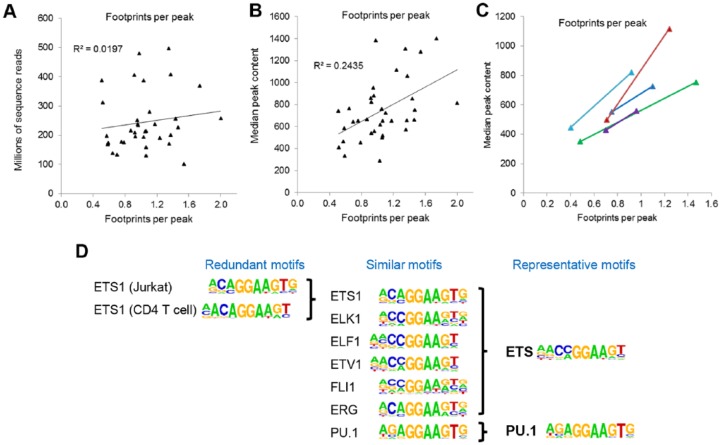
Optimization of data used to construct regulatory networks. (A-C) Efficient identification of occupied motifs using Wellington requires high-read depth DNaseI-Seq data. Due to the variability between DNaseI-Seq data sets, the read depth alone is insufficient to predict the depth of sequencing required to reliably predict footprints (A). In contrast, the median DHS peak volume is a more reliable guide, with a peak volume of ~700 being able on average to allow identification of 1 footprint per peak. Because Wellington is based on statistical probabilities, the likelihood of identifying footprints also increases in the proportion to overall sequence depth (C). (D) The linking of expressed TFs with their DNA motifs is critically dependent on knowing which motifs are likely to be bound by which TFs. Such analyses are often confounded by the overabundance of different motifs ascribed to the same factor, or ascribed to individual family members that bind to the same motifs. We circumvented this problem by identifying single representative motifs that can be associated with entire subgroups of TFs which bind the same motifs and splitting TF families into subsets based on any substantial differences in PWMs. (D) Illustration of this process using annotated HOMER and JASPAR motifs to identify similarities and differences among motifs for ETS family TFs. HOMER motifs are taken from http://homer.ucsd.edu/homer/motif/HomerMotifDB/homerResults.html and JASPAR motifs are taken from http://jaspar.genereg.net/. DHS indicates DNase I hypersensitive site; PWM, position weight matrix; TF, transcription factor.
Figure 3.
Figure 3.
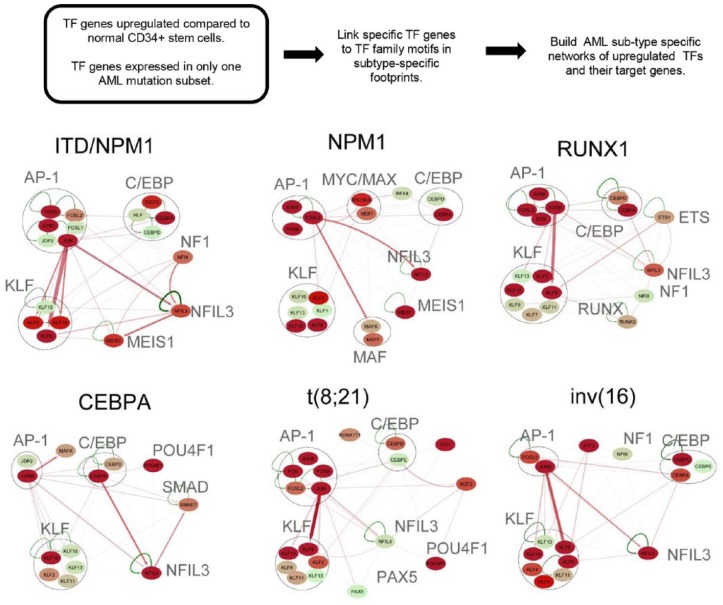
Identification of transcription factor networks driving AML-type-specific gene expression. AML-specific transcription factor (TF) networks are derived by identifying TF genes that are upregulated in AML and then linking these to their motifs where they are footprinted in an AML-specific manner in other genes. Members of deregulated transcription factor families binding to the same motif are depicted as nodes contained within a circle. Each node includes at least 1 member that is upregulated, relative to normal cells or other types of AML, plus all other members of the same family that are expressed. Arrows going outwards from the node highlight footprinted motifs in other individual genes generated by any member of this TF family. Where possible, the footprinted DHS was linked to the target gene using promoter capture HiC data. The relative expression level (FKPM) for the individual genes is depicted in color for low (green), moderate (orange), and high (red) levels of mRNA expression. AML indicates acute myeloid leukemia; DHS, DNase I hypersensitive site.

Comment on

  • Subtype-specific regulatory network rewiring in acute myeloid leukemia.
    Assi SA, Imperato MR, Coleman DJL, Pickin A, Potluri S, Ptasinska A, Chin PS, Blair H, Cauchy P, James SR, Zacarias-Cabeza J, Gilding LN, Beggs A, Clokie S, Loke JC, Jenkin P, Uddin A, Delwel R, Richards SJ, Raghavan M, Griffiths MJ, Heidenreich O, Cockerill PN, Bonifer C. Assi SA, et al. Nat Genet. 2019 Jan;51(1):151-162. doi: 10.1038/s41588-018-0270-1. Epub 2018 Nov 12. Nat Genet. 2019. PMID: 30420649 Free PMC article.

References

    1. Jolma A, Kivioja T, Toivonen J, et al. Multiplexed massively parallel SELEX for characterization of human transcription factor binding specificities. Genome Res. 2010;20:861–873. - PMC - PubMed
    1. Cockerill PN. Structure and function of active chromatin and DNase I hypersensitive sites. FEBS J. 2011;278:2182–2210. - PubMed
    1. Davidson EH. Emerging properties of animal gene regulatory networks. Nature. 2010;468:911–920. - PMC - PubMed
    1. Bonifer C, Cockerill PN. Chromatin structure profiling identifies crucial regulators of tumor maintenance. Trends Cancer. 2015;1:157–160. - PubMed
    1. Robertson G, Hirst M, Bainbridge M, et al. Genome-wide profiles of STAT1 DNA association using chromatin immunoprecipitation and massively parallel sequencing. Nat Methods. 2007;4:651–657. - PubMed

LinkOut - more resources