


Gut feeling: randomized controlled trials of probiotics for the treatment of clinical depression: Systematic review and meta-analysis
- PMID: 31263542
- PMCID: PMC6595633
- DOI: 10.1177/2045125319859963
Gut feeling: randomized controlled trials of probiotics for the treatment of clinical depression: Systematic review and meta-analysis
Abstract
Background: Recently the gut microbiota has attracted significant interest in psychiatric research due to the observed bidirectional gut-brain communication. A growing body of evidence from preclinical work has suggested that probiotics may be effective in reducing stress and anxiety and alleviating low mood. It is unclear to what extent these effects are seen in clinical populations. We aimed to identify all published evidence on the efficacy of probiotics as treatment for depression in clinically depressed populations.
Methods: Randomized controlled trials of patients with depression where probiotics were used as supplementary or standalone treatment were considered eligible. A literature search with the terms (probiotic* OR bacteria OR Lactobacillus OR Bifidobacterium) AND depress* was performed in PubMed and Web of Science. Data on study population characteristics, treatment effectiveness, tolerability and risk of bias were extracted from eligible studies. A random effects model was used for meta-analyses.
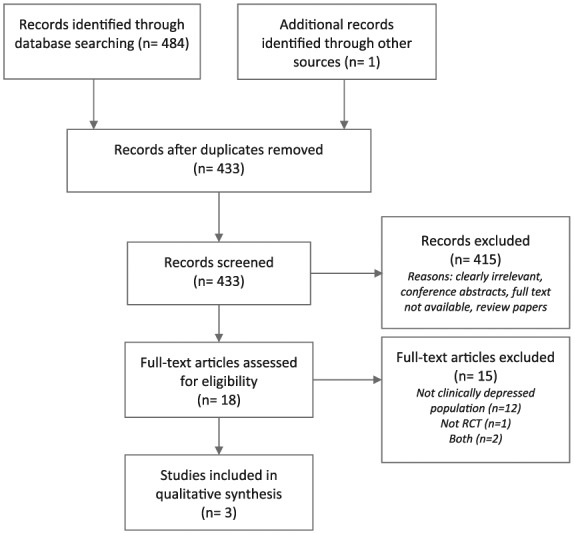
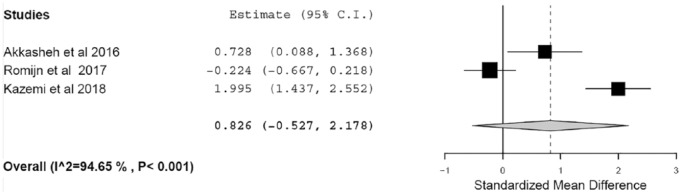
Results: Only three studies met inclusion criteria (229 individuals randomized), two of which administered probiotics as a supplementary treatment to antidepressants and one as a standalone treatment. Upon removal of the latter study from the meta-analysis due to clinical heterogeneity, there was an overall positive effect of probiotics on depressive symptoms (standardized mean difference = 1.371, 95% confidence interval 0.130-2.613).
Conclusions: There is limited evidence for the efficacy of probiotics in depression at present, although there may be a beneficial effect of probiotics on depressive symptoms when administered in addition to antidepressants. Further studies are required to investigate this and explore potential mechanisms.
Keywords: depression; probiotics; randomized controlled trial; systematic review.
Conflict of interest statement
Conflict of interest statement: The authors declare that there is no conflict of interest.
Figures
References
-
- Otte C, Gold SM, Penninx BW, et al. Major depressive disorder. Nat Rev Dis Primers 2016; 2: 16065. - PubMed
-
- GBD 2015 Disease and Injury Incidence and Prevalence Collaborators. Global, regional, and national incidence, prevalence, and years lived with disability for 310 diseases and injuries, 1990–2015: a systematic analysis for the global burden of disease study 2015. Lancet 2016; 388: 1545–1602. - PMC - PubMed
-
- Greenberg PE, Fournier AA, Sisitsky T, et al. The economic burden of adults with major depressive disorder in the United States (2005 and 2010). J Clin Psychiatry 2015; 76: 155–162. - PubMed
-
- Prince M, Patel V, Saxena S, et al. No health without mental health. Lancet 2007; 370: 859–877. - PubMed
-
- Fava M. Diagnosis and definition of treatment-resistant depression. Biol Psychiatry 2003; 53: 649–659. - PubMed
Publication types
LinkOut - more resources
Full Text Sources
Miscellaneous
