Review
. 2019 Aug;23(3):557-572.
doi: 10.1016/j.cld.2019.04.005. Epub 2019 May 24.

HBV/HDV Coinfection: A Challenge for Therapeutics

Affiliations
Review

HBV/HDV Coinfection: A Challenge for Therapeutics

Christopher Koh et al. Clin Liver Dis. 2019 Aug.

Abstract

Chronic hepatitis D (CHD) results from an infection with the hepatitis B virus and hepatitis D virus (HDV). CHD is the most severe form of human viral hepatitis. Current treatment options consist of interferon alfa, which is effective only in a minority of patients. Study of HDV molecular virology has resulted in new approaches entering clinical trials, with phase-3 studies the most advanced. These include the entry inhibitor bulevirtide, the nucleic acid polymer REP 2139-Ca, the farnesyltransferase inhibitor lonafarnib, and pegylated interferon lambda. This article summarizes the available data on these emerging therapeutics.

Keywords: Cirrhosis; Clinical trials; Hepatitis B; Hepatitis D; Therapeutics.


Figures

Figure 1.
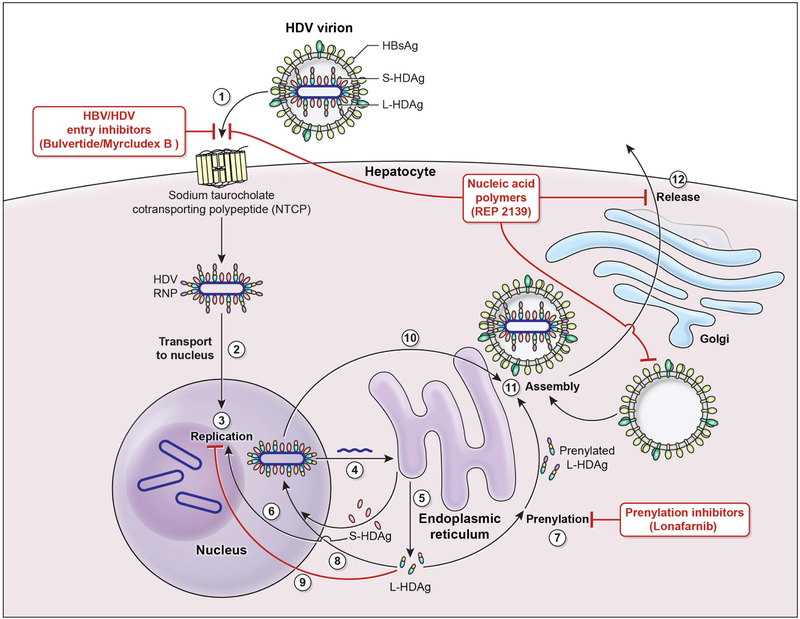
Figure 1.. HDV viral life cycle and sites of investigative drug targets
1. Hepatitis D virus (HDV) virion attaches to the hepatocyte via interaction between Hepatitis B surface antigen proteins and the sodium taurocholate cotransporting polypeptide (NTCP). 2. HDV ribonucleoprotein (RNP) is translocated to nucleus mediated by the hepatitis D antigen (HDAg). 3. HDV genome replication occurs via a “rolling circle” mechanism. 4. HDV antigenome is transported out of the nucleus to the endoplasmic reticulum (ER). 5. HDV antigenome is translated in the ER into small HDAg (S-HDAg) and large HDAg (L-HDAg). 6. S-HDAg is transported into the nucleus. 7. S-HDAg promotes HDV replication in the nucleus. 8. L-HDAg undergoes prenylation prior to assembly. 9. L-HDAg inhibits HDV replication in the nucleus. 10. New HDAg molecules are associated with new transcripts of genomic RNA to form new RNPs that are exported to the cytoplasm. 11. New HDV RNP associates with Hepatitis B virus (HBV) envelop proteins and assembled into HDV virions. 12. Completed HDV virions are released from the hepatocyte via the trans-Golgi network. Investigative drug and their targets: HBV/HDV inhibitors (Bulvertide) - target the NTCP by competitive binding. Nucleic acid polymers (REP 2139-Ca) – inhibits Hepatitis B surface antigen (HBsAg) and subviral assembly as well as HDV entry. Prenylation inhibitors (Lonafarnib) – inhibits the process of prenylation of the L-HDAg which is the step leading up to assembly.

References

    1. Rizzetto M, Canese MG, Arico S, et al. Immunofluorescence detection of new antigen-antibody system (delta/anti-delta) associated to hepatitis B virus in liver and in serum of HBsAg carriers. Gut 1977;18:997–1003. - PMC - PubMed
    1. Taylor JM. Structure and replication of hepatitis delta virus RNA. Curr Top Microbiol Immunol 2006;307:1–23. - PubMed
    1. Rizzetto M, Verme G, Recchia S, et al. Chronic hepatitis in carriers of hepatitis B surface antigen, with intrahepatic expression of the delta antigen. An active and progressive disease unresponsive to immunosuppressive treatment. Ann Intern Med 1983;98:437–41. - PubMed
    1. Yurdaydin C, Idilman R, Bozkaya H, et al. Natural history and treatment of chronic delta hepatitis. J Viral Hepat 2010;17:749–56. - PubMed
    1. Kushner T, Serper M, Kaplan DE. Delta hepatitis within the Veterans Affairs medical system in the United States: Prevalence, risk factors, and outcomes. J Hepatol 2015;63:586–92. - PMC - PubMed

Publication types

MeSH terms