


Achilles tendon cross-sectional area at 12 weeks post-rupture relates to 1-year heel-rise height
- PMID: 31267192
- PMCID: PMC6939153
- DOI: 10.1007/s00167-019-05608-x
Achilles tendon cross-sectional area at 12 weeks post-rupture relates to 1-year heel-rise height
Abstract
Purpose: Achilles tendon rupture leads to long-term plantar flexor deficits, but some patients recover functional performance better than others. Early indicators of tendon healing could be helpful in establishing patient prognosis and making individualized decisions regarding rehabilitation progression. The purpose of this study was to investigate relationships between early tendon morphology and mechanical properties to long-term heel-rise and jumping function in individuals after Achilles tendon rupture.
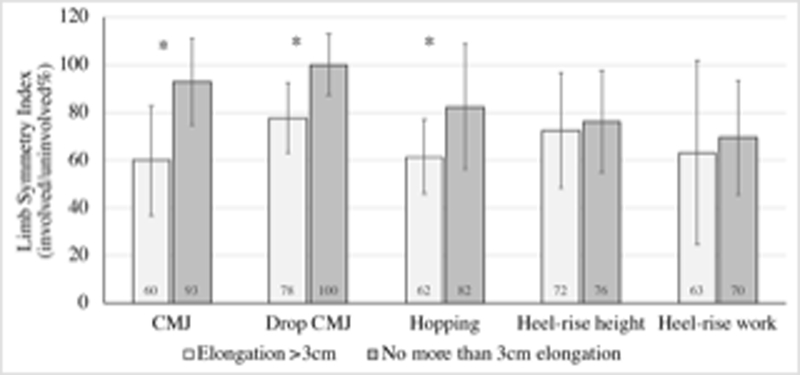
Methods: Individuals after Achilles tendon rupture were assessed at 4, 8, 12, 24, and 52 weeks post-injury. Tendon cross-sectional area, length, and mechanical properties were measured using ultrasound. Heel-rise and jump tests were performed at 24 and 52 weeks. Correlation and regression analysis were used to identify relationships between tendon structural variables in the first 12 weeks to functional outcomes at 52 weeks, and determine whether the addition of tendon structural characteristics at 24 weeks strengthened relationships between functional performance at 24 and 52 weeks. Functional outcomes of individuals with < 3 cm of elongation were compared to those with > 3 cm of elongation using a Mann-Whitney U test.
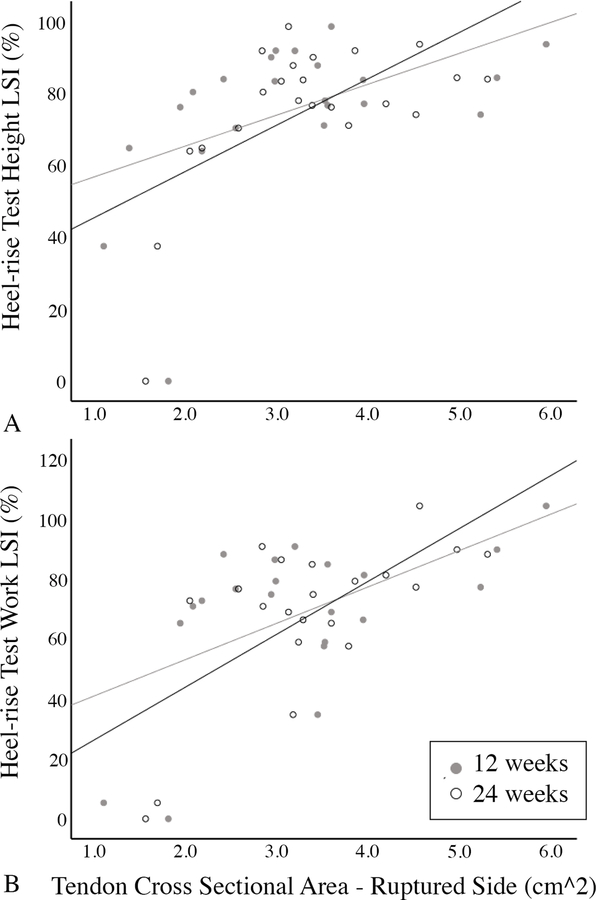
Results: Twenty-two participants [mean (SD) age = 40 (11) years, 17 male] were included. Tendon cross-sectional area at 12 weeks was the strongest predictor of heel-rise height (R2 = 0.280, p = 0.014) and work symmetry (R2 = 0.316, p = 0.008) at 52 weeks. Jumping performance at 52 weeks was not significantly related to any of the tendon structural measures in the first 12 weeks. Performance of all functional tasks at 24 weeks was positively related to performance on the same task at 52 weeks (r = 0.456-0.708, p < 0.05). The addition of tendon cross-sectional area improved the model for height LSI (R2 = 0.519, p = 0.001). Tendon elongation > 3 cm significantly reduced jumping symmetry (p < 0.05).
Conclusion: Tendon cross-sectional area and excessive elongation related to plantar flexor performance on functional testing after Achilles tendon rupture. Once an individual is able to perform function-based testing, tendon structural measures may inform long-term prognosis. Ultrasound-based measures of tendon structure early in recovery seem to relate to later performance on functional testing. Clinically, assessing tendon structure has the potential to be used as a biomarker of tendon healing early in recovery and better predict patients at risk of negative functional outcome.
Level of evidence: II.
Keywords: Ankle; Morphology; Ultrasound; Viscoelastic properties.
Figures
References
-
- Aujla R, Patel S, Jones A, Bhatia M (2018) Predictors of functional outcome in non-operatively managed Achilles tendon ruptures. Foot Ankle Surg 24:336–341 - PubMed
-
- Baxter JR, Hullfish TJ, Chao W (2018) Functional deficits may be explained by plantarflexor remodeling following Achilles tendon rupture repair: Preliminary findings. J Biomech 79:238–242 - PubMed
-
- Brorsson A, Olsson N, Nilsson-Helander K, Karlsson J, Eriksson BI, Silbernagel KG (2015) Recovery of calf muscle endurance 3 months after an Achilles tendon rupture. Scand J Med Sci Sports 26:844–853 - PubMed
-
- Brorsson A, Silbernagel KG, Olsson N, Helander KN (2017) Calf muscle performance deficits remain 7 years after an Achilles tendon rupture. Am J Sports Med 46:470–477 - PubMed
-
- Brorsson A, Willy RW, Tranberg R, Grävare Silbernagel K (2017) Heel-rise height deficit 1 year after Achilles tendon rupture relates to changes in ankle biomechanics 6 years after injury. Am J Sports Med 45:3060–3068 - PubMed
MeSH terms
Grants and funding
LinkOut - more resources
Full Text Sources
Research Materials
