


Landfill leachates and wastewater of maritime origin as possible sources of endocrine disruptors in municipal wastewater
- PMID: 31267401
- PMCID: PMC6719331
- DOI: 10.1007/s11356-019-05566-4
Landfill leachates and wastewater of maritime origin as possible sources of endocrine disruptors in municipal wastewater
Abstract
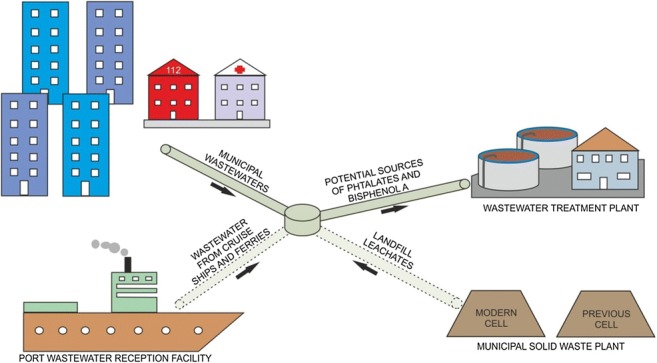
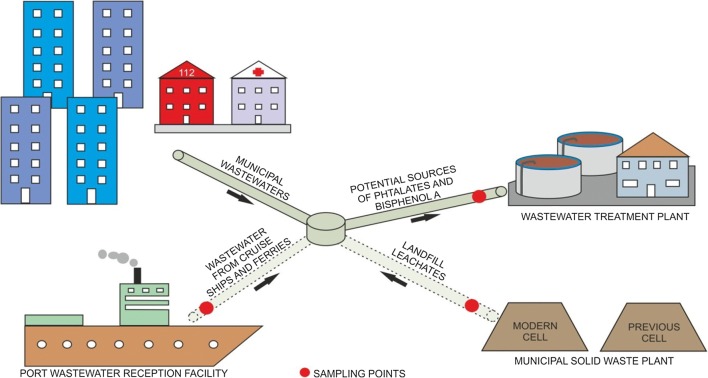
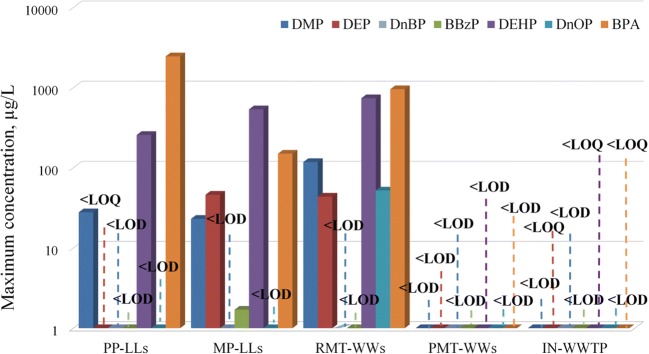
In this study, wastewater from municipal services, such as a port wastewater reception facility (PRF-WW) and a municipal solid waste plant (MSWP), was tested for the presence of the suspected endocrine-disrupting compounds phthalates (PAEs) and bisphenol A (BPA). PAEs and BPA were found in this study in high concentrations in raw wastewater obtained from passenger ships (RMT-WWs) (up to 738 μg/L and 957 μg/L, respectively) collected in the Port of Gdynia and in landfill leachates (LLs) (up to 536 μg/L and up to 2202 μg/L, respectively) from a MSWP located near Gdynia. In particular, the presence of reprotoxic di(2-ethylhexyl) phthalate (DEHP, up to 536 μg/L in LLs and up to 738 μg/L in RMT-WWs) requires further action because if this compound, as well as other PAEs and BPA, is not degraded by activated sludge microorganisms, it may reach receiving waters and adversely impact aquatic organisms. Therefore, PAEs and BPA should be removed either during the onsite pretreatment of tested industrial wastewater or during tertiary treatment at municipal wastewater treatment plants (WWTPs, representing end-of-pipe technology). Graphical abstract.
Keywords: Cruise ship wastewater; Landfill leachates; Micropollutants; Municipal and industrial wastewater; Treatment approach.
Figures
References
-
- APHA-AWWA-WEF . Standard methods for the examination of water and wastewater. Washington D.C.: APHA-AWWA-WEF; 2005.
-
- Badach H, Nazimek TA, Kamińska I. Pesticide content in drinking water samples collected from orchard areas in Central Poland. Ann Agric Environ Med. 2007;14:109–114. - PubMed
MeSH terms
Substances
Grants and funding
LinkOut - more resources
Full Text Sources
