


Alzheimer's disease frequency peaks in the tenth decade and is lower afterwards
- PMID: 31269985
- PMCID: PMC6609405
- DOI: 10.1186/s40478-019-0752-0
Alzheimer's disease frequency peaks in the tenth decade and is lower afterwards
Abstract
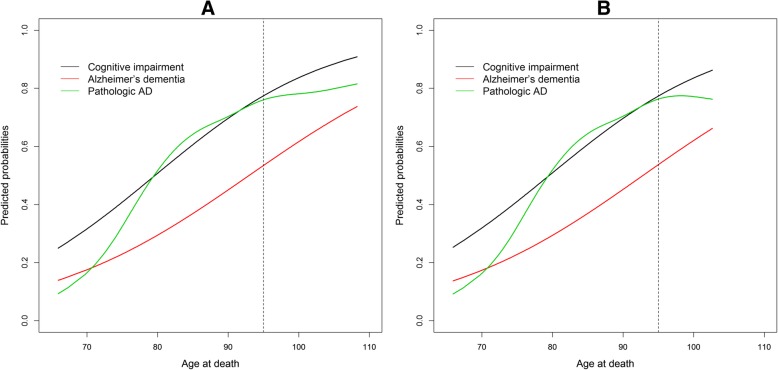
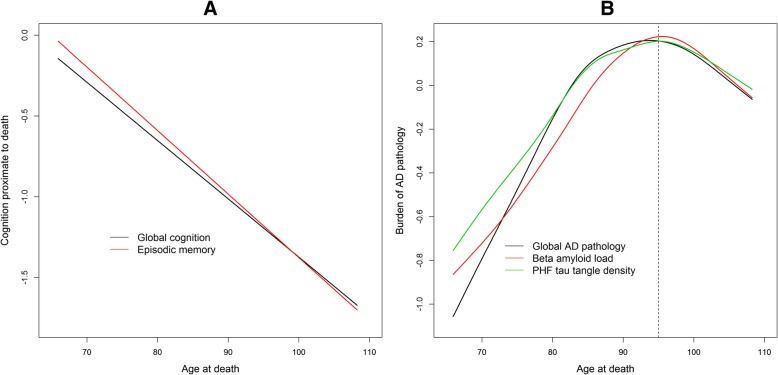
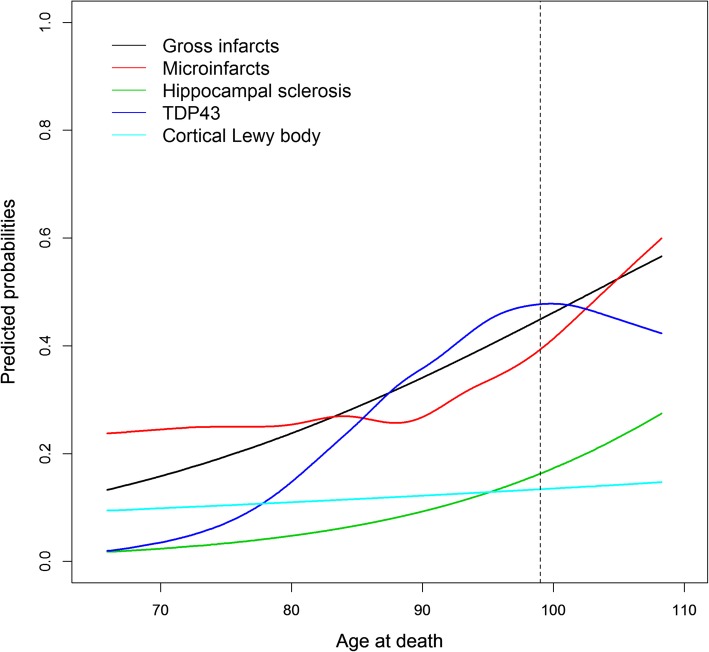
Age is the most robust risk factor for Alzheimer's dementia, however there is little data on the relation of age to Alzheimer's disease (AD) and other common neuropathologies that contribute to Alzheimer's dementia. We use data from two community-based, clinical-pathologic cohorts to examine the association of age with AD and other common pathologies. Participants were 1420 autopsied individuals from the Religious Orders Study or Rush Memory and Aging Project who underwent annual clinical evaluations for diagnosis of Alzheimer's dementia, mild cognitive impairment (MCI), and level of cognition. The neuropathologic traits of interest were pathologic AD according to modified NIA-Reagan criteria, three quantitative measures of AD pathology (global AD pathology score, β-amyloid load and PHFtau tangle density), macro- and micro-scopic infarcts, neocortical Lewy bodies, TDP-43 and hippocampal sclerosis. Semiparametric generalized additive models examined the nonlinear relationship between age and the clinical and pathological outcomes. The probability of Alzheimer's dementia at death increased with age such that for every additional year of age, the log odds of Alzheimer's dementia was 0.067 higher, corresponding to an odds ratio of 1.070 (p < 0.001). Results were similar for cognitive impairment and level of cognition. By contrast, a nonlinear relationship of age with multiple indices of AD pathology was observed (all ps < 0.05), such that pathologic AD reached a peak around 95 years of age and leveled off afterwards; the quantitative measures of AD pathology were significantly lower at ages above 95. The association of age with other neuropathologies was quite distinct from that of AD in that most increased with advancing age. AD pathology appears to peak around 95 years of age while other common pathologies continue to increase with age.
Keywords: Age; Alzheimer’s disease; Amyloid; Neuropathology; Tau protein.
Conflict of interest statement
The authors declare that they have no competing interests.
Figures
References
Publication types
MeSH terms
Grants and funding
LinkOut - more resources
Full Text Sources
Medical
