. 2019 Jul 3;10(1):2931.
doi: 10.1038/s41467-019-10778-w.

An integrated genomic regulatory network of virulence-related transcriptional factors in Pseudomonas aeruginosa

Affiliations

An integrated genomic regulatory network of virulence-related transcriptional factors in Pseudomonas aeruginosa

Hao Huang et al. Nat Commun. .

Abstract

The virulence of Pseudomonas aeruginosa, a Gram-negative opportunistic pathogen, is regulated by many transcriptional factors (TFs) that control the expression of quorum sensing and protein secretion systems. Here, we report a genome-wide, network-based approach to dissect the crosstalk between 20 key virulence-related TFs. Using chromatin immunoprecipitation coupled with high-throughput sequencing (ChIP-seq), as well as RNA-seq, we identify 1200 TF-bound genes and 4775 differentially expressed genes. We experimentally validate 347 of these genes as functional target genes, and describe the regulatory relationships of the 20 TFs with their targets in a network that we call 'Pseudomonas aeruginosa genomic regulatory network' (PAGnet). Analysis of the network led to the identification of novel functions for two TFs (ExsA and GacA) in quorum sensing and nitrogen metabolism. Furthermore, we present an online platform and R package based on PAGnet to facilitate updating and user-customised analyses.


Conflict of interest statement

The authors declare no competing interests.

Figures
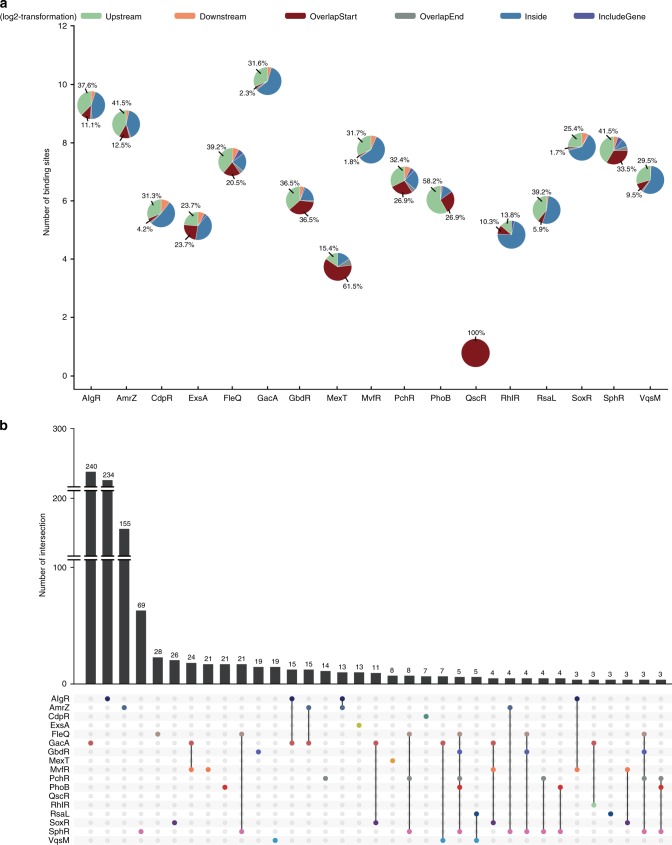
Fig. 1
Fig. 1
TF-binding peak annotations and the overlap of peak target genes. a The position annotation of different TF-binding peaks in P. aeruginosa genome using pie charts, and horizontal axis (log2-transformation) represents the number of binding peaks of TFs. b The overlap of different TFs target genes (TF-binding peaks located on promoters of genes), the histogram represents the number of genes in individual/overlapped set
Fig. 2
Fig. 2
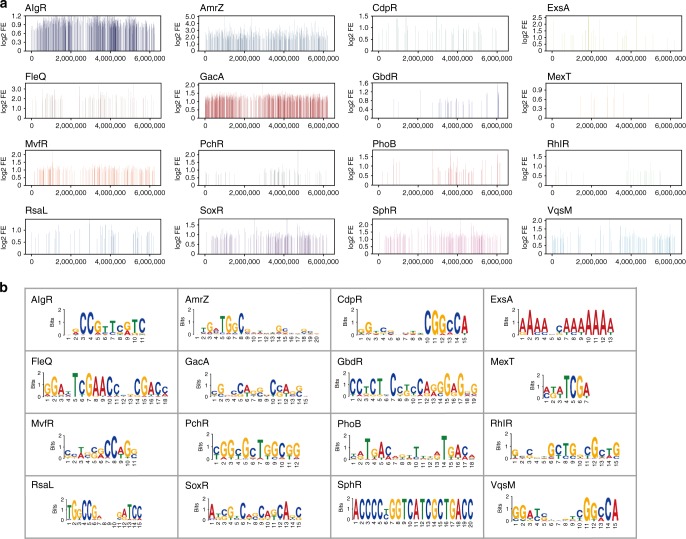
Genomic location and binding motif analysis of 20 TFs. a The coverage of 16 transcription factors peak regions over Pseudomonas aeruginosa chromosome. Each line shows the location and signal enrichment value (log2 Fold Enrichment) of peaks of a transcription factor peak in chromosome. b The binding motifs of transcriptional factors were elucidated using MEME. All peaks were used to define the binding motif. The height of each letter presents the relative frequency of each base at different positions in the consensus sequence
Fig. 3
Fig. 3
Clustering and co-expression patterns of virulence-related TFs. a Hierarchical clustering based on differentially expressed genes in absence of TFs using Pearson correlation coefficients. 4775 genes were differentially regulated by 16 transcription factors obtained from our RNA-seq. Genes regulated by more than one TFs are coloured in white. b Co-expression patterns of differentially regulated genes dependent upon 20 TFs, white balls lined between different TFs balls represent the number of genes that are co-regulated by the TFs combinations
Fig. 4
Fig. 4
Visualization of the PAGnet. PAGnet is established by integrated twenty Pseudomonas aeruginosa transcriptional factors regulons. The rectangle represents 20 genomic transcription factors, and the circle represents the functional targets of different transcription factors. Among these targets, the orange targets are positively regulated by the transcription factor, the blue ones are negatively regulated by the transcription factors, and the grey ones represent regulatory relationship is unknown. The target can be co-regulated by multiple transcription factors, and some TFs have self-regulation
Fig. 5
Fig. 5
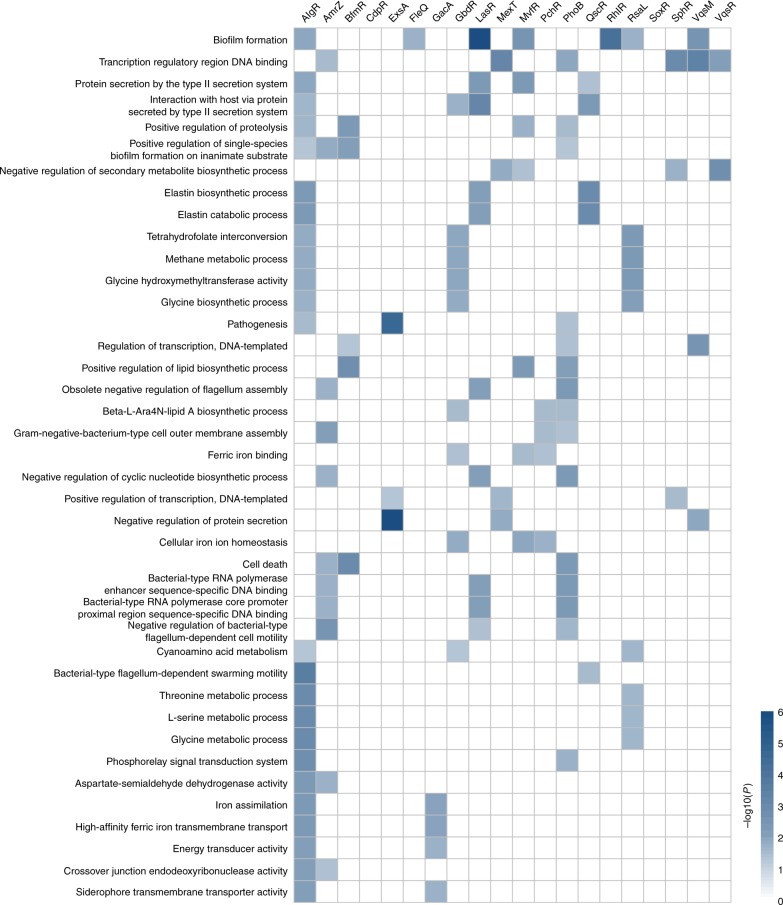
Functional characterization of the PAGnet. The PseudoCAP annotation was used to categorize the targets of 20 transcription factors in network. The colour shade of different block indicates the significance of each TF on every functional category (-log10 (P))
Fig. 6
Fig. 6
Verification of the functional targets of TFs by EMSA and qRT-PCR. The original sequence peaks show the TFs binding regions, and TFs binding regions (PCR-amplified from P. aeruginosa PAO1 genome) identified by ChIP-seq were mixed with an increasing amount of purified TFs protein for the EMSA assay. The expression of target genes was examined by RT-qPCR at the same time. PhoB directly regulated the transcription of PA4139 (a), xcpR (b), nosR (c), PA0123 (d) and PA4108 (e). FleQ directly regulated the expression of PA4139 (f), PA3520 (g), PA3662 (h) and arnB (i). AlgR directly regulated expression of phdA (j). ExsA directly regulated the expression of popN (k), PA3842 (l) and ccoN2 (m). GacA directly regulated the expression of cdpR (n), glnD (o), nasA (p), cbpD (q) and magD (r). All experiments were repeated at least three times. Two-tailed Student’s t-tests were used to examine the mean differences between the data groups. *P < 0.05, **P < 0.01 and ***P < 0.001. Error bars show standard deviations

References

    1. Lyczak JB, Cannon CL, Pier GB. Lung infections associated with cystic fibrosis. Clin. Microbiol. Rev. 2002;15:194–222. doi: 10.1128/CMR.15.2.194-222.2002. - DOI - PMC - PubMed
    1. He J, et al. The broad host range pathogen Pseudomonas aeruginosa strain PA14 carries two pathogenicity islands harboring plant and animal virulence genes. Proc. Natl Acad. Sci. USA. 2004;101:2530–2535. doi: 10.1073/pnas.0304622101. - DOI - PMC - PubMed
    1. Balasubramanian D, Schneper L, Kumari H, Mathee K. A dynamic and intricate regulatory network determines Pseudomonas aeruginosa virulence. Nucleic Acids Res. 2013;41:1–20. doi: 10.1093/nar/gks1039. - DOI - PMC - PubMed
    1. Deng X, et al. Proteome-wide quantification and characterization of oxidation-sensitive cysteines in pathogenic bacteria. Cell Host Microbe. 2013;13:358–370. doi: 10.1016/j.chom.2013.02.004. - DOI - PMC - PubMed
    1. Deng X, et al. Steady-state hydrogen peroxide induces glycolysis in Staphylococcus aureus and Pseudomonas aeruginosa. J. Bacteriol. 2014;196:2499–2513. doi: 10.1128/JB.01538-14. - DOI - PMC - PubMed

Publication types

MeSH terms