Review
. 2019 Oct;205(5):661-686.
doi: 10.1007/s00359-019-01355-z. Epub 2019 Jul 3.

Mechanics to pre-process information for the fine tuning of mechanoreceptors

Affiliations
Review

Mechanics to pre-process information for the fine tuning of mechanoreceptors

Friedrich G Barth. J Comp Physiol A Neuroethol Sens Neural Behav Physiol. 2019 Oct.

Abstract

Non-nervous auxiliary structures play a significant role in sensory biology. They filter the stimulus and transform it in a way that fits the animal's needs, thereby contributing to the avoidance of the central nervous system's overload with meaningless stimuli and a corresponding processing task. The present review deals with mechanoreceptors mainly of invertebrates and some remarkable recent findings stressing the role of mechanics as an important source of sensor adaptedness, outstanding performance, and diversity. Instead of organizing the review along the types of stimulus energy (force) taken up by the sensors, processes associated with a few basic and seemingly simple mechanical principles like lever systems, viscoelasticity, resonance, traveling waves, and impedance matching are taken as the guideline. As will be seen, nature makes surprisingly competent use of such "simple mechanics".

Keywords: Auxiliary structures; Mechanoreception; Pre-processing of information; Sensor fine tuning; Stimulus transformation.


Figures
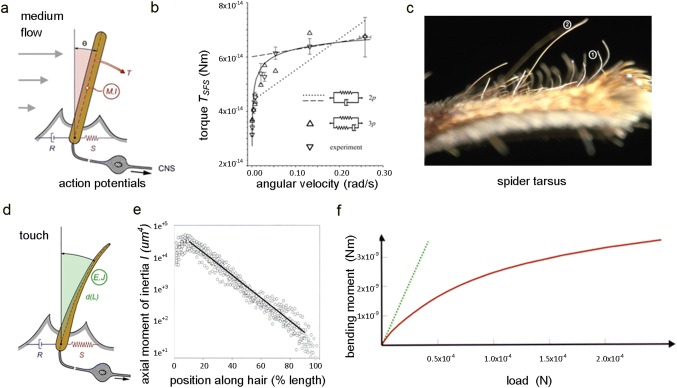
Fig. 1
Fig. 1
Lever systems: a Schematic of an arthropod medium-flow-sensitive hair sensillum; T torque, M mass, I inertia, R viscosity, S elasticity, CNS central nervous system, and θ deflection angle. Different lengths of arrows indicate difference in medium-flow velocity due to boundary layer. b Torque resisting the deflection of a spider (Cupiennius salei, C.s.) trichobothrium when deflected at different speed; inset shows two- and three-parameter model representing the mechanical properties of the hair’s suspension. c Tarsus (length c. 5 mm) of a spider leg (C.s.) showing air flow sensitive trichobothrium (1) and tactile hair (2). d Schematic of arthropod tactile hair-like sensillum; E Young´s modulus, J second moment of inertia, L length of hair, R viscosity, S elasticity. e Axial moment of inertia along the tactile hair of a spider (C.s.). f Bending moment (red) of spider (C.s.) tactile hair exposed to increasing stimulus force from above; green line indicates values calculated for stiff hair. (a Barth , , ; b McConney et al. ; c, d Barth ; e, f Dechant et al.2001); with kind permission from Elsevier Ltd. (a, c, d), the Royal Society London (b), and Springer-Verlag GmbH (e, f)
Fig. 2
Fig. 2
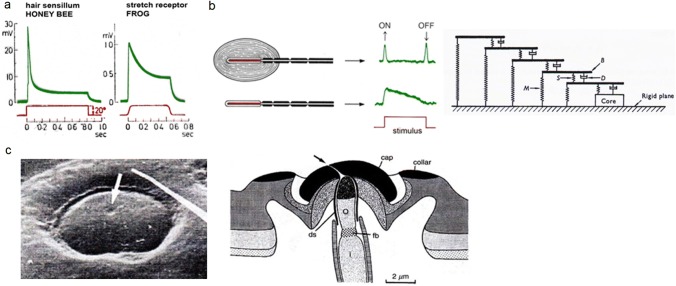
Viscoelasticity: a Receptor potential response of honey bee hair sensillum and frog stretch receptor to ramp-and-hold stimuli. b Vater–Pacini corpuscle (P.C., left) and its receptor potential in response to a tactile ramp-and-hold stimulus applied with the capsule intact (above) and the capsule largely removed (below). Right: Simple mechanical analog of capsule with elasticities (springs) and viscosities (dashpots) explaining stimulus transformation (high-pass filter). c Insect campaniform sensillum. Left: scanning electron micrograph of a sensillum (longer diameter c. 15 µm) on the fly (Calliphora vicina) leg. Right: schematic of section through stimulus conducting structures according to transmission electron micrograph and showing the different components with different shading. ds dendritic sheath, fb fibrillar body, o and i outer and inner segment of dendrite. (a Fuortes , modified; b left: Loewenstein and Mendelson , right: Loewenstein and Skalak ; c Grünert and Gnatzy 1987); with kind permission from Springer-Verlag GmbH (a, c) and Wiley and Sons (b)
Fig. 3
Fig. 3
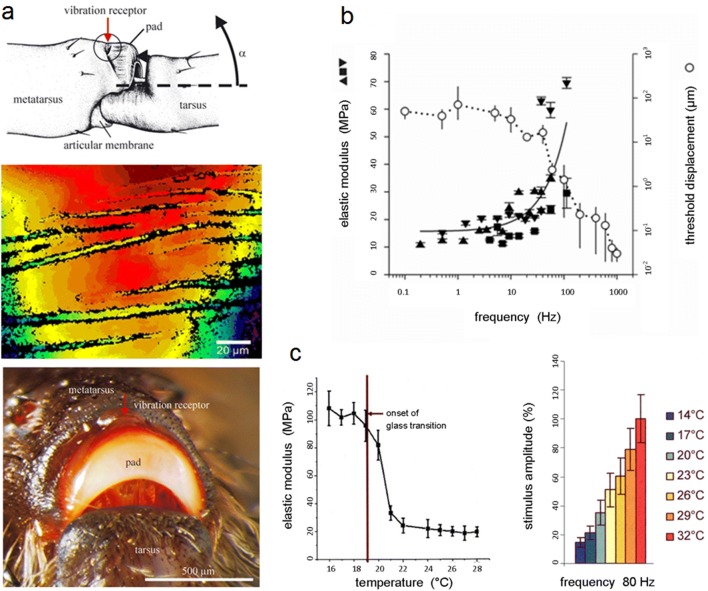
Viscoelasticity and cuticular strain receptors. a Top: Spider (C.s.) strain receptor serving as vibration receptor, located dorsally and distally on the metatarsus of the leg. Arrow indicates movement of the tarsus stimulating the organ by pushing (arrow head) onto the cuticular pad at the distal metatarsus. Middle: White-light interferometric picture of the slits composing the vibration receptor organ seen from above. Bottom: The distal end of the metatarsus showing the cuticular pad, which transmits the vibratory stimulus to the vibration receptor. b Frequency dependence of the pad’s elastic modulus (left y-axis) and a typical threshold curve of tarsal displacement (right y-axis) needed to elicit a slit’s nervous response (action potential) (C.s.). cLeft: The pad’s elastic modulus as a function of temperature showing the material’s glass transition range. Right: stimulus amplitude (tarsus deflection) needed to elicit a nervous threshold response of a slit at different temperatures (C.s.). (a Top: McConney et al. ; middle: Schaber et al. ; bottom: McConney et al. ; b McConney et al. ; c left: Young et al. ; right: Vogel 2008); with kind permission from the Royal Society London (a, b) and Elsevier Ltd. (c)
Fig. 4
Fig. 4
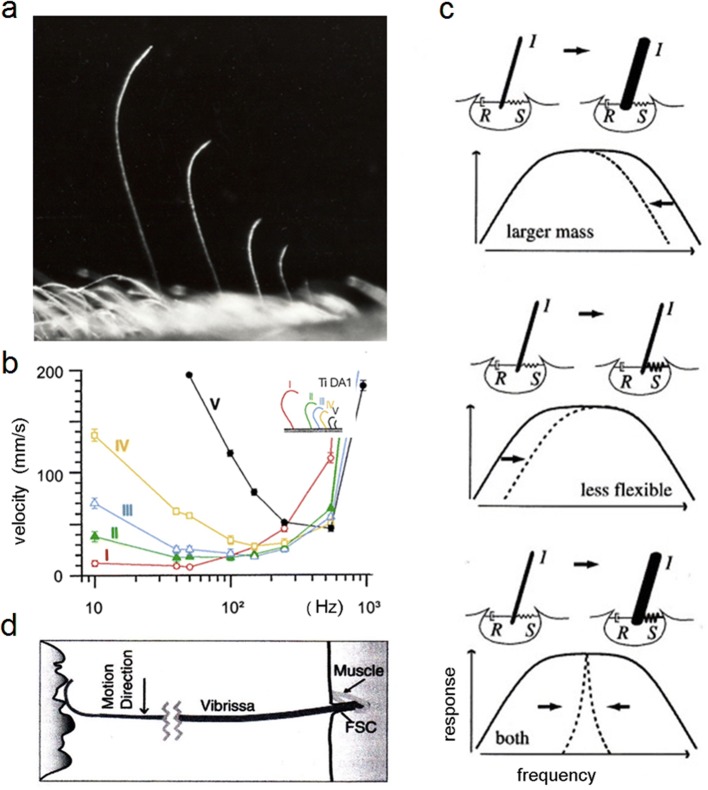
Resonance. a A group of spider (C.s.) trichobothria on the tarsus. b Mechanical frequency tuning of five trichobothria of different length on the spider (C.s.) tibia (length of hairs I–V 1150 µm, 700 µm, 650 µm, 500 µm, and 400 µm). Air-particle velocity necessary to deflect the hairs by 2.5° at frequencies between 10 Hz and 900 Hz. c Ways of mechanically modifying frequency tuning. Top: increasing the mass of the hairshaft decreases the upper boundary of the optimal frequency band; middle: increasing the elastic resistance of the suspension shifts the low-cat boundary of the optimal frequency range to higher values; bottom: hairs can become resonant by being less flexible and heavier. d Rat vibrissa sweeping past a surface with spatial frequency components causing it to deflect at specific frequencies. (a Barth unpubl.; b Barth et al. , modified; c Bathellier et al. ; d Neimark et al. 2003); with kind permission from the Royal Society London (c) and the Society for Neuroscience (d)
Fig. 5
Fig. 5
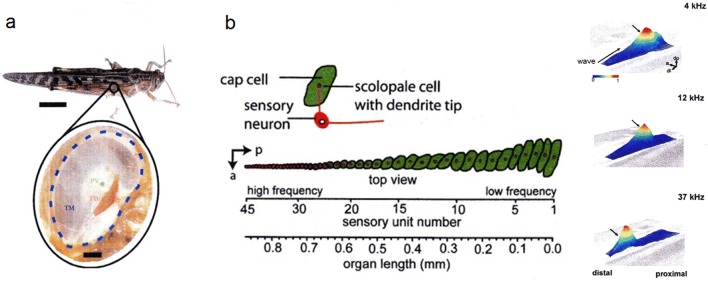
Traveling waves. a Tympanum of the abdominal locust ear (Schistocerca gregaria). Scale bars: body 12 mm, membrane 0.2 mm; TM tympanal membrane, PV pyriform vesicle, FB folded body. b Left: Crista acustica of the hearing organ of a katydid (Mecopoda elongata) on its front leg tibia; cellular elements of the sensory units (scolopidia) involved in the transformation and transduction of the acoustic stimuli. a anterior, p posterior. Right: Examples of normalized waves induced by sound of different frequency; note tonotopy. (a Windmill et al. ; b Hummel et al. 2016); with kind permission from the Royal Society London (a) and the Society for Neuroscience (b)
Fig. 6
Fig. 6
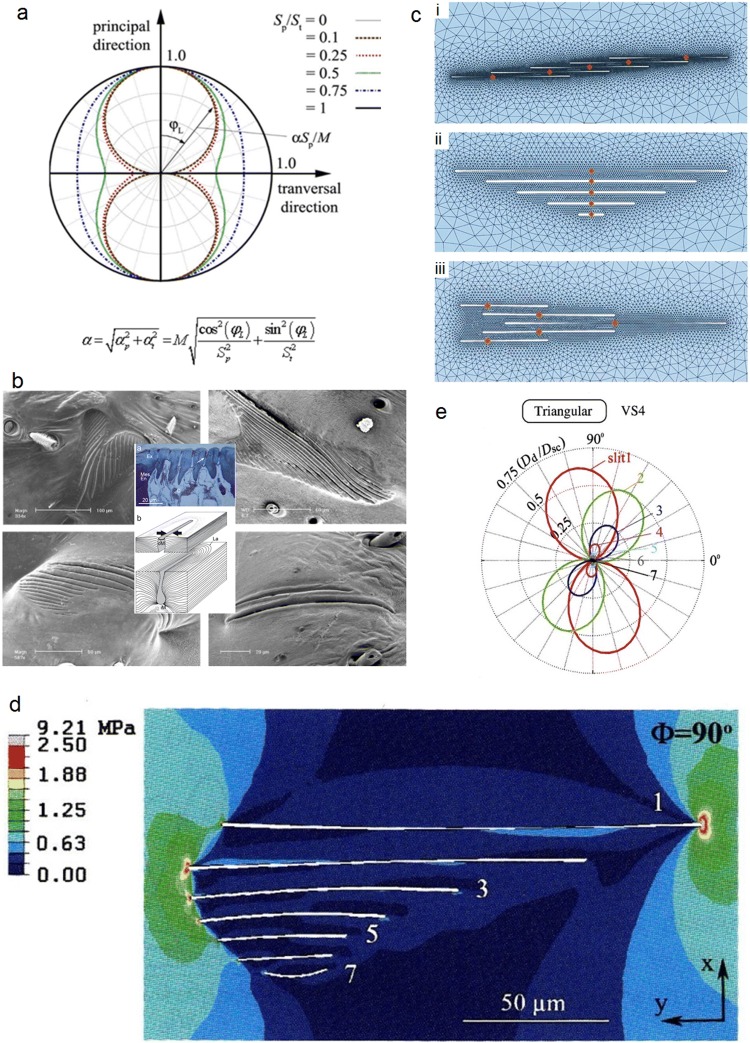
Directionality. a Directional characteristics of the joints of arthropod hair-like sensilla; polar plot derived from mathematical model for different ratios of joint stiffnesses in the preferred (Sp) direction and the direction transversal to it (St). ϕL load direction, α deflection angle, ϕα direction of deflection, and M moment introduced to joint. b Lyriform slit sense organs of different outline shapes on the spider (C.s.) leg. Center: Histological cross section through slits and arrangement of cuticular laminae (La) forming it; arrows indicate adequate stimulation of the slit by its compression. oM outer membrane covering the slit, iM inner membrane, Ex,Mes,En exo-, meso-, and endocuticle, c cellular components. c Deformed configurations of three FE models of lyriform slit sense organs subjected to uniaxial compressive loading at an angle of 90° with regard to the slit long axes. d Von Mises equivalent stresses (MPa) at model slits arranged as in a specific natural lyriform organ (VS4) of the spider C.s. Load at 90° to slit long axes. e. Directional mechanical sensitivity (given as Dd/Dsc, the ratio between slit face deformation Dd at the dendrite’s position and the displacement Dsc at mid-length of a single isolated slit) of the organ shown in d under uniaxial compressive far-field loads from different directions. Note remarkable differences between the slits and the big changes of slit face deformation even with small changes of load direction. (a Dechant et al. ; Barth ; b Barth , ; Hößl et al. ; c Hößl et al. ; d, e Hößl et al. 2009); with kind permission from Springer-Verlag GmbH (ae)
Fig. 7
Fig. 7
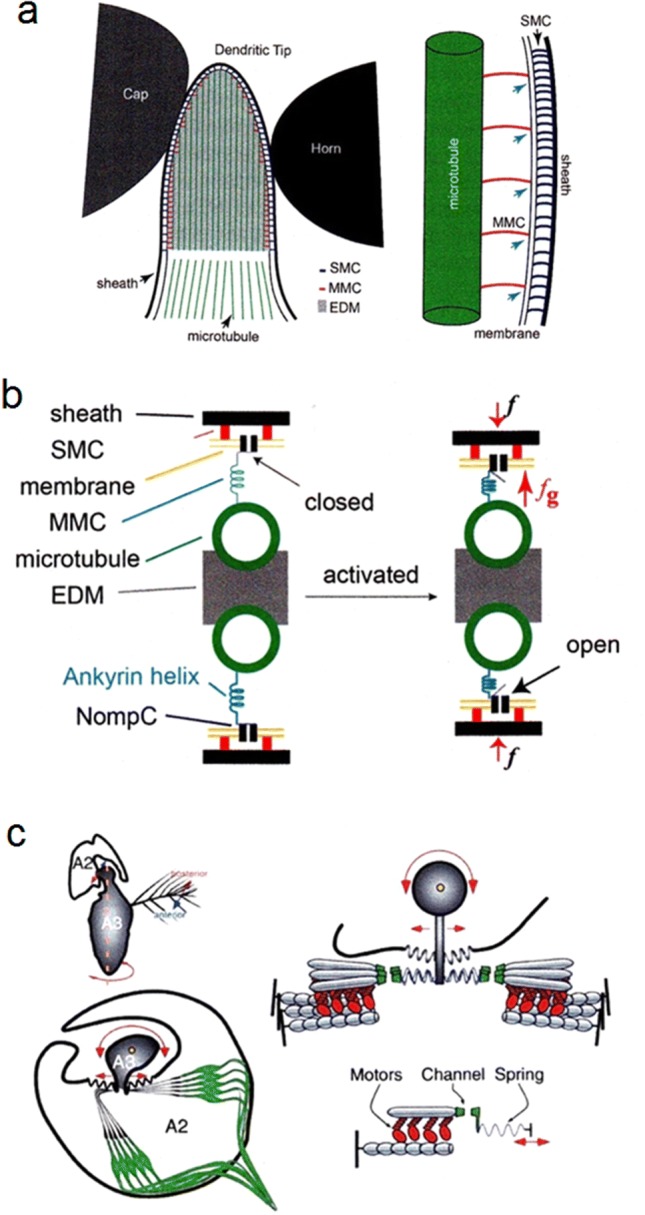
The cellular and molecular level. a Dendritic tip and supporting structures of Drosophila hair-like sensilla. SMC sheath-membrane connector; MMC membrane-microtubule connector; EDM electron-dense material. b Linkage model of mechanotransduction proposed for campaniform sensilla and possibly also applicable to mechanosensitive arthropod hair-like sensilla. External force (f) is transformed to gating force (fg) opening the mechanosensitive transduction channel. The gating spring may be the Ankyrin helix c Transducer-based model oft he Drosophila ear. A Front view of antenna showing the two distal segments A2 and A3, the latter carrying the feathery arista. The arista together with A3 takes up the sound signal, being moved back and forth by frictional forces. Bottom: cross section of joint between A2 and A3. Arrows indicate movements evoked by sound stimulation. Note two populations of mechanosensitive sensory cells (green). B Model showing two opposing transducer modules (consisting of one ion channel, a set of adaptation motors and one gating spring) coupled symmetrically to a harmonic oscillator. (a, b Liang et al. ; c Nadrpowski et al. 2008); with kind permission from Springer-Verlag GmbH (a, b) and Elsevier Ltd. (c)

References

    1. Albert JT. Sensory transduction: The “swarm intelligence“of auditory hair bundles. Curr Biol. 2011;21:R632–633. doi: 10.1016/j.cub.2011.06.041. - DOI - PubMed
    1. Albert JT, Kozlov AS. Comparative aspects of hearing in vertebrates and insects with antennal ears. Curr Biol. 2016;26:R1050–R1061. doi: 10.1016/j.cub.2016.09.017. - DOI - PubMed
    1. Albert JT, Friedrich OC, Dechant H-E, Barth FG. Arthropod touch reception: spider hair sensilla as rapid touch detectors. J Comp Physiol A. 2001;187:303–312. doi: 10.1007/s003590100202. - DOI - PubMed
    1. Albert JT, Nadrowski B, Göpfert MC. Mechanical signatures of transducer gating in the Drosophila ear. Curr Biol. 2007;17:1000–1006. doi: 10.1016/j.cub.2007.05.004. - DOI - PubMed
    1. Anton S, Barth FG. Central nervous projection patterns of trichobothria and other cuticular sensilla in the wandering spider Cupiennius salei (Arachnida, Araneae) Zoomorphol. 1993;113:21–32. doi: 10.1007/BF00430974. - DOI

Publication types

MeSH terms