


Transcranial electrical and magnetic stimulation (tES and TMS) for addiction medicine: A consensus paper on the present state of the science and the road ahead
- PMID: 31271802
- PMCID: PMC7293143
- DOI: 10.1016/j.neubiorev.2019.06.007
Transcranial electrical and magnetic stimulation (tES and TMS) for addiction medicine: A consensus paper on the present state of the science and the road ahead
Abstract
There is growing interest in non-invasive brain stimulation (NIBS) as a novel treatment option for substance-use disorders (SUDs). Recent momentum stems from a foundation of preclinical neuroscience demonstrating links between neural circuits and drug consuming behavior, as well as recent FDA-approval of NIBS treatments for mental health disorders that share overlapping pathology with SUDs. As with any emerging field, enthusiasm must be tempered by reason; lessons learned from the past should be prudently applied to future therapies. Here, an international ensemble of experts provides an overview of the state of transcranial-electrical (tES) and transcranial-magnetic (TMS) stimulation applied in SUDs. This consensus paper provides a systematic literature review on published data - emphasizing the heterogeneity of methods and outcome measures while suggesting strategies to help bridge knowledge gaps. The goal of this effort is to provide the community with guidelines for best practices in tES/TMS SUD research. We hope this will accelerate the speed at which the community translates basic neuroscience into advanced neuromodulation tools for clinical practice in addiction medicine.
Keywords: Addiction; NIBS; Non-invasive brain stimulation; Psychiatry; Substance use disorder; Transcranial electrical stimulation; Transcranial magnetic stimulation; rTMS; tDCS; tES.
Copyright © 2019 Elsevier Ltd. All rights reserved.
Conflict of interest statement
Declaration of Competing Interest
Flavio Frohlich is the founder, majority owner, and Chief Scientific Officer of Pulvinar Neuro LLC. Michael Nitsche is a member of the Scientific Advisory Board of Neuroelectrics. Colleen A. Hanlon has served as a consultant for Brain Research and Development Services (Brainsway). Other authors reported no conflict of interest.
Figures
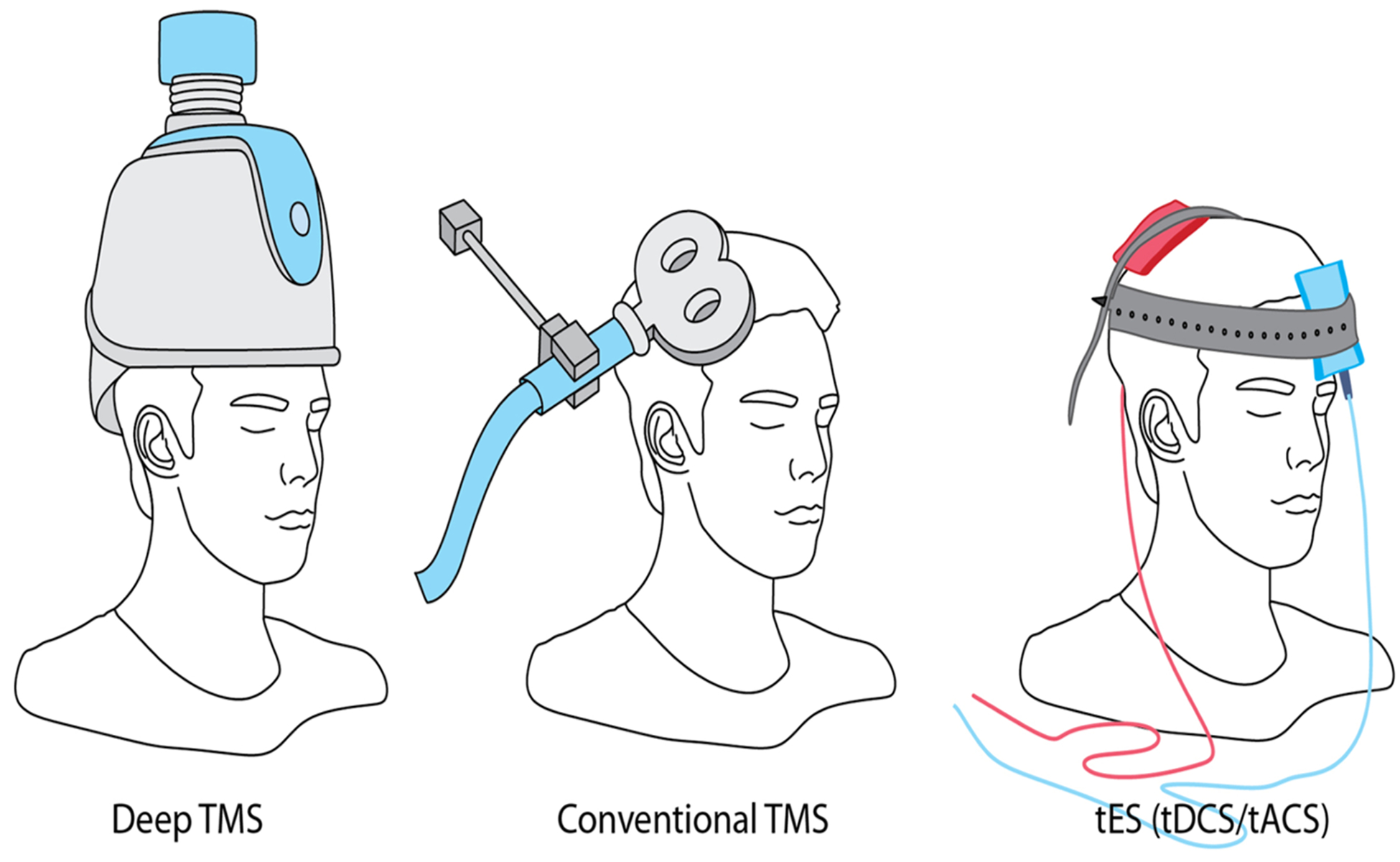


References
-
- Addolorato G, Antonelli M, Cocciolillo F, Vassallo GA, Tarli C, Sestito L, … Di Giuda D, 2017. Deep transcranial magnetic stimulation of the dorsolateral prefrontal cortex in alcohol use disorder patients: effects on dopamine transporter availability and alcohol intake. Eur. Neuropsychopharmacol 27 (5), 450–461. 10.1016/j.euroneuro.2017.03.008. - DOI - PubMed
-
- Ahn S, Prim JH, Alexander ML, McCulloch KL, Frohlich F, 2019b. Identifying and engaging neuronal oscillations by transcranial alternating current stimulation in patients with chronic low back pain: a randomized, crossover, double-blind, sham-controlled pilot study. J. Pain 20 (3). 10.1016/j.jpain.2018.09.004.277.e271-277.e211. - DOI - PMC - PubMed
Publication types
MeSH terms
Grants and funding
LinkOut - more resources
Full Text Sources
Medical
Research Materials
Miscellaneous
